


09
2021-09
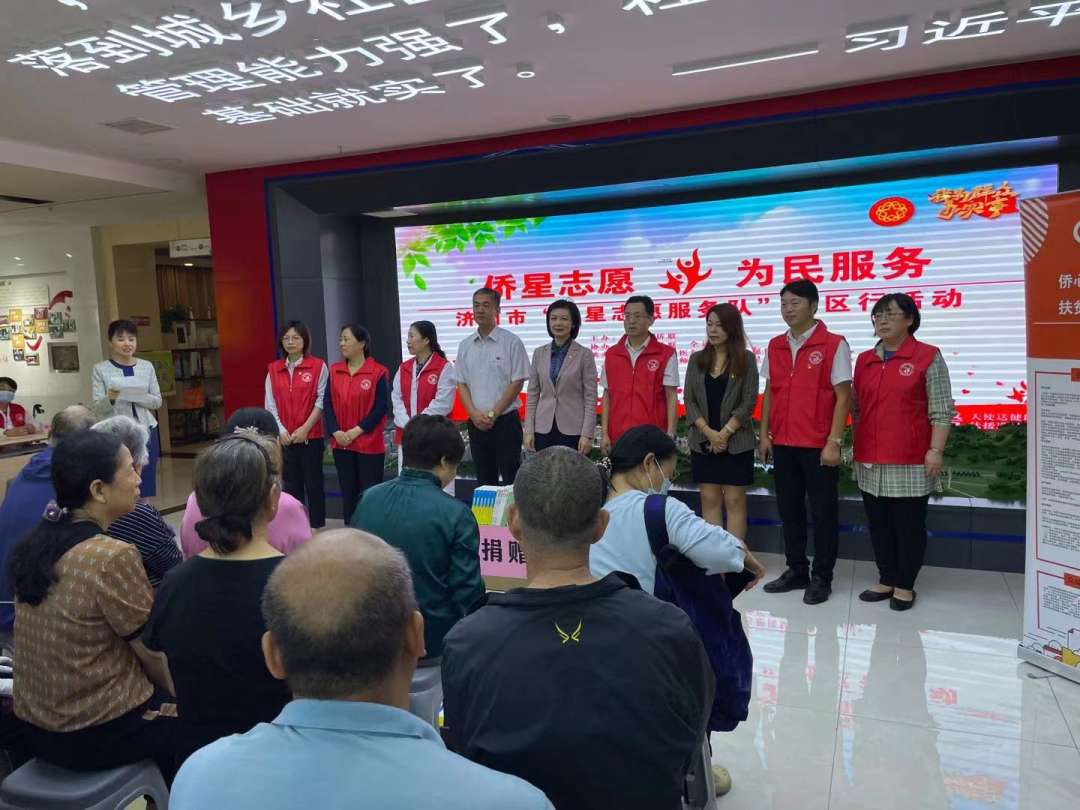
On the morning of September 8, 2021, lawyer Zhou Jiakui, deputy director of Zhongcheng Qingtai Jinan Institute and director of the Public Welfare Law Center, led a team to the National Games Village Community of Longdong Sub-district Office, Lixia District, Jinan City, to participate in the "Overseas Chinese Love Law" organized by the Jinan Federation of Overseas Chinese. Community "activity. The event was presided over by Zhu Xueting, chairman of the Federation of overseas Chinese in Lixia District, and leaders such as Mi Wenpeng, chairman of the Federation of overseas Chinese in Jinan City, and Sun Hongcheng, vice chairman of the Federation of overseas Chinese in Jinan City, attended and delivered speeches. In the event, lawyer Zhou Jiakui donated legal books to the community on behalf of Zhongcheng Qingtai, and led a team to provide free legal advice to community residents on the spot, so that residents can enjoy high-quality legal services at home. The residents who came to consult did not disperse until noon, and the service effect was remarkable. This activity is a public welfare activity carried out by the Jinan Federation of overseas Chinese in order to promote the study and education of party history, solidly carry out the activity of "I do practical things for the masses", and implement the voluntary service concept of "dedication, fraternity, mutual assistance and progress" of Shandong overseas Chinese Star Volunteer Service Group and the service tenet of "facing the grass-roots level, serving the people's livelihood, creating a better life, and promoting the progress of social civilization. Prior to this, lawyer Zhou Jiakui led a team of lawyers to participate in various public welfare activities for overseas Chinese organized by the Municipal Federation of overseas Chinese, which fully demonstrated Zhongcheng Qingtai's fine tradition of being enthusiastic about public welfare and contributing to society.
2021-09-09
08
2021-09
Abstract: The parties to the construction contract of the construction project usually agree that the extension of the construction period shall be confirmed by the contractor or supervisor in the form of a construction period visa, and agree on the time limit for the contractor to apply for the extension of the construction period. There is a dispute as to whether the contractor's overdue application for the extension of the construction period should be supported, for this reason, the Supreme People's Court issued the "(I) of Interpretation on the Application of Law in the Trial of Construction Contract Disputes" (Interpretation No. 25 of the Law [2020]) (hereinafter referred to: "(I) for Judicial Interpretation of New Construction Projects") Article 10, paragraph 2, but the book stipulates two exceptional cases in which the contractor's late application for extension of the construction period should be supported. In view of the problem of the contractor's overdue application for construction period extension, this paper starts with the basic problem of construction period extension, introduces the construction period delay events that cannot be attributed to the contractor, analyzes the dispute over whether the contractor's overdue application for construction period extension loses its substantive rights, and analyzes the determination of the contractor's overdue application for construction period extension and the contractor's burden of proof for construction period extension, in order to benefit the practical operation of the construction period extension problem. Key words: time delay, overdue application, burden of proof Due to the non-standard construction market in China, the weak awareness of the rules of all parties, the contractor's legal risk prevention and control ability and management ability are not strong, and in practice, due to the non-cooperation of the contractor, the contractor's right to apply for the extension of the construction period is usually not supported. Especially on the issue of the contractor's overdue application for extension of the construction period, the contractor's legal rights are more vulnerable to infringement. To this end, this paper, based on the (I) of Judicial Interpretation of New Construction Projects, introduces in detail the problem of the contractor's overdue application for extension of the construction period, and puts forward corresponding suggestions. Basic Problems of 1. Period Extension Definition of (I) Duration Extension The extension of the construction period means that in the event of a delay in the construction period that cannot be attributed to the contractor, the contractor obtains the extension of the construction period in accordance with the contract or the legal provisions. The parties usually agree in the construction contract that the extension of the construction period shall be confirmed by the contractor or supervisor by visa, and shall apply for the extension of the construction period within a certain period of time. (II) delay events not attributable to the Contractor include 1. Delay of construction period caused by the Employer Article 803 of the Civil Code stipulates the employer's liability for breach of contract: "If the employer fails to provide raw materials, equipment, sites, funds and technical data in accordance with the agreed time and requirements, the contractor may postpone the date of the project and has the right to request compensation for losses such as work stoppage and work stoppage." Article 798 stipulates the acceptance of concealed works: "Before concealed works are concealed, the contractor shall notify the employer for inspection. If the employer fails to check in time, the contractor may postpone the project date and have the right to claim compensation for losses such as work stoppage and work stoppage." the general clause 7.5.1 of the construction contract (model text) (GF-2017-0201 text) (hereinafter referred to as the "model text") stipulates that the construction period is delayed due to the employer's reasons: "during the performance of the contract, the construction period is delayed and (or) the cost is increased due to the following circumstances, the Employer shall bear the delayed construction period and (or) increased expenses, and the Employer shall pay the Contractor reasonable profits:(1) the Employer fails to provide the drawings as agreed in the Contract or the drawings provided do not conform to the Contract;(2) the Employer fails to provide the construction site, construction conditions, basic data, permission, approval and other commencement conditions as agreed in the Contract;(3) There are errors or omissions in the measurement datum point, datum line and leveling point provided by the employer and their written data;(4) The employer fails to agree to issue the commencement notice within 7 days from the planned commencement date;(5) The employer fails to pay the advance payment, progress payment or completion settlement payment according to the date agreed in the contract;(6) The supervisor fails to issue instructions, approval and other documents as agreed in the contract;(7) Other circumstances as agreed in the terms of the special contract." In addition, Article 11 of the "(I) for Judicial Interpretation of New Construction Projects" stipulates that "before the completion of the construction project, the parties have a dispute over the quality of the project, and the quality of the project has been appraised, the appraisal period shall be the period of the extension of the construction period". The circumstances provided for in this provision are generally due to the contractor's challenge to the quality of the project, and can also be attributed to delays caused by the contractor. 2, according to the law or the contract should bear the adverse consequences of the event. It mainly refers to the occurrence of force majeure events or infectious diseases such as wars, abnormal weather, natural disasters that cannot be reasonably foreseen, and the need for protection of cultural relics found on site, which are not subject to construction will. General clause 17.1 of the model text states that "force majeure refers to natural disasters and social emergencies that are unforeseen by the parties to the contract at the time of signing the contract, inevitable and insurmountable in the course of the performance of the contract, such as earthquakes, tsunamis, plagues, riots, martial law, riots, wars and other situations stipulated in the special contract terms." Article 17.3.2 stipulates: "(4) If the force majeure affects the contractor's performance of the obligations stipulated in the contract, which has caused or will cause the delay of the construction period, the construction period shall be postponed, and the cost and loss of the contractor's shutdown shall be reasonably shared by the contractor and the contractor, and the wages of the workers that must be paid during the shutdown shall be borne by the contractor;" 3. Delays in construction period caused by changes proposed by the Employer or the Supervisor and changes proposed by the Contractor and agreed by the Employer During the performance of the construction contract of the construction project, if there is a design change that exceeds the scope of the original drawing, and the resulting change order, negotiation, change construction preparation, material procurement, mechanical equipment preparation, etc., the contractor has the right to claim to the contractor that the construction period for the increased work content be extended. The General Terms and Conditions of the Model Text 10.6 stipulate that if the construction period changes due to changes, the parties to the contract may request adjustment of the construction period of the contract. Disputes 2. whether the contractor loses the substantive right to apply for the extension of the construction period after the deadline. The construction contract for a construction project usually stipulates: "The contractor shall apply to the contractor or supervisor for an extension of the construction period within a certain time limit, and shall be confirmed by the contractor or supervisor's visa, and if the contractor fails to claim the extension of the construction period within the agreed time limit, it shall lose the right to request the extension of the construction period. Item (1) of Article 19.1 of the General Terms of the Model Text stipulates: "The contractor shall, within 28 days after knowing or should have known the occurrence of the claim, submit a notice of intention to claim to the supervisor and explain the cause of the claim; If the contractor fails to issue the notice of intention to claim within the aforementioned 28 days, it shall lose the right to request additional payment and (or) extension of the construction period." This article provides for a system of claim period, which requires the contractor to claim to the contractor within 28 days of the extension of the construction period, compensation for the increased costs and payment of reasonable profits for delays not caused by the contractor. Although the claim period stipulated in the Model Text can urge both parties to the contract to claim their rights in a timely manner, it has caused many disputes in practice. In practice, there are two views on whether the contractor loses the substantive right to apply for the extension of the construction period after the deadline: One view is that the failure of the contractor to apply for an extension of the construction period is not necessarily a loss of authority. The main reason is that the system of time limits for claims under the Model Text is not the same as the statute of limitations and the period of exclusion. First of all, the period of claim stipulated in the Model Text is agreed upon by the parties, while the limitation of action and the period of exclusion are the statutory system stipulated in the General Principles of Civil Law, and the overdue "right" agreed by the parties should not be recognized as the loss of substantive rights, and the elimination of substantive rights should be stipulated by the mandatory law. Secondly, from the actual effect, after the expiration of the statute of limitations, the obligor has the right to refuse to perform the defense, the right holder loses the right to win the case, and the contractor's late extension of the duration of the project has not been eliminated. The loss of rights in the Model Text refers to the loss of procedural rights, the failure of the contractor to claim an extension of the duration within the agreed time limit, and the loss of such procedural rights due to the failure to provide timely and effective evidence, not a direct loss of substantive rights. If the right holder has sufficient evidence to prove that his rights and interests have been damaged, he shall not be deprived of his right to claim compensation within the statute of limitations. If the authenticity of the relevant facts is unknown, the claimant shall bear the adverse consequences. Another view is that if the contractor applies for an extension of the construction period within the time limit, it will have the legal consequences of the elimination of the right to win in the proceedings. First of all, "the law does not protect those who sleep on their rights", the claim period in the Model Text is similar to the statute of limitations system in civil law, and if the contractor delays the time limit, the court should not protect its substantive rights before the arbitration body. In addition, from the principle of reciprocity of rights, the Model Text 19.2 stipulates: "(2) The contractor shall, within 28 days after the supervisor receives the claim report or further supporting materials related to the claim, the supervisor shall issue to the contractor the results of the claim processing signed by the contractor. If the contractor replies late, it shall be deemed to approve the contractor's claim;" Similarly, if the contractor applies for an extension of the construction period late, it shall be deemed that the construction period is not extended. 3. Determination of Contractor's Overdue Application for Extension of Construction Period from the Perspective of (I) for Judicial Interpretation of New Construction Projects In view of the great controversy in judicial practice about whether the contractor loses the substantive right to apply for the extension of the construction period after the deadline, the second paragraph of Article 10 of the (I) on Judicial Interpretation of New Construction Projects stipulates: "If the parties agree that the contractor fails to apply for the extension of the construction period within the agreed time limit, it shall be handled in accordance with the agreement, except that the employer agrees to extend the construction period after the agreed time limit or the contractor raises a reasonable defense." According to this provision, the (I) for Judicial Interpretation of New Construction Projects adopts the principle of respecting the autonomy of the parties, and there is an agreement to follow its agreement. In addition, the book provides two exceptions: that is, if the employer explicitly agrees to the extension of the construction period or if the contractor provides reasonable defense against the failure to apply within the agreed time limit, the people's court shall support the contractor's claim to extend the construction period. The provisions of the (I) for Judicial interpretation of New Construction projects not only reflect the principle that "the law does not protect people who sleep on their rights" and fully respect the autonomy of the parties, but at the same time, the two exceptions stipulated in the book require the court to examine the contractor's reasonable defense and evidence, and determine whether the construction period should be postponed according to the degree of proof. According to the provisions of the (I) of Judicial Interpretation of New Construction Projects, it can be seen that:(1) The court or arbitration institution shall judge the meaning of the parties according to the agreement of the construction contract and the actual performance of the parties. Although the Contractor fails to apply to the Employer for the extension of the construction period according to the agreed time limit, if the Employer indicates that it agrees to the extension of the construction period through relevant meeting minutes, correspondence, commitment letter, etc. after the agreed time limit, it shall be deemed that the Employer and the Contractor have changed the original contract agreement and the agreed time limit for claim shall no longer apply. (2) The contractor puts forward reasonable defense reasons. If the project is changed due to the employer, the project quantity is increased, the situation changes such as war, abnormal climate, natural disasters and force majeure events cause the project to stop, and the contractor gives a reasonable explanation to the fact that the construction period is delayed. At this time, the court shall also approve the extension of the construction period as appropriate. The judge should, according to the rule of thumb and in line with the concept of pursuing fairness and justice, examine the evidence more reasonably, determine the facts, and exercise discretion cautiously, and should not support the contractor's claim to postpone the construction period. In practice, another situation is that the contractor and the contractor have agreed on the time limit for applying for the extension of the construction period, but they have not agreed that the overdue claim for the extension of the construction period shall be regarded as the non-extension of the construction period or as a waiver of the right, and it cannot be directly determined that the contractor's overdue application for the extension of the construction period is a waiver of the right to claim the extension. 4. The Contractor shall bear the burden of proof for the extension of the construction period. If the contractor applies for the extension of the construction period within the time limit and requests the employer to compensate for the losses, in addition to giving a reasonable explanation to the fact of applying for the extension of the construction period within the time limit, the contractor shall also bear the burden of proof for the following facts, including:(1) the fact that the construction period is not attributable to the contractor;(2) the fact that the construction period can be extended for specific days and the calculation method;(3) Causality between the fact of construction period delay and the actual number of days of construction period delay (the measurement of causality is usually based on whether the influence of the fact on the construction acts on the key line). Proof of common construction period extension: 1. The Employer fails to provide raw materials, equipment, site, funds, technical data, drawings and commencement conditions in accordance with the agreed time and requirements. The above facts are caused by the Employer's breach of contract. In this case, if the Contractor claims to postpone the construction period and requests the Employer to compensate for the losses, it shall bear the burden of proof for the following facts: ① the fact that the Employer has breached the contract; ② the number of days that the construction period can be postponed and the calculation method; ③ the losses suffered by the Contractor due to the delay of the construction period and the specific amount. 2, according to the law or the contract should bear the adverse consequences of the event. What is mentioned here mainly refers to the occurrence of force majeure events such as wars, abnormal weather, natural disasters, etc. that cannot be reasonably foreseen, or infectious diseases, and the need to protect cultural relics found on site, which are not subject to the will of the contractor. The Contractor shall provide evidence of the following facts: ① evidence of the existence of the above-mentioned force majeure event or accident; ② the force majeure event or accident is sufficient to have a serious impact on the construction period. 3, due to the contractor or supervisor proposed changes, as well as by the contractor, and agreed by the contractor caused by the change delay or increase in the amount of work. The construction period delay includes critical line delay and non-critical line delay, and the causality is usually measured on the basis of whether the impact of the fact on the construction works on the critical line. The critical line is also called critical path, which is the route with the longest total working duration on the line, I .e. the route with the longest construction period. The total duration of all processes on the critical line is the total construction period of the project. Any delay of any process on the critical line will cause the delay of the total construction period of the project. Non-critical lines have a certain floating time. If the delay of the construction period is less than the floating time, it will not affect the total construction period. Therefore, in the case that there is a change or increase in the amount of work in the project, and the contractor and the contractor have not formed the construction period visa, meeting minutes and other supporting materials, it is necessary to judge whether the impact of the change or increase in the amount of work on the construction works on the key line. If the contractor claims to postpone the construction period or compensate for the loss due to the change proposed by the employer or the supervisor, as well as the change proposed by the contractor and agreed by the employer, the following facts shall be proved in addition to the fact that the design change or increase of the engineering quantity caused by the employer: ① there is a causal relationship between the design change or increase of the engineering quantity of the employer and the delay of the construction period, the impact of engineering changes or increases in the amount of work on the construction of key lines; ② specific costs incurred by the contractor due to design changes or increases in the amount of work. In addition, it should be noted that design changes do not necessarily lead to delays, and if they are optimization changes, they may shorten the duration. 4, the contractor failed to pay the project advance payment, progress payment according to the date agreed in the contract. If the contractor fails to pay the project funds as agreed in the contract, the contractor may require the contractor to pay the project funds and interest, which may not necessarily cause delay in the construction period. If the contractor does not stop work, the contractor's failure to pay the project as agreed will not have a material adverse impact on the contractor's construction. In addition, if the contractor fails to pay the progress payment and the advance payment in accordance with the contract because of the contractor's delay in the construction period and the quality of the project, it is not appropriate to determine that the construction period can be extended or to require the contractor to compensate for the loss. Therefore, the contractor failed to comply.
2021-09-08
08
2021-09
On the morning of September 8, 2021, Lin cunyou, general manager of Shandong expressway road and bridge group co., ltd., Wang feng, minister of the legal department, and sun Jiabao and their entourage visited zhongcheng Qingtai law firm for business exchanges. Han honggang, director of zhongcheng Qingtai law firm, Xu Hui, director of Shanghai institute, and Zhang Xu were warmly received. Director Han Honggang accompanied General Manager Lin Cunyou and his entourage to visit the office environment of the law firm and introduced the development history, integrated operation and management model, team building, practice philosophy, and party building work of Zhongcheng Qingtai Law Firm. At the symposium, Director Xu Hui and lawyer Zhang Xu gave a detailed introduction to the development of Zhongcheng Qingtai in the company's mergers and acquisitions, investment, reorganization, bankruptcy, urban construction and real estate business. General Manager Lin Cunyou gave an introduction to the bridge, tunnel, high-speed rail and other construction business, investment and financing business of Expressway and Bridge. The two sides had in-depth exchanges on the legal issues that are prone to Expressway and Bridge shares, and finally reached a consensus, enhance mutual trust, learn from each other, learn from each other, and learn from each other's strengths to promote win-win cooperation.
2021-09-08

07
2021-09
Recently, the Shandong Higher People's Court formulated the "Guidelines on Regulating the Seizure, Seizure, and Freezing of Property" (hereinafter referred to as the "Work Guidelines"), which will come into effect on August 6, 2021. The Work Guidelines are formulated in accordance with the provisions of the the People's Republic of China Civil Procedure Law, the Provisions of the Supreme People's Court on Several Issues Concerning the Handling of Property Preservation Cases by the People's Courts, and the Provisions of the Supreme People's Court on the Seizure, Seizure and Freezing of Property in Civil Execution by the People's Courts and other laws and judicial interpretations, combined with the actual trial execution work of the courts in the province, the purpose is to standardize the measures of sealing up, detaining and freezing in the preservation and execution of civil litigation, to prevent over-standard, over-range and over-time seizure, and to safeguard the legitimate rights and interests of the parties in accordance with the law. The work guidelines are divided into 36 articles, covering the general provisions, the seizure, seizure and freezing of all kinds of property, as well as relief procedures, etc., in the estimation of property value, the execution concept of good faith and civilization of the court, as well as the processing when it comes to the presale of commercial housing, have been improved and innovated, and responded to many problems in practice, thus effectively improving the operability of the judicial level. In this article, our lawyers summarize the highlights of the Work Guidelines in the real estate sector. A uniform method of estimating the value of real estate has been developed. According to Article 21 of the Provisions of the Supreme People's Court on the Seizure, Seizure and Freezing of Property in Civil Enforcement of the People's Courts, the seizure, seizure and freezing of the property of the person subject to execution shall be limited to the amount of the claim and the execution expenses determined by the legal document, and shall not be sealed, seized or frozen significantly beyond the amount of the subject matter. The current provisions clearly prohibit the court from seizing the amount of the subject matter, and in the preservation and enforcement procedures, the value of real estate, land use rights, construction in progress and other real estate is often unable to determine, the specific value must be subject to the assessment report, and the assessment procedure is later placed in the seizure, freezing, seizure procedures. Therefore, in the seizure of real estate, land use rights, construction in progress and other real estate, how to avoid the amount of seizure, has become a major problem in judicial practice. The "work guidelines" clearly require that the property value should be estimated when sealing up, detaining or freezing the property of the person subject to execution, and a unified estimation method should be formulated for the value of real estate, land use right and construction in progress, which reduces the arbitrariness of value estimation and provides a way to avoid over sealing up real estate in judicial practice. Law Index: Guidelines of the Higher People's Court of Shandong Province on Regulating the Seizure, Seizure and Freezing of Property Article 1: To seal up, seize and freeze the property of the person subject to execution (or the person subject to preservation, the same below), the amount of the subject matter of execution and the value of the sealed up, seized and frozen property and the value of the sealed up, seized and frozen property available for execution (I. e. the amount of the property that can be used to pay off the creditor's rights in this case) shall be estimated, and the value of the sealed up, the amount obviously exceeding the target shall not be sealed up, detained or frozen. Article 3: The value of seized, seized or frozen property may be estimated in the following manner:(2) If the property is seized, the value of the seized property shall be estimated by reference to the value of the property in the same location and under the same conditions. If the seized property is a first-hand house, you can refer to the sales price of the real estate development enterprise and the guide price issued by the local real estate management department; if the seized property is a second-hand house, you can refer to the price approved by the tax authority and the second-hand house market transaction price. (3) If the land use right is seized, the value of the seized property shall be calculated by reference to the amount of the transfer recorded in the land transfer contract. (4) If the construction in progress is pre-sealed, the value of the sealed-up property shall be estimated with reference to the amount of investment in the project, the amount of work completed, demolition and resettlement, sales, etc. Article 4: In addition to bank deposits, if the parties have an agreement on the value of the seized, seized or frozen property, the value of the seized property may be estimated by reference to the agreement of the parties. Protection of the legitimate rights and interests of the priority recipients In judicial practice, when the court estimates the value of the real estate to be sealed up, it may omit the priority compensation rights of the construction project price, mortgage and other priority compensation rights on the real estate, especially the priority compensation right of the construction project price cannot be found in the real estate registration authority, so it is easier to be ignored in the evaluation of the execution of the property. In order to safeguard the legitimate rights and interests of the priority payee such as the actual builder and the mortgagee, the Work Guidelines clearly stipulate that if there is a known priority of the construction project price, mortgage, pledge, lien, etc. on the subject matter, the priority payment amount shall be deducted when estimating the value of the property available for execution. Law Index: Guidelines of the Higher People's Court of Shandong Province on Regulating the Seizure, Seizure and Freezing of Property Article 6: Where there is a known priority right, mortgage, quality right, lien, etc. on the subject matter of the seizure, seizure or freezing of the construction project price, the amount of priority compensation shall be deducted when estimating the value of the seized, seized or frozen property available for execution. Clarify the rules for the seizure of commercial housing presale by development enterprises. (1) When the real estate development enterprise purchased by the executed person presale commercial housing, the "Work Guidelines" clarify the main identity of the real estate management department and the real estate development enterprise to assist the obligor, and provide assistance obligations of the real estate development enterprise in two aspects Provisions: one is to notify the enforcement court when the house meets the transfer registration conditions, and the other is to pay the purchase price directly to the court account when the commercial housing sales contract is terminated. This regulation fully takes into account the characteristics of presale commercial housing, no matter whether the commercial housing sales contract can continue to be performed, the executor can get the final compensation, effectively improving the efficiency of implementation. At the same time, the "Work Guidelines" stipulate that when the court seals up the presale commercial housing purchased by the person subject to execution, the real estate development enterprise has the right to apply for execution objection. (2) When the person to be executed is a real estate development enterprise, the Work Guidelines clearly stipulate that the commercial housing under its name that has been approved for sale (pre-sale) can still be sealed up, but the fact that it has been sold and delivered should be ascertained and recorded. The seizure record is sufficient. In judicial practice, when the developer is the person to be executed, the court is always hesitant about whether the commercial housing that has been presale can be sealed up. This "Work Guidelines" clarifies that such commercial housing can be sealed up. If outsiders in the presale commercial housing case believe that the court's seizure infringes their own legitimate rights and interests, they can apply to the enforcement court to exclude enforcement. Law Index: Guidelines of the Higher People's Court of Shandong Province on Regulating the Seizure, Seizure and Freezing of Property Article 17: If the real estate development enterprise presale commercial housing purchased by the executed person is sealed up, the real estate management department and the real estate development enterprise shall be the obligor. The notice of assistance in execution served on the real estate development enterprise may state that when the house meets the conditions for transfer registration, the enforcement court shall be notified. When the real estate development enterprise and the person subject to execution terminate the sale contract, the purchase of the house shall be returned to the person subject to execution according to the contract. The money is paid to the court account. During the pre-seizure period, if the sales contract is terminated in accordance with the law, and the real estate development enterprise pays the purchase price to the court account, the enforcement court shall lift the pre-seizure. In the process of execution, if the real estate development enterprise requests the exclusion of execution, it shall be examined in accordance with the provisions of Article 227 of the Civil procedure Law. Article 18: If the person subject to execution is a real estate development enterprise, the commercial housing under its name that has been approved for sale (pre-sale) may be sealed up, but the facts of the sale and delivery of the real estate shall be ascertained and recorded in the seizure record. In the process of execution, if an outsider requests the exclusion of execution, it shall be examined in accordance with the provisions of Article 227 of the Civil Procedure Law. Rules for reconciliation of parties after excess seizure Under the current regulations, when the real estate subject is over-sealed, the court often decides whether to unseal it based on the objection of the party being executed, and then raises an enforcement objection to the party who is not satisfied with the court's decision. The Work Guidelines stipulate the reconciliation rules for the parties after the over-seizure, that is, if the person subject to execution considers that the seizure is obviously over-standard, the enforcement court may organize the person subject to execution and the person applying for execution to negotiate, and if the person applying for execution approves, the seizure of the over-standard part may be directly lifted. This provision can effectively improve the efficiency of implementation and save judicial resources. Law Index: Guidelines of the Higher People's Court of Shandong Province on Regulating the Seizure, Seizure and Freezing of Property Article 33: If the enforcement court finds that the seizure is obviously over-standard, it may lift the seizure of the over-standard part ex officio. If the person applying for execution is not satisfied with the act of dissolution, it shall be examined in accordance with the provisions of Article 225 of the Civil Procedure Law.
2021-09-07
07
2021-09
In order to actively respond to the theme practice activity of "I do practical things for the masses" of Dezhou Judicial Bureau, on August 31, lawyers Li Shengbao and Cao Zongzhen of Shandong Zhongcheng Qingtai (Linyi) Law Firm were invited to Xinglong Town to carry out law popularization lectures. We will further promote the construction of rural areas under the rule of law in the town, cultivate grass-roots rural legal talents, and speed up the construction of a new pattern of rural governance at the grass-roots level. At the same time, lawyer Li explained the job responsibilities of "one village (community) and one legal adviser": 1. Assist in the autonomous management of the village (community). Help to review and revise the articles of association of village (community) self-government organizations, village rules and regulations and other management regulations. 2. Provide legal advice and legal assistance to the public. To answer the legal problems encountered in daily life for the masses, provide legal opinions, and provide legal aid to the qualified masses. 3. Carry out legal publicity. Hold legal lectures to popularize legal knowledge. 4. Participate in people's mediation. Assist the village (community) to strengthen the construction of people's mediation organizations, provide legal professional knowledge training for people's mediators, and improve their work level and legal literacy. The implementation of the special training project of "leaders of the rule of law" is not only an important way to promote the construction of the rule of law in rural areas and enhance the ability of rural governance, but also an important measure to further consolidate the foundation of publicity and education on the rule of law in the town. Through this training, the legal quality of the "rule of law leaders" in the jurisdiction and the ability to resolve conflicts and disputes in accordance with the law have been effectively improved. Participants who participated in the training said that in the actual work in the future, they will influence and drive the people around them to respect the law, learn the law, abide by the law, and use it, and play a role in better resolving contradictions at the grassroots level and maintaining social stability. Lawyers from Zhongcheng Qingtai Linyi Institute will also unswervingly participate in the project and use their legal knowledge to influence a group of "rule of law leaders".
2021-09-07

07
2021-09
Helping Ideal, Helping Dream Youth, Dezhou Attends Grants Issuing Ceremony of Youth League Committee
In order to promote the high-quality development of the Hope Project in the new era, further improve the care and assistance system for young people in difficulties, and help the city's poverty alleviation and rural revitalization effectively link up, on the morning of August 27, the Communist Youth League Dezhou Municipal Committee held the 2021 Dezhou City "Hope Project Realization Action" Grant issuing ceremony. Wei Jinhui, Secretary of the Party branch and deputy director of Shandong Zhongcheng Qingtai (Dezhou) law firm, and Li Dezhi, deputy secretary of the Youth League branch, attended the grant ceremony. At the ceremony, Zhongcheng Qingtai Dezhou Institute, as a caring enterprise, issued a grant of 10000 yuan to the freshmen of the university in difficulty, and the Communist Youth League Committee issued a plaque for the caring unit of the Hope Project. In addition, Secretary Wei Jinhui and Deputy Secretary Zhai Xiujuan also supported the freshmen of the University in distress in their own names. Since its establishment, Shandong Zhongcheng Qingtai (Dezhou) Law Firm has always adhered to the service tenet of "centering on the center, serving the overall situation, paying attention to the people's livelihood, and contributing to the society". As a law firm with a sense of social responsibility, we have always participated Social welfare undertakings, attaching importance to social responsibility, and giving back to the society are an important part of our law firm's culture. For many years, we have been actively carrying out and participating in various forms of social welfare activities. In addition to providing professional legal services, all colleagues of the law firm devote themselves to social welfare and practice the purpose of service. In the next step, Dezhou Institute will conscientiously implement the requirements of the practical activities of "I do practical things for the masses" in the study and education of party history, continue to carry out various forms of social welfare activities, and strive to give back to the society.
2021-09-07

07
2021-09
In order to promote the healthy and orderly development of enterprises, on September 3, lawyers from the securities business team of Shandong Zhongcheng Qingtai (Dezhou) Law Firm were invited to Shandong Hengyun Group to give a special lecture on legal risk prevention and control in contract management. In the lecture, the speaker Zhou Qiong lawyer combined with the actual case, the purchase and sale contract, processing contract conclusion and performance of the legal risks in detail. In response to the company's needs for contract management and contract risk prevention, the business team sorted out the matters needing attention in the contract terms according to the two major types of contracts: procurement and sales, combined with the four major business sectors of welding materials, transformers, energy-saving equipment, and photovoltaic power generation. Strive to conduct a round of special training for the group's sales, technical, and financial personnel within 2 months to enhance the company's ability to resist risks. Private enterprises are an important part of the national economy, an important participant in market economic activities, and an important force to promote economic and social development. The securities business team of Shandong Zhongcheng Qingtai (Dezhou) Law Firm, Lawyer Zhou Qiong, Lawyer Yao Jinchi and Lawyer Li Dezhi, combined with many years of practical experience, summarized the legal risks that private enterprises should pay attention to in the process of production and operation, and provided all-round legal services for more than a dozen companies involved in Hengyun Group.
2021-09-07

06
2021-09
On March 15, 2013, Company B (the employer) and Company A (the contractor, the agent of the Exchange) signed the Construction Framework Agreement, agreeing that Company A should contract to construct a project to be developed by Company B, and make an agreement on the location of the project, the scope of the project contract, the pricing principle, the contract price, the project quality, the liability for breach of contract and other substantive contents. In April 2014, Company B invited public bidding for the residential building project involved in the case, and Company A participated in the bidding. On July 1, 2014, Company A obtained the Letter of Acceptance for the residential building project involved in the case. On July 29, 2014, Company B and Company A signed the "Construction Project Construction Contract", which agreed that Company A would undertake the residential building project involved in Company B's case. On August 18, 2014, Company B and Company A signed the Construction Project Construction Contract again, which agreed that Company A should undertake all the contents of civil engineering, water, heating, strong current and weak current system engineering except unit door, pile foundation, dewatering, foundation pit support, fire protection. On January 8, 2015, Company A obtained the Letter of Acceptance for Section A of the underground garage involved in the project. On January 11, 2015, Company B and Company A signed the "Construction Project Construction Contract" for the third time, agreeing to the construction of Section A of the underground garage involved in the project by Company A. Before October 10, 2015, the residential buildings involved in the project were capped one after another. Before June 27, 2016, the acceptance of the main structure of the above residential buildings is qualified. On December 26, 2015, the construction of all projects was stopped. On May 17, 2016, Company B and Company A signed the "Confirmation of Project Quantity Involving the Case". On May 31, 2016, Company B and Company A signed the "Agreement on Resumption of Work Involving the Case". On July 5, 2016, as Company B failed to fulfill the agreement of the resumption of work agreement, Company A issued a "Notice of Suspension of Work" to Company B. On July 11, 2016, Company A stopped construction again. On November 25, 2016, the case was filed in Shandong Higher People's Court. Company A filed a lawsuit with the court and requested: 1. Company B is required to pay overdue project funds, interest and liquidated damages for overdue payment; 2. Company B is required to pay the actual expenses of the project such as personnel wages and rental fees, and the actual interest paid to pay the wages of migrant workers after the shutdown; 3. Request confirmation of the priority right to compensation for the construction project price. Company B filed a counterclaim: Company A is required to compensate for economic losses (the specific amount is determined according to the assessment). focus of controversy The focus of the core dispute in this case has five points: 1. Whether the framework agreement, the three construction contracts, the confirmation of the project quantity and the resumption of work agreement are legal and valid; 2. Whether Company A's claim for Company B to pay outstanding project funds, interest and liquidated damages for late payment should be supported; 3, A company requires B company to pay personnel wages, rental fees and other actual expenses of the project and pay after the shutdown to pay the wages of migrant workers and the actual expenditure of interest claims should be supported; 4, A company's request to confirm the right to priority compensation of the construction project price should be supported; 5. Whether Company B's claim for compensation for economic losses from Company A should be supported. Referee gist (I) on the first point of dispute, the Court held that: The project involved is within the scope of the project that must be tendered in accordance with the law. Both parties have signed a framework agreement before bidding and winning the bid for the project involved, agreeing that Company A will contract the project involved in the case, which violates the mandatory provisions of the Bidding Law. Therefore, in accordance with the provisions of Article 52, Item 5 of the original Contract Law, the court found that the framework agreement and the three construction contracts involved in the case were invalid. The confirmation of quantities and the resumption of work agreement are reached by the parties after the suspension of the project involved in the case for the purpose of checking the cost of the completed project and the resumption of work, which does not violate the mandatory provisions of laws and administrative regulations and is legal and effective. (II) With regard to the second dispute, the Court held that: First, on the outstanding payment of the project. Article 2 of the old "Judicial Interpretation of Construction Projects" (Fa Shi [2004] No. 14, now repealed) stipulates that "the construction contract of the construction project is invalid, but the construction project has passed the completion acceptance, and the contractor requests to pay the project price with reference to the contract., Should be supported", Article 14, Item 3 stipulates that "the construction project has not been completed and accepted, and the employer uses it without authorization, the date of completion shall be the date of transfer of possession of the construction project". In this case, although the framework agreement and the three construction contracts are invalid, and the project involved in the case has not been completed and accepted, both parties agree that the project involved in the case has been delivered for use, and also check the cost of the completed project. Therefore, the court supports Company A's request for Company B to pay the project funds. Second, about interest. 1. On the basis. (1) Because the court has entrusted the quality problems and repair costs of the underground garage according to the application of Company B, and Company B has also filed a corresponding counterclaim request, the court will no longer detain the warranty for the underground garage project. (2) For the cost of other projects except the underground garage, the construction contract stipulates that the warranty period is 2 years, and the warranty is 3% of the project cost. Although the project involved in the case has not been completed and accepted, the main structure of the residential building involved in the case has passed the acceptance as of June 27, 2016, and Company A has not made any claim on the cost of the construction project after signing the resumption agreement on May 31, 2016. Therefore, the warranty period shall start from June 27, 2016 and expire on June 26, 2018, and the warranty fund shall be returned. 2. About the starting time of interest. Article 18 of the old Judicial Interpretation I of Construction Projects stipulates that "interest shall be paid from the date on which the price of the project is payable". The two parties signed the confirmation of the project quantity on May 17, 2016, and reached an agreement on the cost of the project involved in the case, so the interest shall be calculated from May 17, 2016. 3. About interest rates. Company A requires Company B to bear the corresponding interest rate of the outstanding project payment as "bank interest". Third, on late payment liquidated damages. The framework agreement and the three construction contracts involved in the case are invalid, and the corresponding breach clauses are also invalid. Company B has also compensated Company A for lack of funds. Therefore, Company A requires Company B to pay liquidated damages for overdue payment, and the court does not support it. (III) With regard to the third point of dispute, the Court held that: First, the confirmation of quantities and the agreement on resumption of work signed by both parties state that the reason for the shutdown is that Company B's funds are not in place, and Company B has also compensated Company A for the shutdown. Therefore, Company A requires Company B to compensate for the corresponding losses caused by the shutdown. The claim is reasonable, but Company A has the responsibility to prove the existence of the corresponding losses. Second, Company A claimed that the actual project expenses such as personnel wages and rental fees occurred from December 1, 2015 to October 15, 2016, but the corresponding basis was not confirmed by Company B's signature. The mechanical and labor costs listed in the corresponding evidence during the shutdown period were not supported by evidence such as actual payment vouchers. The occurrence time of management personnel and labor wages listed in the corresponding evidence was from March to December 2016, which was inconsistent with the loss claimed by Company A. Third, Company A claims that it borrowed money to pay the wages of migrant workers and actually paid interest after the shutdown. However, the IOU provided by Company A is not sufficient to prove that it borrowed money to pay the wages of migrant workers, nor is it sufficient to prove that it borrowed money due to the fault of Company B. The amount of interest payable on the loan provided by Company A is calculated unilaterally and has not been confirmed by Company B. Therefore, the evidence provided by Company A is not sufficient to prove its claim, and the court does not support it. (IV) on the fourth point of dispute, the Court held that: According to the provisions of Article 286 of the original Contract Law and the original Reply on the Priority of Compensation (Fa Shi [2002] No. 16, now repealed), the construction project contractor has the priority of compensation for the project discount or auction price of its construction, and the period for the contractor to exercise the priority is six months from the date of completion of the construction project or the date of completion agreed in the contract, the price of the construction project includes the actual expenses of the staff remuneration and materials that the contractor shall pay for the construction project, and does not include the losses caused by the contractor's breach of contract. In this case, although the construction contract for the construction project involved in the case stipulates the completion date, company B admitted in the confirmation of the project quantity and the resumption agreement that the project involved in the case was shut down due to insufficient funds. the resumption agreement also stipulates that "the construction period will be automatically postponed, and company B will not make a claim for the construction period accordingly. the progress and construction period of the project after the resumption shall be separately agreed upon by both parties", and the two parties have not actually agreed upon the construction period, the residential building project involved in the case has not been completed and accepted, and the underground garage project involved in the case has not been completed so far. Therefore, Company A submitted to Company B on November 7, 2016 that the claim of priority compensation for the construction project price did not exceed the legal deadline. In addition, the interest that Company B should pay to Company A is a legal interest on the outstanding payment of the project and should be attributed to the scope of priority compensation. Therefore, Company A has the priority right to pay the construction price within the scope of the construction project. The (V) Court on the fifth focus of the dispute held that: Judging from the appraisal conclusion, both precipitation and construction are the reasons for the quality problems of the underground garage. When the appraisers appeared in court, they also said that precipitation and construction are the reasons for the rise. Now both parties have not provided sufficient evidence to prove that the quality problems of the underground garage should be completely attributed to the other party. Therefore, the court, according to the appraisal conclusion, combined with the construction of the underground garage project and the evidence provided by both parties, it is decided that Company A shall bear 60% of the quality responsibility of the underground garage project and Company B shall bear 40% of the quality responsibility of the underground garage project. Case assessment (I) the project involved in the case is a project that must be tendered in accordance with the law, the act of "deciding before bidding" violates the mandatory provisions of the "Tendering and Bidding Law". The court found that the framework agreement and the three construction contracts involved in the case were invalid. 1. The project involved in the case is a residential building project. In April 2014, it was subject to public bidding. According to the current law at that time, it belonged to the scope of the project that must be tendered according to law. Article 3 of the Tendering and Bidding Law stipulates: "The following construction projects within the territory of the People's Republic of China, including the survey, design, construction, supervision of the project, and the procurement of important equipment and materials related to the construction of the project, must be tendered: (1) Large-scale infrastructure, public utilities and other projects related to the public interest and public safety; (II) all or part of the use of state-owned funds investment or state financing projects; projects that (III) use loans or aid funds from international organizations or foreign governments. The specific scope and scale standards for the projects listed in the preceding paragraph shall be formulated by the development planning department of the State Council in conjunction with the relevant departments of the State Council and submitted to the State Council for approval. Where the law or the State Council has provisions on the scope of other projects that must be tendered, such provisions shall be followed." Article 3 of the Regulations on Standards for the Scope and Scale of Bidding for Construction Projects formulated by the former State Development Planning Commission in 2000 (Order No. 3 of the State Development Planning Commission of the People's Republic of China, which has expired, hereinafter referred to as Order No. 3 of the Planning Commission) stipulates: "The scope of public utility projects related to social public interests and public safety includes: (1) municipal engineering projects such as water supply, power supply, gas supply and heat supply; (II) science and technology, education, culture and other projects; (III) sports, tourism and other projects; (IV) health, social welfare and other projects; (V) commercial housing, including affordable housing; (VI) other public utility projects." Therefore, the project involved in the case belongs to the "commercial housing" stipulated in Item (V) of Article 3 of the Planning Commission Order No. 3, and belongs to the scope of projects that must be tendered in accordance with the law. 2. For projects that must be tendered in accordance with the law, the act of "deciding before bidding" violates the mandatory provisions of the "Tendering and Bidding Law". The court found that the framework agreement and the three construction contracts involved in the case were invalid. In practice, in order to lock in the contractor in advance and exclude other competitors, many parties advance the time for substantive consultation and signing of the agreement to the start of the bidding process. This phenomenon is called "first decision and then bid". Regarding "first decision and then bidding", the "Bidding Law" and related laws and regulations are not clearly defined. When the court determines "first decision and then bidding", it often takes Article 43 of the "Bidding Law" as the legal basis. Article 43 of the Tendering and Bidding Law stipulates that "before determining the winning bidder, the tenderer shall not negotiate with the bidder on the substantive contents such as the bid price and the bidding plan". Compared with the provisions of Article 43 of the Tendering and Bidding Law, the substantive consultation act of bidding after bidding is determined is a more serious violation of the tendering law. According to the weightlifting rule, the agreement signed by the parties (pre-bid contract) violates the mandatory provisions of the law and should be invalid. The following conditions need to be met for deciding before recruiting: (1) Time conditions: According to Article 43 of the Bidding Law, the time node for limiting the prohibited acts is "before the winning bidder is determined", that is, before the bid is determined. In the case of "first decision and then recruitment", the act of "first decision" may occur at the latest before the winning of the bid, not before the start of the tender. (2) Pre-determined behavior: the tenderee and the winning bidder have signed substantial documents or the winning bidder has entered the construction site before winning the bid. That is, the tenderer has in writing or by the winning bidder actually participate in the construction of the way in fact identified the winning bidder. If both parties determine the winning bidder in advance in the form of written documents, the documents formed by them shall contain substantive contents such as project price and payment, project quality, construction period, etc., and reflect the intention of the tenderee to determine the winning bidder accordingly. In this case, on March 15, 2013, company B and company a signed the construction framework agreement, which agreed that company a would contract a project to be developed by company B, and made an agreement on the location of the project, the scope of the project contract, the pricing principle, the contract price, the project quality, the liability for breach of contract and other substantive contents. On July 1, 2014, Company A was determined to be the winning bidder for the project involved in the case. On July 29, 2014, August 18, 2014 and January 11, 2015, Company B and Company A signed three Construction Contracts successively. Therefore, according to the provisions of Item 5 of Article 52 of the original Contract Law, the court determined that the framework agreement and the three construction contracts involved in the case were invalid. After the repeal of the Contract Law, Article 153 of the Civil Code continues the above provision: "A civil juristic act that violates a mandatory provision of a law or administrative regulation shall be null and void. However, the mandatory provision shall not render the civil juristic act null and void. A civil juristic act that violates public order and good morals shall be null and void". 3. The provisions on the scope of infrastructure and public utility projects that must be tendered (No. 843 of the development and Reform Regulations [2018]) came into effect on June 6, 2018. Since then, commercial residential construction projects invested by private enterprises are no longer projects that must be tendered. Announced on March 27, 2018, Article 4 of the Regulations on Projects Subject to Bidding (Order No. 16 of the National Development and Reform Commission of the People's Republic of China, hereinafter referred to as Order No. 16 of the National Development and Reform Commission), which came into effect on June 1, 2018, stipulates: "Large-scale infrastructure, public utilities and other projects related to social public interests and public safety that do not fall under the circumstances specified in Articles 2 and 3 of these Provisions, the specific scope of the bidding must be determined by the development and reform department of the State Council in conjunction with the relevant departments of the State Council.
2021-09-06
06
2021-09
In March 2021, lawyer Shi Lingxiao of Shandong Zhongcheng Qingtai (Dezhou) Law Firm accepted the entrustment of the client, Mr. Yang, to handle a motor vehicle traffic accident compensation dispute between the client, Mr. Yang, and others. In September 2021, the case was concluded. The client, Mr. Yang, was very satisfied with the handling results and the agency process. He sent a pennant of "People's Good Lawyer, Patron saint of the People" to express his gratitude. On a certain day in 2020, Teacher Yang and Zhang had a traffic accident. The accident caused Teacher Yang to be injured and admitted to the hospital for hospitalization. The traffic police determined that Zhang assumed full responsibility for the accident, and Mr. Yang did not assume responsibility for the accident. The sudden traffic accident suddenly disrupted the peaceful life of Mr. Yang's family. After the hospitalization condition improved, Mr. Yang's family chose to use legal weapons to protect their legitimate rights and interests. After accepting the entrustment, lawyer Shi Lingxiao worked hard and repeatedly in mediation centers, courts, judicial appraisal centers, insurance companies and other places. His serious and responsible work attitude and down-to-earth work style deeply moved Mr. Yang. Lawyer Shi Lingxiao sighed a lot after seeing the pennant presented by teacher Yang. She said that although the traffic accident case is not very complicated, it must not fail to live up to the trust of every client, be honest, do things professionally, and do a good job in every lawyer's work.
2021-09-06

06
2021-09
On the morning of September 2, in order to actively respond to the marriage and family tour activity of Dezhou women's Federation, Liu aiju, a lawyer from Shandong zhongcheng Qingtai (Dezhou) law firm, went to Jiamaying town of Wucheng County at the invitation of Wucheng County Women's Federation to give a lecture on law popularization for the executive committee of grass-roots women's Federation. Lawyer Liu focuses on the marriage and family compilation in the civil code, focusing on the understanding of the civil code, the highlights of the marriage and family compilation, and the analysis of relevant cases. He uses simple language and vivid cases to analyze the divorce cooling-off period, joint property of husband and wife, joint debts of husband and wife, custody of children, family agency, divorce damages and other relevant provisions in the marriage and family compilation, and guides the executive committee of grass-roots women's federations to study, abide by the law, establish a good family tradition and carry forward family virtues. The executive committee of the Women's Federation and Lawyer Liu actively interacted and discussed enthusiastically. The atmosphere was active. At the same time, Lawyer Liu patiently and meticulously answered the questions raised by everyone. The executive committee of the Women's Federation said that the lectures were easy to understand and had knowledge of marriage and family laws. More understanding, very beneficial, this lecture achieved good results. Zhongcheng Qingtai lawyers will continue to promote the "I do practical things for the masses" activities, practice the lawyer's public welfare mission, and assume more social responsibilities.
2021-09-06


Zhongcheng Qingtai Jinan Region
Address: Floor 55-57, Jinan China Resources Center, 11111 Jingshi Road, Lixia District, Jinan City, Shandong Province
