


19
2023-04
Viewpoint... Whether the mortgagee has a priority right to pay the mortgage rent.
Whether the mortgagee has a priority right to pay the rent generated by the mortgage, this paper makes the following analysis: 1. [link to the law]] Article 212 of the Civil Code stipulates: "If the debtor fails to perform the due debts or the realization of the mortgage right agreed by the parties occurs, resulting in the mortgaged property being seized by the people's court according to law, the mortgagee shall have the right to collect the natural or statutory fruits of the mortgaged property from the date of seizure, except where the mortgagee fails to notify the obligor who shall pay off the statutory fruits. The fruits provided for in the preceding paragraph shall first be offset against the cost of collecting the fruits." Article 321 of the Civil Code stipulates: "Natural fruits shall be obtained by the owner; if there is both an owner and a beneficial owner, they shall be obtained by the beneficial owner. If the parties agree otherwise, they shall follow their agreement. Legal fruits shall be obtained in accordance with the agreement; if there is no agreement or the agreement is unclear, they shall be obtained in accordance with the trading habits." Article 20 of the Provisions of the Supreme People's Court on the Seizure, Seizure and Freezing of Property in Civil Enforcement of the People's Courts stipulates: "The effect of seizure and seizure shall be as follows and natural fruits of the seizure and seizure." Article 197 of the original "Property Law" stipulates: "If the debtor fails to perform the due debts or the realization of the mortgage right agreed by the parties occurs, resulting in the mortgaged property being seized by the people's court according to law, the mortgagee shall have the right from the date of seizure. Collect the natural or statutory fruits of the mortgaged property, except where the mortgagee has not notified the obligor who should pay off the statutory fruits. The fruits provided for in the preceding paragraph shall first be offset against the cost of collecting the fruits." Analysis: According to the above-mentioned legal provisions of the Civil Code, the mortgagee's collection of rent from the mortgaged property is premised on the following four points: the 1. debtor fails to perform the due debt or the realization of the mortgage agreed upon by the parties; 2. the mortgaged property is seized by the people's court in accordance with the law (from the date of seizure, the mortgagee has the right to collect rent from the mortgaged property); 3. the mortgaged property; the 4. of the fruits shall first be offset against the cost of collecting the fruits. According to the above-mentioned law, the mortgagee has the right to collect the rent generated by the mortgage, then when there are other rights in the mortgage rent, the mortgagee has the right of priority to pay the rental income The Civil Code does not specify this. 2. Typical Case] Case 1:(2019) Supreme Law Enforcement No. 479 Case after: The building owned by Hou Fujiang, which is located at No. 13 Xiangyang Road, Linfen City, has been leased by co-owner Liu Shuping to Linfen Branch of Agricultural Development Bank of China at an annual rent of 1.8 million yuan since August 15, 2015. On May 19, 2016, Linfen Intermediate People's Court notified Linfen Branch of Agricultural Development Bank of China to assist executor Hou Fujiang in freezing (suspending payment) the rent of the building located at No. 13 Xiangyang Road, Linfen City, and executed the 2017 rent of the property in accordance with (2016) Jin 10 Executive Ruling No. 21. On January 28, 2015, Tang xiufen obtained the mortgage right of the real estate involved in the above-mentioned case of Hou fujiang, the executor. the other property right certificate of the house is (temporary housing mortgage) No. XX. On August 1, 2017, the mortgagee Tang Xiu Fen applied for the execution of the property in the Yaodu District People's Court, and the Yaodu District People's Court issued (2016) Jin 1002 Executive 2587 No. 2 execution ruling and seized the property. On March 29, 2018, the Yaodu District People's Court made (2016) an enforcement ruling of one of the 1002 executive 2587 of the Jin Dynasty, changing the application executor to Tang Dongjin. On July 20, 2018, the People's Court of Yaodu District, based on (2016) Jin 1002 Executive 2587 No. 5, executed the ruling and notified the lessee of the house to the Linfen Branch of the Agricultural Development Bank of China to assist in the extraction of the house rent. In the case of dispute over the loan contract between Shanxi Tongshida Coal Chemical Group Longshun Coke Iron Co., Ltd. and Li Junsheng, Bai Yunjie and Hou Fujiang executed by Linfen Intermediate People's Court, Tang Dongjin objected in writing to Linfen Intermediate People's Court's (2016) Jin 10 Executive No. 21 Assistance Notice requesting Linfen Branch of Agricultural Development Bank of China to assist in the execution of rent. The Court's view: In the Court's view, the focus of the case is whether 1. the effect of the mortgagee's priority payment of the mortgage is as good as the legal interest of the mortgage. 1. Whether the effect of the mortgagee's priority payment of the mortgage is as good as the legal interest of the mortgage. According to Article 197 of the the People's Republic of China Property Law, the mortgage creditor may collect the legal interest of the security if the mortgage claim has expired and the court takes measures to seize it. The effect of the mortgage right is not as good as the statutory interest before the seizure, but the court's seizure of the mortgaged property means that the mortgage right enters the realization procedure, and the mortgagee has the right to receive the natural or statutory interest of the mortgaged property from the date of seizure. The essence of the mortgage is to guarantee the realization of the mortgage claim by the exchange value of the mortgage, and after the court seizes the property, the rent, as part of the exchange value of the mortgage, should be included in the scope of the priority payment of the mortgage. In this case, the Yaodu District People's Court, as the enforcement court for the enforcement of priority creditor's rights, notified the lessee of the house on July 20, 2018 that it would assist the executor Linfen Branch of the Agricultural Development Bank of China to assist in withdrawing the house rent. Therefore, the house rent after July 20, 2018 can be obtained by the Yaodu District People's Court as the legal interest of the mortgaged house. 2. Whether the mortgagee has the right to receive the statutory interest if the statutory interest of the mortgage is seized by another court as a result of the ordinary monetary claim in another case. Does the provision of article 197 of the the People's Republic of China Property Law on the collection of fruits by a creditor mean that the creditor can be paid off directly with the fruits. "Right to receive" means that the creditor has the right to manage the civil interest rather than the right to dispose of it. The right of the mortgagee to receive the interest does not affect the ownership of the interest, which remains in the possession of the mortgagee. Therefore, no matter which creditor obtains the interest in this case, it cannot obtain the legal effect of being directly liquidated. The mortgage, regardless of which court of enforcement of the claim is seized, does not affect the mortgagee's right of priority payment. In the objection procedure of this case, Linfen Intermediate People's Court transferred the right to collect the house rent after July 20, 2018 to Yaodu District People's Court, the priority creditor's rights enforcement court, which guaranteed the mortgagee's right to collect legal fruits. Its (2018) Jin 10 Zhiyi No. 112 enforcement ruling complied with the law. Shanxi High Court (2019) Jin Zhi Fu No. 39 Executive Ruling Revokes Linfen Intermediate People's Court (2018) Jin 10 Zhi Yi No. 112 Executive Ruling is unfounded and should be corrected. Case 2:(2020) Supreme Famin Shen No. 2989 Case after: November 22, 2016. On the 23rd, Shenzhen Huizhong Company, as the pledgee, and Wan Zhao Company, as the pledgee, went through the unified registration of movable property ownership-change registration in the Credit Information Center of the People's Bank of China: the description of the pledged property clearly states that the pledgee will pledge the current and future rental income rights of 4 commercial properties in Block C of Tianlang Garden in Beijing with its ownership until the borrower pays off the principal and interest on the loan. On January 26, 2016, Tianbao Sub-branch of Bank A went through the mortgage registration procedures for the commercial real estate in Beijing owned by Shenzhen Huizhong Company. On May 12, 2017, the Higher People's Court of City A seized 4 commercial properties under the name of Shenzhen Huizhong Company, located in Block C of Tianlang Garden, Beijing, for the period from May 12, 2017 to May 11, 2020. On June 5, 2018, the Taiyuan Intermediate People's Court seized the above-mentioned properties. On June 29, 2018, the Hohhot Intermediate People's Court seized the above-mentioned properties. In the case of a dispute over the loan contract between Bank A Tianbao Sub-branch and Junan Company and Shenzhen Huizhong Company, the Higher People's Court of City A issued a civil judgment confirming the priority right to compensation for the commercial real estate owned by Huizhong Company in Chaoyang District, Beijing. After the judgment came into effect, Bank A Tianbao Sub-branch applied to the Higher People's Court of City A for enforcement. The Higher People's Court of City A designates the Second Intermediate People's Court of City A to be responsible for the execution. The Second Intermediate People's Court of Later A City made an executive ruling (2018) No. 621 of Jin 02: Auction of Commercial Real Estate in Chaoyang District of Beijing under the name of Shenzhen Huizhong Company. Ten Thousand Mega Company raised an objection to the execution of the auction of commercial real estate located in Chaoyang District, Beijing under the name of Shenzhen Huizhong Company. The Court's view: The Court believes that: combined with the reasons set out in the application for retrial of Wanzhao Company and the evidence provided, the main issue examined by the Court is: Wanzhao Company's claim to suspend the execution of the commercial real estate located in Chaoyang District, Beijing under the name of Huizhong Company can be established. In order to protect the legitimate rights and interests of outsiders and parties to the subject matter of enforcement, the current law provides for a system of enforcement objections. The purpose of an action filed by an outsider or a party to an execution objection is to request the people's court to exclude or continue the execution of a particular subject matter of execution. Thus, whether there is a cause sufficient to exclude or continue the execution of a particular subject matter of execution is the key to the people's court's judgment of whether the party's claim can be established. In this case, Wanzhao Company, as an outsider, filed an enforcement objection lawsuit, requesting the court to suspend the enforcement of the commercial real estate located in Chaoyang District, Beijing under the name of Huizhong Company. The main reason is that Wanzhao Company and Huizhong Company signed a "guarantee contract" and went through the "unified registration of movable property ownership" with the credit reference center of the people's Bank of China. Does Tianbao Branch of Bank A have the mortgage right to the real estate involved in the case, none of them can fight against the rental pledge right of the 10,000-dollar company to the property involved in the case. According to the facts of the case that have been ascertained, on January 26, 2016, Tianbao Sub-branch of Bank A went through the mortgage registration formalities for the real estate involved in the case. On November 22, 2016, Wanzhao Company registered the present and future rental income of the property involved in the case. The aforementioned facts show that Bank A Tianbao Branch has a mortgage right to the property involved in the case in accordance with the law, that is, in the event of the debtor's failure to perform the debt, the mortgagee Bank A Tianbao Branch has the right to enjoy the right of priority payment within the scope of the mortgage guarantee for the price of the property involved in the case at a discount, auction and sale of the mortgage. Wanzhao Company, on the other hand, has a preferential right to payment of the rental income of the property involved only compared to unsecured ordinary creditors. From the current legal provisions, where the same property is mortgaged to more than two creditors, the law establishes rules for determining the order of liquidation based on whether or not publicity has been completed and the order of publicity. Obviously, the quality right enjoyed by the company in this case is not enough to fight the mortgage right of the Tianbao branch of Bank A. As a result, Bank A Tianbao Sub-branch applied to the People's Court for the execution of the property-related request has a legal basis, and Wanzhao Company, on the grounds that it enjoys the right to pledge its accounts receivable against the mortgage of Bank A Tianbao Sub-branch, claimed that the legal basis for suspending the execution of the property-related request is insufficient. The company may only have the right of priority in the payment of the remaining part of the rent after the creditor of the mortgagee A Bank Tianbao Branch has been fully paid. In addition, the legal nature of the mortgagee's notification obligation under Article 197, paragraph 1, of the the People's Republic of China Property Law. Wanzhao Company's application for retrial claimed that the mortgagee's notification obligation was the effective element of the mortgage and the effective element of the rental income interest, not the confrontation element, and the court of first instance found that the confrontation element was wrong. The Court is of the view that this ground is also untenable. First of all, as a non-possessory security right, the mortgage is generally established, the interest generated by the mortgaged property should be owned by the mortgagor. However, after the mortgaged property is seized, the mortgagee's rights and interests are realized through the law enforcement agency's possession. Based on this, the interest after the mortgage property is seized should belong to the mortgagee. Secondly, from the point of view of legislative purpose, the provisions of the law on the interest of mortgaged property are to prevent the mortgagee from delaying the disposal of the mortgage in order to collect the interest after the mortgage has entered the realization procedure. The interest of the mortgaged property is enjoyed by the mortgagee in favor of the realization of the mortgage, in line with the purpose of legal norms. Third, the interest of mortgaged property usually involves the settlement of the rights and interests of the legal interest obligor, and the notification obligation given to the mortgagee is conducive to preventing the debtor's wrong payment and also to safeguarding the rights and interests of the mortgagee. However, whether the mortgagee fulfills the obligation of notification does not affect whether the effect of the mortgage right extends to the interest. That is, if the mortgagee fails to fulfill the obligation of notification, the liquidating obligor pays the legal interest to the mortgagor because he does not know that the property is mortgaged, and its legal consequences still have the effect of liquidation. Summary of 3. Lawyers From the above case one and case two, it can be seen that case one and case two both recognize the effect of the mortgagee on the priority of mortgage payment and the rent generated by the mortgage, which is the current mainstream view on the priority of mortgage payment. At the same time, after the mortgage is established, the rent generated by the mortgage should be owned by the mortgagor, and after the mortgage is seized, the rights and interests of the mortgagee can be realized by the law enforcement agency, in this case, the rent after the mortgage is seized belongs to the mortgagee. At the same time, whether the mortgagee fulfills the obligation of notification to the obligor who should pay off the legal fruits does not affect whether the effectiveness of the mortgage affects the fruits. That is, if the mortgagee fails to fulfill the obligation of notification, the obligor will pay the legal fruits to the mortgagee because he does not know that the property is mortgaged, the legal consequences will still have the effect of liquidation, the mortgagee may not claim the invalidity of the liquidation and may not oppose the bona fide liquidation obligor.
2023-04-19
17
2023-04
On April 15, Shandong Overseas Engineering Construction and Development Alliance held its third president's meeting in Rizhao. Lawyer Li Heng, deputy director of Shandong Zhongcheng Qingtai Law Firm, attended the meeting and introduced the basic situation of our institute at the meeting. After deliberation at this meeting, the Shandong Overseas Engineering Construction and Development Alliance formally accepted my application to join the alliance. I have become a member of the alliance and the only law firm member of the alliance. On April 16, the Shandong Overseas Engineering Construction Development Forum was held in Rizhao. This is a high-level professional forum of the 6th Shandong Green Building and Building Energy Saving New Technology Products Expo. It is organized by the Shandong Provincial Department of Housing and Urban-Rural Development and Rizhao City. Co-organized by the People's Government. Wang Yuzhi, director of the Provincial Department of Housing and Urban-Rural Development, attended the forum and delivered a speech. Fang Qiuchen, president of the China Foreign Contracting Engineering Chamber of Commerce, delivered a video speech. Zhang Jinmei, member of the party group and deputy mayor of the Rizhao Municipal People's Government, attended the forum and delivered a speech. Wang Runxiao, member of the party group and deputy director of the Provincial Department of Housing and Urban-Rural Development, presided over the forum. Lin Yuan, vice chairman of the Provincial Council for the Promotion of International Trade, and Zhao Zhenglai, a second-level inspector of the Provincial Bureau of Geology and Mineral Resources, attended the forum. Experts from the China Chamber of Foreign Contractors, Beijing Urban Construction Group, and China Export Credit Insurance Corporation Shandong Branch made special reports. More than 200 responsible comrades from the Foreign Affairs Office of the Provincial CPC Committee, the Provincial Development and Reform Commission, the Provincial Chamber of Commerce for Foreign Investment and Economic Cooperation, the Municipal Housing and Construction Bureau and the member units of the Shandong overseas Engineering Construction and Development Alliance attended the forum. As our representative, Li Heng participated in the overseas engineering construction and development forum of Shandong Province and had a good communication with relevant units. The Shandong Overseas Engineering Construction and Development Alliance was established on November 27, 2019. It is a major measure for the Shandong engineering construction industry to seize the opportunity of the "Belt and Road" and accelerate the layout of overseas markets. It marks that the province's construction companies are going to sea together and working together for a win-win situation. Substantial steps. Among the world's 250 largest international contractors in ENR in 2019, 10 companies in Shandong Province were shortlisted, accounting for nearly 1/7 of the country. The Shandong Overseas Engineering Construction and Development Alliance focuses on solving the challenges and difficulties encountered in the overseas development of enterprises, and organizes industrial chain enterprises such as development, design, materials, equipment, scientific research institutes, bancassurance, legal consulting, etc., for the construction industry in Shandong Province Enterprises have built a platform for group development, strong alliances, and international cooperation, which is of great significance to enhance the scale efficiency of the construction industry in Shandong Province and promote the construction of a modern and strong province in the new era.
2023-04-17

17
2023-04
The Ministry of Housing and Urban-Rural Development issued the national standard "General Code for Safety, Health and Occupational Health on Construction and Municipal Construction Sites", numbered GB 55034-2022, which will be implemented from June 1, 2023. This specification is a compulsory engineering construction specification, and all provisions must be strictly implemented. At the same time, the following mandatory provisions related to engineering construction standards shall be abolished: 1. Articles 3.0.9, 5.0.3, 10.0.6, 12.0.3(6) and 15.0.4 (paragraphs) of GB 50656-2011 of the Code for Safety Production Management of Construction Enterprises. 2. Articles 2.0.1, 2.0.2, 2.0.3, 2.0.21, 4.1.11, 4.1.14, 4.5.2, 5.1.4, 5.1.10, 5.5.6, 5.10.20, 5.13.7, 7.1.23, 8.2.7, 10.3.1, 12.1.4 and 12.1.9 of JGJ 33-2012. 3. to articles 1.0.3, 3.1.4, 3.1.5, 3.3.4, 5.1.1, 5.1.2, 5.1.10, 5.3.2, 5.4.7, 6.1.6, 6.1.8, 6.2.3, 6.2.7, 7.2.1, 7.2.3, 8.2.3, 8.2.10, 8.2.11, 8.2.15, 8.3.4, 9.7.3, 10.2.2, 10.2.5, 10.3.11 of the "Technical Code for Temporary Electricity Safety on Construction Site" JGJ 46-2005. 4. Articles 4.0.1 and 5.0.3 of Construction Safety Inspection Standard JGJ 59-2011. 5. Articles 5.0.5 and 12.0.7 of the Safety Technical Specification for Hydraulic Sliding Formwork Construction JGJ 65-2013. 6. Articles 4.1.1, 4.2.1, 5.2.3, 6.4.1 and 8.1.2 of JGJ 80-2016 "Technical Code for Safety of High-altitude Operation in Building Construction. 7. Articles 5.1.5, 5.1.7, 6.1.1, 6.1.2, 8.3.2, 9.1.1, 11.0.2 and 11.0.3 of JGJ 88-2010 "Safety Technical Specification for Gantry and Derrick Material Hoists. 8. Articles 4.2.1, 4.2.5, 4.2.6 and 5.1.6 of JGJ 146-2013 Environmental and Hygienic Standards for Construction Sites of Construction Projects. 9. Articles 5.1.1, 5.1.2, 5.1.3, 5.2.2 and 6.0.3 of Technical Code for Safety of Building Demolition Engineering JGJ 147-2016. 10. Articles 5.1.6, 6.1.9 and 6.2.4 of Technical Code for Safety of Construction Formwork JGJ 162-2008. Eleven, "building exterior wall cleaning and maintenance technical regulations" JGJ 168-2009 article 4.1.3, 5.5.5. XII. Articles 2.0.2, 2.0.3, 2.0.4, 5.1.4 and 6.3.2 of JGJ 180-2009 "Technical Code for Safety of Earthwork in Building Construction. XIII. Articles 2.0.4, 3.0.1, 3.0.2, 3.0.3, 3.0.4, 3.0.5, 3.0.6, 3.0.10, 3.0.14, 3.0.17 and 3.0.19 of JGJ 184-2009 "Standard for Allocation and Use of Labor Protection Articles for Construction Operations. XIV. Articles 4.1.6, 4.2.10, 5.2.2, 5.2.10 and 5.3.9 of JGJ 215-2010 "Safety Technical Regulations for Installation, Use and Disassembly of Construction Hoists. 15. Articles 3.0.1, 3.0.3, 3.0.5 and 4.4.5 of JGJ 266-2011 of "Technical Regulations for Safe Use of Municipal Bridge Erecting Machines. Sixteen, "building construction lifting engineering safety technical code" JGJ 276-2012 3.0.1, 3.0.19, 3.0.23. Seventeen, "building tower crane safety monitoring system application technical specification" JGJ 332-2014, 3.1.1, 3.1.2, 3.1.3.
2023-04-17
17
2023-04
Comparison and Enlightenment of Three 3. Standards Unification of (I) Art: The Trend of Secularization of Art and Opening of Art Concept Through the combing of the development of the qualification standards for copyright protection of practical works of art, we can find two chains on which its development depends, one is the secularization of art (including the development of industrial art), and the other is the dichotomy of the idea and expression of copyright protection. With the development of the industrial revolution and the popularization of culture, art gradually moved from the so-called noble palace to the secular and daily life. As the poet Paul Valerie said, "Great innovation will change all the techniques of art, which will definitely affect the artistic creation itself, and may eventually lead to the most charming way to change the artistic concept itself." In fact, art or beauty itself is a difficult concept to define, the concept of art should be open. When we appreciate and protect the pictures hanging in the art museum as works of art, can't we appreciate and protect the pictures carved on the dish as works of art. The unified theory of art fully reflects the development of modern art, especially the development of a branch of art-practical art. Another legal basis of the unified theory of art is the respect of intellectual labor, which holds that if the intellectual labor of pure art should be respected, then the intellectual labor of practical art should also be respected, so it should be protected by copyright. (II) High Class: Persistence of the Theory of Art Separation Adhering to the traditional concept of pure art, the high class believes that art is aesthetic and appreciative and belongs to the realm of the spiritual world, while the practical goods are the realm of the material world; if the practical goods are incorporated into pure art, the purity of art will be destroyed. Secondly, the theory also puts forward from the perspective of economic development, such as the inclusion of real goods into copyright protection to obtain monopoly rights, it will hinder its rapid entry into the public domain, weaken the competition in the practical market, and hinder the development of industrial economy. In addition, real goods can be protected through patents such as industrial designs, and no additional protection is required through copyright. (III) separability: A compromise between artistic separation and artistic unity The separable standard is a compromise between the two theories of art separation and art unification. It avoids the question of whether art unification or art separation as much as possible. It insists on adopting the dichotomy theory of thought and expression in the field of copyright, and holds that the function of practical goods cannot be protected by copyright. Therefore, it puts forward the theory of separable function and art to fit the dichotomy of thought and expression, copyright protection can only be obtained when the artistic features of practical goods can be separated from the functional features. Although the separable criterion is a compromise between artistic separation and artistic unity, it actually recognizes the objective existence of practical art and prefers artistic unity. (IV) revelation Although there has been a dispute between the separation of art and the unification of art, since the Berne Convention has made clear the qualification of practical works of art, and with the development of industrial art, the copyright protection qualification of practical works of art has been more and more accepted by the international community. Although some countries adhere to high-class standards, they still give copyright protection to practical works of art, which is actually a compromise; and the separable standard is also a compromise to practical works of art. From the perspective of the development of EU countries, the 1998 directive and the subsequent legislative or judicial changes of its member states further show the trend of artistic unification. The most controversial issue of the unified theory of art, as opposed to the criterion of separability, is its dichotomy that may confuse thought and expression. But this problem can be corrected to a great extent. In French judicial practice, the rule of exclusion of full-function domination has been developed, and when there is only one or several limited designs for the realization of the function of real goods, it cannot be protected by copyright. This functional dominance exclusion criterion is similar to the functional binding method in the separable standard, but the separable standard requires a lower degree of functional binding, as in the American theory, as long as the practical function largely dominates the artistic characteristics, then copyright protection cannot be obtained. From this perspective, there is no difference in essence between the separable standard and the unified art standard for the copyright protection qualification of practical products, only the difference in degree, and the unified art standard does not completely break through the two points of thought and expression. Compared with the high-class standard, the unified standard of art has obeyed the trend of the development of practical art, and promoted the development of practical art to a great extent. And those fears of artistic unity hindering economic development have not happened. In France, which practices the unified theory of art, its industrial economy is not restricted, but its fashion industry is booming. According to a survey initiated by the French Fashion Institute (IFM), the sales of the French fashion industry such as jewelry and glasses far exceed that of the French automobile industry and aviation industry. According to statistics, the annual sales of the French fashion industry have reached 150 billion euros, while the aviation industry is 102 billion euros and the automobile industry is 39 billion euros. Although we can find many factors in the development of the French fashion industry, its extensive protection of practical works of art is one of the key factors that cannot be ignored. Some scholars in the United States also called for learning from the French approach and giving fashion design copyright protection to promote the development of the American fashion industry. In addition, although practical designs can be protected in the patent field, the conditions and contents of design protection in the patent field are quite different from those in the copyright field. The patent field cannot protect all original designs, so the patent field protection is not suitable as an excuse to give up the copyright protection of practical products. Compared with artistic unity and artistic separation, the separable standard seems to be able to coordinate the two to a certain extent, balancing the protection of intellectual labor in the design of practical goods and the rapid popularization of industrial products. However, from the perspective of American judicial practice, the application of the separable standard in practice is extremely complicated and difficult. Even professionals can hardly judge whether specific practical works of art are qualified for copyright protection, which makes the law lose its clarity and stability. From the above combing of the American concept can be separated method, can be divided into two categories. One is the subjective method, the ordinary rational observer method, the design process method, the marketability method belongs to this category. The subjective method of judgment deviates from the characteristics of artistic development to a large extent. Art is not completely restricted by ordinary rational people. For example, Van Gogh's paintings did not receive the attention of ordinary people at that time; in addition, the subjective method itself is difficult to get rid of subjective arbitrariness. Dilemma. The other is objective methods. Other methods in American judicial practice are more inclined to this type. No matter how these methods are expressed, their essence cannot be separated from the practical function binding exclusion rule, that is, if the practical function of practical works of art binds its artistic characteristics, then it cannot be protected by copyright. However, these methods are neither clear nor clear about the degree of binding, so they are inevitably limited to a vague state. The unified standard of art in France is a simple path out of the quagmire similar to the separable standard. Some scholars in the United States also support the use of similar art unified standards instead of separable standards. 4. the Choice of Copyright Law in China (I) China's Legislation and Judicial Practice So far, China's "Copyright Law" has not included practical works of art in the scope of copyright protection. According to the understanding of the legislative participants at that time, the reasons are as follows: first, it is difficult to distinguish between practical art works and pure art works. Some art works belong to pure art, but they can be used in practical products. For example, Qi Baishi's paintings may be printed on bed sheets; second, it is difficult to distinguish between practical art and industrial design. Compared with copyright, industrial property protection has no advantages in terms of renewal and protection period. If copyright protection is given, no one may apply for industrial property protection; third, it is difficult to distinguish between practical arts and arts and crafts, and the latter is more widely accepted by the public. After joining the "Berne Convention", in order to implement the Convention, the State Council issued the "Regulations on the Implementation of International Copyright Treaties" in 1992, which granted foreign practical artworks copyright protection qualifications. Since then, China's judicial practice has also begun to try to include domestic practical works of art into copyright protection. Through more than 20 years of development, the fear that giving copyright protection will cause no one to apply for industrial property protection has not occurred, and the concept of practical works has begun to be widely accepted in the field of intellectual property and art. In the judicial practice of our country, there are roughly three kinds of judgment standards for the copyright protection of practical works of art: one is the public cognition standard, the other is the separable standard, and the other is the unified standard of aesthetic significance. 1. Public perception standards The public perception standard means that a practical work of art should reach a certain degree of art, so that the general public can regard it as a work of art. A typical case of this standard is the "Swiss Interleger Company v. Kecao (Tianjin) Toys Co., Ltd. and other copyright disputes" of the Beijing Higher People's Court ". In this case, Interleger Company believed that Kegao Company had infringed the copyright of 53 kinds of Lego toy building blocks. The court classified these building blocks into the category of "practical art works" and held that: practical art works should have the characteristics of practicality, artistry, originality and reproducibility; Practicality means that the article has practical value, rather than simply having ornamental and collection value; artistry, on the other hand, requires that the object has a degree of artistic creation that is at least sufficient for the general public to regard it as a work of art. Based on this standard, the court confirmed that some Lego toy blocks are practical works of art and are protected by copyright. This standard has also been used in other cases, such as the "Huahaida Company v. Ruichuan Company's Dispute over Infringement of Property Rights of Other Works" heard by the Intermediate People's Court of Xiamen City, Fujian Province ". When judging whether Huahaida's "Babylon Outdoor Stove Dining Table" enjoys copyright, the court held that whether the work involved in the case is a work of art should depend on its artistry, so that when the general public sees it, whether it is considered a work of art. According to this standard, the court determined that "Babylon Outdoor Stove Dining Table" is not a work of art. 2. Separable standard Separable standard is also used in the judicial practice of our country. A more typical case is "Blue Box International Co., Ltd. v. Dumex Infant Food Co., Ltd., Shanghai Lechao Household Products Co., Ltd., Zhejiang Krupp Machinery Co., Ltd.," heard by Shanghai Pudong New Area People's Court and Shanghai No. 1 Intermediate People's Court. "Shanghai Aishitu Economic and Trade Development Co., Ltd. Copyright Ownership and Infringement Dispute Case". Blue Box registered a "Bear Amusement Luggage Cart" as a work of art, and believed that Krupp and other companies violated its copyright if they used it without its authorization. In the trial of the case, the court of first instance held that the "bear amusement luggage cart" conforms to the characteristics of practical works of art. The specific analysis is as follows: the bear car is composed of two parts: the pulley trunk box (I. e. pulley amusement car) and the amusement car faucet (I. e. bear face panel). On the whole, it is a toy with practical functions. The bear face panel with artistic beauty and the box with practical function can be physically distinguished and independent of each other. In addition, the part of the faucet itself has a bear face pattern but has a general practical function. The two are integrated and are difficult to separate physically, but they can be separated conceptually, because even if there is no pattern, it will not affect the function of the faucet. Secondly, the design of the bear face pattern is original, and the beauty has reached a certain artistic height. Accordingly, the court of first instance determined the art qualification of the works involved. In this case, the court of first instance first adopted the methods of physical separability and conceptual separability commonly used in American judicial practice to determine whether there are separable artistic features, and then determined whether they constitute works of art according to the originality standard of works of art. The standard of separability is followed in the judicial practice of Shanghai courts. For example, in the case of "Yongfu Co., Ltd. v. Huang Xixin and Shanghai Duyi Trading Co., Ltd. Copyright Dispute" heard by Shanghai No. 1 Intermediate People's Court, the court held that: to constitute a practical art work, first of all, its practical function and artistic beauty should be independent of each other; secondly, its independent artistic design has originality. 3, the aesthetic significance of the creation of a unified standard Another standard is the unified standard of aesthetic significance, which does not adopt the separable method or the public cognitive method, that is, regardless of whether the practical function and artistic characteristics of practical works of art can be separated or not, and regardless of whether the artistry can be recognized by the public, the unified standard of originality of works of art is adopted. As long as this standard is met, works of art are constituted. The typical case of adopting this standard is the series of cases of "Lego Company v. Guangdong Xiaobai Dragon Animation Toy Industry Co., Ltd. and other copyright infringement disputes. Lego Company believes that Guangdong Xiaobai Dragon Animation Toy Industry Co., Ltd. and others have infringed the copyright of 57 of its building blocks and initiated 57 lawsuits around 2010. In the trial of these cases, the Beijing No. 1 Intermediate people's Court unified the qualification standards for copyright protection of practical works of art, and held that intellectual creativity should reach the basic height required by the copyright law. The basic intellectual creativity does not require the intellectual achievement to reach a higher degree of artistic or scientific beauty, but only requires that the intellectual creativity embodied in the work should not be too insignificant. In the appeal trial of this series of cases, the Beijing Higher People's Court held that the creative labor required to constitute a work requires not only the input of simple manual labor, but also not only an industrial or manual skill, but must include The necessary "creative" factor. In the retrial of this series of cases, the Supreme People's Court held that for art works, their originality requires the author's unique creativity and concepts in the field of aesthetics; therefore, for those objects that have both appreciation value and practical value, Whether it can be protected as a work of art depends on the unique personality and creativity embodied in the author's intellectual labor in aesthetics. Intellectual labor that does not belong to the field of aesthetics has nothing to do with originality. A series of cases such as Lego Company v. Xiaobai Dragon Company have been tried by the intermediate, senior and highest courts in China, which is of typical significance. In this series of cases, no matter the intermediate, senior or the Supreme people's Court, they did not adopt the separable standard to analyze whether the practical works of art need to be separated from the function and art in order to obtain the copyright protection qualification, but only adopted the originality standard of the works of art. This standard is obviously similar to the French uniform standard of art. Theoretical Discussion of (II) China In the field of intellectual property theory in China, the separable standard has been generally recognized. Zheng Chengsi, a well-known copyright research expert in my country, believes: "The copyright owner of a practical artwork can only confirm the infringement if he can prove that the defendant has copied the part of the artistic modeling that can still exist independently in his work except for the practical function." The scholar Lu Haijun thinks that the practical works of art should be regarded as a separate kind of copyright object, and the separable standard should be adopted as the qualification standard. Other researchers have combined the separable criteria and the high-class criteria. For example, scholar Wang Qian believes that the protection of practical art works as art works should meet three conditions: first, the practical function and artistic beauty must be independent of each other; second, the art design that can exist independently is original; third, it should reach a higher level of artistic creation. On the basis of separable criteria, other researchers distinguish different types of separation to determine different protection periods. For example, scholar Cui Guobin believes that for physically separable parts, the artistic part constitutes an independent work and enjoys the same long period of protection as ordinary works of art.
2023-04-17
15
2023-04
The legal perspective of minerals. The new policy of mining rights transfer proceeds.
On April 14, the Ministry of Finance, the Ministry of Natural Resources, and the State Administration of Taxation jointly issued the "Measures for the Collection of Proceeds from the Transfer of Mining Rights" to adjust the method of collecting proceeds from the transfer of mining rights. The Measures shall come into force on May 1, 2023, and the Interim Measures for the Administration of the Collection of Proceeds from the Transfer of Mining Rights (Caizong [2017] No. 35) and the Notice of the Ministry of Natural Resources of the Ministry of Finance on Further Clarifying Issues Related to the Collection and Administration of Proceeds from the Transfer of Mining Rights (Caizong [2019] No. 11) shall be repealed at the same time. The Measures for the Collection of Proceeds from the Transfer of Mining Rights are detailed, adjusted and supplemented in the following areas: 1. Collection management system On the basis of maintaining the stability of the overall share ratio between the central and local governments, the provisions on the share of the proceeds from the transfer of mining rights in different situations shall be refined and clarified. Link up with the reform of the transfer of non-tax revenue collection and management responsibilities, and adjust and clarify the collection and management responsibilities between departments. According to the establishment of mining rights, it is clearly stipulated how to determine the expropriation land in complex situations such as cross-provincial, cross-city and county mining rights, as well as oil and gas mining rights. In the collection and management system, it promotes the collection and management policy to keep pace with the times. 2. Method of collection of proceeds from the sale On the one hand, it is clear how the rate of return is levied. Research and formulation of the "Mining Catalog (Trial)" (hereinafter referred to as the "Mining Catalog") in the form of mining rights transfer yield. For the 144 minerals in the Mineral Catalogue (accounting for 83.2 per cent of the statutory 173 minerals), the proceeds from the transfer of mining rights are paid in two parts: "levy by amount" and "levy by rate year by year. Among them, the part of "levy by amount" is determined according to the result of competition in the transfer link, and the difference in owner's equity due to different resource endowments can be reflected in the transfer link. The part of "year-on-year rate collection" shall be paid by the mining right holder on an annual basis according to a certain proportion of the sales revenue (I. e. the rate of transfer) after the mining and sales. On the other hand, the proportion of down payment levied in the form of amount has been reduced, the period of installment payment has been extended to the greatest extent, and the relevant provisions of the market benchmark price have been refined. The optimization and adjustment of the collection method of transfer proceeds is not only conducive to maintaining the market competition mechanism, ensuring the safety and effective use of resources; it also respects the objective laws of mining exploration and development, focuses on solving the problem of the fast pace of collection, and balances the time distribution of the financial burden of mining rights holders. It reduces the cost of enterprises, dispels the concerns of some geological exploration units, encourages speeding up the transfer of mining and production, and releases production capacity as soon as possible. In the way of collecting the proceeds of the sale, the payment pressure on the enterprise is reduced. 3. Contributions and refunds The transfer mechanism of fee source information between natural resources and tax departments is clarified. Provisions have been made for the truthful declaration and payment responsibilities of mining rights holders to ensure that the collection mechanism is implemented. Extend the time limit for mineral rights owners to 30 days from the receipt of payment notices to facilitate their fund-raising. The division of responsibilities and procedures for returning the warehouse have been refined, and it is clear that the local supervision bureaus of the Ministry of Finance are responsible for the return of the central share of the proceeds from the transfer of mining rights. In terms of contributions and refunds, management and service effectiveness have been improved. 4. Convergence of old and new policies Distinguish the three time periods before July 1, 2017, from July 1, 2017 to the date of implementation of the Measures, and after the date of implementation of the Measures, combined with whether the mining rights involve state-funded proven mineral areas and whether the minerals are in the "Minerals" In the Catalogue, detailed regulations have been made respectively. At the same time, it is emphasized that the signed contract or installment payment approval will not be adjusted, and the mining right may continue to pay the remaining part in accordance with the contract agreement or approval. For some enterprises in arrears of mining rights transfer proceeds, one-time payment pressure is greater, allowed to pay in installments. In the convergence of the old and new policies, the classification clarifies the policy of collecting the proceeds of the transfer of the new and old mining rights. The Ministry of Natural Resources stated that the new expropriation method realizes the flexible payment of mining rights transfer income by enterprises, effectively reduces the financial pressure of enterprises, and also ensures that the rights and interests of national resource assets are not lost, which is conducive to the rational adjustment of mineral resource income and promotes the sustainable development of mining.
2023-04-15
15
2023-04
On April 14, Wang Aiqiu, deputy chairman of the Heze Municipal Committee of the Kuomintang Revolutionary Committee, Su Huimin, secretary general of the Heze Municipal Committee of the Kuomintang Revolutionary Committee, and a group of 16 people came to Zhongcheng Qingtai (Jinan) Law Firm to visit and investigate the establishment of the Jinan Municipal Committee of the Kuomintang Revolutionary Committee's social rule of law practice station and the high-tech legal branch of the National Demonstration Branch of the Kuomintang Revolutionary Committee. Yao Huming, deputy chairman of the Jinan Municipal Committee of the National Revolutionary Committee and chairman of the board of supervisors of Zhongcheng Qingtai Law Firm, attended the reception. Chairman Yao Huming led everyone to visit the content of the construction of the party building position, as well as the social rule of law practice co-construction station of the Jinan Municipal Committee of the Kuomintang Revolutionary Committee, the high-tech legal branch of the National Demonstration Branch of the Kuomintang Revolutionary Committee, and the home of the Kuomintang Revolutionary Committee. He introduced the basic situation of the Jinan Kuomintang Revolutionary Committee and the highlights and experiences of the work in ideological construction, organizational development, political participation and social services in recent years. Chairman Yao Huming also introduced the basic situation, industry status and influence of Zhongcheng Qingtai Law Firm to Heze Democratic Revolution and his party. Chairman Yao Huming said that the law firm adheres to the establishment of the Party, builds the brand of Luzheng Zhongcheng Qingtai Party Building, strengthens the leadership of "Party Building", does a good job in the united front, strengthens the care, assistance and education management of members of democratic parties, and provides strong support and guarantee for democratic parties to perform their duties. Members of the National Revolutionary Committee should show a good style of work and responsibility in their daily work, enhance consensus, unite their efforts, and create a higher-level pattern of multi-party cooperation in a new era. At the end of the meeting, the two sides exchanged calligraphy and painting and books of "Outstanding Revolutionary People" as gifts.
2023-04-15

14
2023-04
[Abstract] For the copyright protection of practical art, two theories of artistic unity and artistic separation have been formed. On this basis, three basic standards for the qualification of copyright protection of practical art have emerged: artistic unity, separability or high class. In comparison, the high-class standard deviates from the era of industrial art development and has a tendency to be gradually abandoned; the separable standard has major defects of ambiguity and uncertainty; and the unified art standard is concise and clear, which is more in line with industrial art. The trend of development, more respect for the fruits of intellectual labor, practice has also proved that it can stimulate the development of the practical art industry to a large extent. At present, the protection of practical works of art in China's copyright legislation is not clear; judicial practice is also chaotic, forming a public cognitive standards, separable standards, aesthetic significance of the creation of unified standards and other standards; theoretical circles more advocate the use of separable standards, but lack of sufficient research and demonstration. At present, China has become a big manufacturing country and is transforming into an innovative economy, which provides a material basis for the copyright protection of practical art, and puts forward high requirements for protection. In this context, the revision of China's copyright law is appropriate to choose a unified standard of art and protect the copyright of original practical works of art; at the same time, it compromises with separable and high-class standards, giving a shorter 25-year protection period for general practical works of art, and giving a protection period equivalent to pure works of art for practical works of art with a higher degree of art; no copyright protection is granted to practical works of art whose artistic characteristics are completely or extremely governed by practical functions. Key words: practical art copyright art unity separable high class Presentation of 1. issues Traditional copyright law adopts a strict dichotomy of art and utility, and the object of protection is pure art or works of fine art (works of pure or fine art). This theory may be more appropriate in the early industrial and earlier times, when the separation of practical products and works of art was more obvious; materialistic products that satisfy clothing, food, housing and transportation are not very artistic, such as clothes are coarse linen, lack of exquisite colors, patterns and shapes; spiritual products that satisfy aesthetics have fewer practical functions, such as literature, painting and sculpture. But with the development of modernization, real goods are becoming more and more exquisite; such as mobile phones, which were earlier bulky and bulky models, but now have a variety of shapes, colors and exquisite decorations. With the broad spectrum of art in the practical field, more and more practical products with aesthetic value put forward strong copyright protection requirements, so the copyright law is facing the reform of the protection object. The country that made the earlier legislative change was France. In 1902, it amended the copyright law and clearly stipulated that regardless of the purpose of the work, the carving and design of decorations should be protected. This change is also gradually reflected in international treaties. At the Brussels Congress to revise the Berne Convention held in 1948, works of applied art (works of art) was explicitly included in the object of copyright protection. However, at the Berlin Congress to revise the Berne Convention in 1909, the object qualification of works of applied art was opposed by many members. After 1948, more and more countries of the Berne system included works of applied art in the object of copyright protection. Although the copyrightability of works of practical art has rarely been questioned, the eligibility conditions and protection standards for their copyrights have not been agreed upon in the international community. On the whole, there are three main qualification criteria for copyrightable goods: artistic unity, separability or high class. In our country, the early copyright law did not treat practical works as works. In 1992, with my country's accession to the Berne Convention, my country promulgated the "Regulations on the Implementation of International Copyright Treaties", Article 6 of which stipulates: "The protection period for foreign applied art works is 25 years from the completion of the work. The provisions of the preceding paragraph shall not apply to works of art (including animated designs) used in industrial products." Although the regulation stipulates the copyright protection qualification of practical art works, it is clearly limited to foreign works, and there is no specific judgment standard for practical works. For domestic works of applied art, the qualification of works has not been clear in the legislation. However, in judicial practice, many courts have used the way of expanding interpretation to include practical works of art in the protection of works of art, but the criteria adopted are very confusing. At present, my country is undergoing the third revision of the "Copyright Law". In the "the People's Republic of China Copyright Law (Revised Draft for Review)" issued by the State Council, it is clear that practical art works are regarded as a type of work, and it stipulates: "Practical art works, It refers to toys, furniture, accessories and other flat or three-dimensional plastic art works with practical functions and aesthetic significance". However, the draft does not specify the qualification conditions for practical works of art. So after the passage of the legislation, China is still facing the current judicial practice in the chaotic situation. Therefore, the copyright protection qualification of practical goods is still a subject that needs to be studied in the field of copyright law in China, and it is necessary to put forward a reasonable and feasible standard for copyright protection of practical goods on the basis of the standards of separation, high class and artistic unity, according to the current situation in China. 2. III standard traceability Unified Standard for (I) Art Earlier French law also adhered to the strict distinction between pure art and practical art (applied art). As an industrial art, practical design is not protected by the copyright law of 1793, but by the design law of 1806. French judicial practice has also developed many standards for the distinction between the two. For example, whether the production process of the product is mechanical, if it is a practical work of art, it is not protected by copyright law; Industrial purpose standards, if the purpose is to use industrial designs are not protected by copyright law; The standard of artistic characteristics is judged by the judge through the aesthetic point of view. These standards have many flaws and can easily lead to subjective arbitrariness. For example, products produced mechanically or used for industrial purposes do not mean that they are not artistic. In these objections, the theory of "unity of art" gradually developed, and some representative scholars, such as Eugene Pouillet, thought that it was difficult to draw a clear boundary between beauty and unbeauty, and it was unreasonable to deny the artistry of practical products simply because of their practicality. With the great development of industrial art, the theory of the unification of art gradually gained the upper hand in France. In 1902, the French copyright law was revised to list decorations as the object of copyright protection, regardless of their purpose. It was further amended in 1909 to include all physical designs as objects of copyright protection, regardless of the nature, artistic features and nature of the physical article. Since then, the French copyright law has always adhered to the theory of artistic unity, not only explicitly listing practical works of art as works, but also specifically listing seasonal clothing industrial products as works. However, the unified standard of art in France does not mean that all practical works of art are accepted without conditions. According to French judicial practice, designs that are completely (entirely,exclusively or solely) governed by function (dictate) are excluded from the protection of copyright law. (II) separable standard The separable standard means that the artistic part embodied in the appearance of the real product is physically or conceptually separated from the practical function of the real product, then the appearance of the real product will be protected by copyright law. Separable standards were developed earlier in Italy and later adopted by many countries, and some typical countries are selected below to illustrate the development of the separable standard system. 1. Italian copyright law-the origin of the legislation of separable standards. The theory of separable standard in Italy (the theory of dissociation) is developed in the debate with the French theory of the unification of art. This theory is called the theory of separation of art and utility (the duality of art), and its representative scholar is Piola (Piola-Caselli), which advocates that art and utility are separated, and practical goods cannot be protected by copyright. As early as 1925 in the Italian copyright law, the theory of artistic unification was supported, but in judicial practice, the Italian High Court adopted Piola Caselli's point of view. In 1940, the Italian Design Law made it clear that decorative designs and models could not be protected by copyright law, which strengthened the view that art and practicality were separated. However, the Italian copyright law of 1941 amended it to give copyright protection to the part where the artistic value of practical goods can be separated from the industrial characteristics, which is the Italian separable standard (scindibile). Italy's separability standard includes both physical separability and conceptual separability. For example, the figure statue on the door of Florence's baptistery will still maintain its artistic characteristics even if it is embedded in other media, which is physically separable. The structure of the salt bottle made by Cellini can undoubtedly be used on candy bottles or ink bottles, which is conceptually separable. However, the Italian concept of separability is very narrow, almost all three-dimensional designs are excluded in practice. In 1998, the European Community passed the "Design Legal Protection Directive" (Directive 98/71/EC), which made design copyright protection a mandatory obligation of members and stipulated that designs registered in member states should also be eligible for copyright protection. However, the degree of protection and the conditions of protection are determined by the member states themselves. The latest deadline for implementing the directive is 2001. In order to implement the directive, Italy amended its copyright law in 2001 to remove the separability condition and to include industrial designs with clear innovative and artistic value into the category of works protected by copyright. In terms of artistic value, the standard of artistic quality (artistic quality) has been formed in judicial practice. How to define "artistic quality" has caused a lot of controversy in Italy, and many solutions have been proposed, two of which are followed by case law. The first method is: to judge the purpose of creation, copyright is granted to designs made by artists in the art field of the same trade and practical products can be sold in artistic terms; The second method is that the design should be highly creative, that is, its appearance design is more likely to attract aesthetic evaluation rather than practical functional evaluation. The evidence of its aesthetic evaluation lies in whether the design is quoted in art books or displayed in museums or pavilions. 2. U.S. Copyright Law-The Prosperity of Separable Standards The copyright protection of the United States was first based on its constitution. In 1790, the United States promulgated the first copyright law. Later, after many amendments, the scope of its works became wider and wider. However, until 1909, the object of artistic works protected by its copyright law was limited to fine artistic works. In 1909, the United States copyright law explicitly used the term works of art (works of arts) and deleted the modified word fine (fine). This amendment of the United States copyright law shows the strong demand for copyright protection of industrial works of art. In fact, before this, the United States has begun to recognize that copyright protection can be granted to practical works of art, and should not be limited to fine works of art. During this period, the issue was hotly debated in the American theoretical circle, but the US Copyright Office, as an official institution, refused to provide copyright protection for practical works of art. The emergence of a landmark case to expand the object of copyright protection in 1954 completely changed the situation of serious differences before. This case is the Mazer v. Stein case. One of the main issues in the case was whether the dancer statue made in China was used as a table lamp base for copyright protection. The Supreme Court of the United States held that whether the dancer's statue is eligible for patent protection and whether it is installed on a desk lamp cannot prevent its copyright protection qualification; the intention or actual use of an industrial product cannot prevent its copyright protection qualification. In this case, the opinion of the Supreme Court of the United States completely removed the obstacles to the copyright protection of practical works of art, but the case did not specify the standard of copyright protection of practical works of art. In 1959, after the case, the U.S. Copyright Office issued regulations stipulating that if the shape of the actual product contains features such as artistic statues, curves, and drawings, the work can be registered when these features can be separated and independent as works of art. Since then, American legislation has borrowed the Italian standard of separability to distinguish practical works of art. The 1976 revision of the United States Copyright Act incorporated the contents of the 1959 statute, further clarified the separable standard, and described it in its entirety. Its 101st definition clause stipulates that paintings, graphics and sculptures contain practical works of art; For handicrafts, protect the shape of handicrafts rather than their mechanical or practical aspects; For the appearance design of practical products, if the painting, graphics and sculpture features contained in them can be separated and independent from the practical functions of practical products, the parts that can be separated and independent will be protected. The United States Copyright Act of 1976 establishes the separable standard in the form of an act. In the congressional report of the bill, it is particularly prominent that it is clear that separable includes physically separable (physical separability) and conceptually separable (conceptual separability), as long as one of them is satisfied. Although the United States Copyright Act of 1976 seems to clarify the standard of separability, it is completely impossible to find how to judge the conditions or methods of separability, especially the concept of separability, from the expression of its legislative provisions. Relatively speaking, physical separation is better understood, which means that the part as an artistic feature can be cut from its practical part. Or remove the practical part, the part of the artistic feature can exist independently. For example, the jewelry design on the belt, the separation of the jewelry design from the belt does not damage the practical function of the belt; Another example is the Mazer v. Stein case in 1954, the dancer statue can be cut out of the table lamp. Conceptually separable means that although the artistic features of a practical product cannot be physically separated, it can also be protected by copyright if it can be conceptually separated from the practical function. For example, the pattern carved on the vase can be used on the thermos. Although in many cases the pattern cannot be cut from the vase, it can be conceptually separated and used on other bottles. Relatively speaking, concept separability is a very abstract concept, which often gives us the feeling that we seem to understand its connotation, but when we encounter specific cases, it is vague and specious. For example, the shape of a vase is both beautiful and suitable for flower arrangement. At this time, the shape of beauty can also be applied to other bottles or jars. Generally speaking, it can be separated conceptually, but it is not easy to judge whether it is a concept separable in US copyright law. So far in the United States theory, legislation and judicial circles have not formed a unified concept can be separated to define the standard, but formed a large number of methods. For example, in the new Varsity Brands case in the United States in 2015, the Sixth Circuit Court of the United States summarized nine conceptual separable judgment methods; and scholar Shah Shahani (Sepehr Shahshahani) summarized 10 methods. Comprehensive American reality.
2023-04-14
14
2023-04
On April 12, 2023, in order to implement the decisions and deployments of the Party Central Committee and the State Council on the reform of the mining rights transfer system, the reform of the oil and gas system, the strengthening of domestic exploration and development of important energy and mineral resources, and the increase of storage and production, give full play to the decisive role of the market in resource allocation, give better play to the role of the government, deepen the reform of "decentralization, management and service", improve the ability to ensure energy resources, the official website of the Ministry of Natural Resources issued an announcement on the public solicitation of opinions of the Ministry of Natural Resources on deepening the Reform of Mineral Resources Management (draft for soliciting opinions). The draft for soliciting opinions retains the original framework and has been revised on the basis of the opinions of the Ministry of Natural Resources on promoting the Reform of Mineral Resources Management (for trial implementation) (Natural Resources regulations [2019] No. 7). 1. modify background 1. Deepening the reform of mineral resources management is an important measure to implement a series of decisions and deployments of the Party Central Committee and the State Council. The Party Central Committee and the State Council have successively issued the "Overall Plan for the Reform of the Ecological Civilization System", "Several Opinions on Deepening the Reform of the Oil and Gas System", "The Reform Plan for the Mining Rights Transfer System", and "Guiding Opinions on Coordinating the Reform of the Natural Resource Asset Property Rights System." In order to implement the reform requirements of the CPC Central Committee and the State Council, document No. 7, based on the outstanding problems existing in the exploration and exploitation of mineral resources, absorbs some mature and feasible experience of the first trial, and rises to the level of mineral resources management system, so as to accumulate practical experience for the revision and exploration of the mineral resources law. 2. Deepening the reform of mineral resources management is an objective need to strengthen the domestic exploration and development of important energy mineral resources and increase storage and production. The 20th National Congress of the Communist Party of China and the Central Economic Work Conference put forward a series of requirements such as strengthening the domestic exploration and development of important energy and mineral resources, increasing storage and production, promoting the implementation of a new round of prospecting breakthrough strategic actions, and ensuring the security of the energy and resource industry chain supply chain. To implement these requirements, it is necessary to further deepen the reform of mineral resources management, study and solve new situations and new problems in the implementation, continuously improve the level of mineral resources management, and promote the exploration and development of mineral resources. 3. The reform of mineral resources management has achieved positive results. Local and market entities generally reflect that the reform of mineral resources management is strong and operational, which has effectively solved some institutional problems in mining administration for many years and plugged institutional loopholes. All localities have further standardized the transfer of mining rights, the management rights and responsibilities of departments at all levels have become clearer, and the service awareness, service level and approval efficiency have been further improved. It has effectively reduced the burden on market players and further optimized the mining business environment. 2. Amendment Principles On the basis of implementing the decisions and deployments of the Party Central Committee and the State Council on the reform of the mining rights transfer system, the reform of the oil and gas system, strengthening the domestic exploration and development of important energy and mineral resources, and increasing storage and production, the revised principles of this draft for comments are: 1. Adapt to the domestic economic situation and changes in the foreign environment, implement the requirements of the central government on the reform of mineral resources management, strengthen the domestic exploration and development of important energy and mineral resources, and increase storage and production; 2. Follow the rules of geological work and respond to the demands of society and enterprises; 3, in line with the "Mineral Resources Law" (revised draft) guiding ideology and related content; 4, the policy risk is generally controllable, the degree of consensus is high, good operation of the first introduction, see not very accurate, operational difficulties to be in-depth study and demonstration in the future. 3. Modification Highlights On the basis of retaining the framework structure and main contents of the original document, the draft for soliciting opinions focuses on the following aspects: 1. In order to solve the problem that the transfer agreement is too strict, make rational use of resources, and give full consideration to the demands reflected by local departments in charge of natural resources and mining rights holders, scattered resources around the mining rights have been set up, as well as the gap area (except for sand, gravel and soil minerals for ordinary construction) with a distance of about 300 meters between adjacent mining rights belonging to the same subject (safety production distance requirements), allows the transfer of prospecting rights and mining rights to the same subject by agreement (Article 2). 2. In order to strengthen the investment confidence of market entities and solve the problem of large deductions repeatedly proposed by enterprises, the proportion of deductions should be appropriately lowered. First, the deduction base is changed from the area contained in the first license to the area stated in the exploration license at the time of renewal, and second, the deduction ratio is adjusted from 25% to 20% (Article 7). 3. The integration of oil and gas exploration and mining is an innovative system issued by Document No. 7. Combined with the practice in the past three years, it has sorted out and refined the self-reporting integration plan, carried out the integration of exploration and mining work, registered mining rights and other links as well as the management requirements for untransferred mining, and clarified the contents of the "Integration of Oil and Gas Exploration and Mining Plan" (Article 6, Annex 2). Since the implementation of No. 4 and No. 7, more than 60 national standards and industry standards such as the Classification of Solid Mineral Resources Reserves have been completed and issued, and 10 series of mineral resources reserves management reform documents have been issued, and the reserves specified in No. 7 have been fully completed. Management reform tasks. We will continue to promote the reform of the management of mineral resources reserves and implement the new classification standards for mineral resources reserves. (Article 8 9.). 5. In order to reduce the cost of the counterpart's work, on the basis of extending the extension period of the prospecting right, the retention period of the prospecting right shall be extended from 2 years to 5 years (Article 7). 6. The WTI crude oil price, which is the basis for determining the market benchmark price of the proceeds from the transfer of oil and gas mining rights, will be revised to the Shanghai crude oil futures price (Annex 1). 7. In order to ensure the smooth progress of mining rights transactions, promote the use of guarantees or deposits in mining rights transactions and improve the competitive transfer of mining rights. (Article 1) 8. Combined with practical experience, it is clear that the evaluation of the proceeds from the transfer of mining rights shall be organized and carried out by the provincial natural resources authorities (Article 4). 9, with the "mining rights transfer transaction rules" and other documents, simplify or adjust the relevant content expression (first, third). Full text of 4. draft for comments Ministry of Natural Resources on Deepening the Management of Mineral Resources Opinions on reform of certain matters (Draft for Comments) The competent departments of natural resources of all provinces, autonomous regions and municipalities directly under the Central Government, and the Bureau of Natural Resources of Xinjiang Production and Construction Corps: In order to implement the decisions and deployments of the Party Central Committee and the State Council on the reform of the mining rights transfer system, the reform of the oil and gas system, the strengthening of domestic exploration and development of important energy and mineral resources, and the increase of storage and production, give full play to the decisive role of the market in resource allocation and better play The role of the government, deepen the reform of "decentralization, management and service", strictly observe the bottom line of resource security, optimize the spatial pattern, we hereby put forward the following opinions on deepening the reform of mineral resources management. 1. comprehensively promotes competitive transfer of mining rights Except for special circumstances such as agreement transfer, other mining rights shall be transferred through open competition in the form of bidding, auction and listing, and shall be implemented in accordance with the Rules on the Transfer of Mining Rights (Natural Capital Regulation [2023] No. 1). Promote the use of guarantees or deposits in mining rights transactions and explore the establishment of relevant rules to ensure the smooth progress of mining rights transactions. When the oil and gas (including oil, hydrocarbon natural gas, shale gas, coalbed methane, natural gas hydrate, the same below) prospecting right is transferred through competition, the starting price of the oil and gas prospecting right shall be determined according to the market benchmark price standard of the transfer income listed in Annex 1. 2. strictly controls the transfer of mining rights agreement For rare earth and radioactive mineral exploration and mining projects or key construction projects approved by the State Council, the competent department of natural resources may transfer mining rights to specific subjects by agreement. The agreement of the local competent department of natural resources to transfer the mining right shall be submitted to the local people's government at the same level for approval, and the Ministry of natural resources shall first seek the opinions of the people's government at the provincial level. Based on the consideration of mine safety production and rational development and utilization of resources, in the deep or upper part of the mining right, scattered resources around the mining right, and the gap area between adjacent mining rights belonging to the same subject about 300 meters (safety production distance requirements), the original production system needs to be used for further exploration and exploitation of mineral resources (except ordinary construction sand and gravel minerals), the exploration right and mining right can be transferred to the same subject by agreement. Such agreements are no longer reported to the local people's government. 3. actively promote the "net mine" transfer Implement the "net ore" transfer of sand and gravel mining rights, and actively promote the "net ore" transfer of other minerals. Strengthen the preparatory work for the transfer of mining rights, optimize the process of mining rights transfer, and improve service efficiency. According to the mineral resources planning, geological work results and the needs of the main body of the market, the establishment of mining rights transfer project library, in conjunction with the relevant departments, in accordance with the law to circumvent the ecological protection red line and other prohibitions to restrict the exploration and mining area, reasonably determine the scope of transfer, and do a good job with land use sea forest grass and other approval items and management policies, so that after the transfer of mining rights, mining rights holders can legally and regulations for land use for approval procedures, normal exploration and mining work. If the mining right holder is unable to carry out exploration and mining work due to the preliminary work of the transfer of mining rights, the competent department of natural resources may change or terminate the contract according to law, withdraw the mining right, and return all or part of the collected mining right transfer income in accordance with the relevant provisions. 4. implementation of the same mineral exploration right mining right transfer registration at the same level management The Ministry of Natural Resources is responsible for the transfer and registration of mining rights of 14 strategic minerals, including petroleum, hydrocarbon natural gas, shale gas, natural gas hydrate, radioactive minerals, tungsten, rare earth, tin, antimony, molybdenum, cobalt, lithium, potash salt and crystalline graphite; other strategic minerals are controlled by mineral resources planning, and the provincial natural resources department is responsible for the transfer and registration of mining rights. The remaining minerals are the responsibility of the provincial and lower natural resources authorities. The assessment of the proceeds from the transfer of mining rights shall be organized and carried out by the provincial department in charge of natural resources. 5. opens oil and gas exploration and exploitation market Domestic and foreign companies registered in the People's Republic of China with net assets of not less than 0.3 billion yuan are eligible to obtain oil and gas mining rights in accordance with regulations. Engaged in oil and gas exploration and exploitation shall meet the qualification requirements and regulations on safety and environmental protection, and shall have corresponding technical capabilities for oil and gas exploration and exploitation. 6. implementation of oil and gas exploration and production integration system If the oil and gas prospecting right owner discovers the oil and gas resources available for exploitation and decides to continue exploitation after completing the oil (gas) test operation, it can be exploited after submitting the exploration and mining integration plan (Annex 2) to the natural resources authority with registration authority within 30 days. In areas where geological reserves are proven in the course of exploration and mining, a report on mineral resources reserves shall be prepared in a timely manner for review and filing. Within 5 years of reporting the exploration and mining integration plan, the prospecting right owner shall sign a mining right transfer contract and register the mining right in accordance with the law. If the plan for the integration of exploration and mining is reported for more than 5 years and the mining rights continue to be mined without being transferred, it shall be treated as illegal mining. If the prospecting right holder decides not to continue mining after completing the oil (gas) test operation, and if the mining is completed within 5 years or cannot be transferred and the mining is stopped, the mining right registration shall no longer be processed. 7. adjust the term of prospecting right The period of registration for the new establishment, renewal and retention of prospecting rights is 5 years. 20% of the area specified in the exploration license shall be deducted when applying for the renewal registration of the exploration right (except for the deep or upper exploration of the mining right). No deduction shall be made for the scope of submitted resources for non-oil and gas or the scope of submitted proven geological reserves for oil and gas. The oil and gas prospecting right may deduct the same area of other blocks of the prospecting right owner in the same basin, but the newly transferred oil and gas prospecting right shall not be used to deduct the area of other blocks of the prospecting right owner within five years. If there is an agreement in the contract for the assignment of prospecting rights, it shall be executed in accordance with the contract. 8. implementation of new mineral resource reserve classification Mineral resources management and planning, policy formulation, mineral resources exploration and exploitation, resource reserve estimation and evaluation, mineral resources statistics and release, and the formulation of relevant technical standards shall implement the "Solid Mineral Resources Reserves Classification" (GB/T 17766-2020), "Oil and Gas Mineral Resources Reserves Classification" (GB/T 19492-2020) and the current national standards and specifications such as geothermal and mineral water. 9. Strengthening Mineral Resources Reserves Review and Filing The competent department of natural resources shall implement the legal requirements of the state of mineral resources, perform the duties of the owner of mineral resources, review and record the reserves of mineral resources declared by the mining right holder or the project construction unit upon application, and issue review and record documents. The competent department of natural resources may entrust the mineral resources reserve evaluation institution to organize the evaluation and filing work according to the scope and authority of the evaluation and filing, and the relevant expenses shall be included in the financial budget. 10. clarify the scope and authority of review and filing Mineral resources reserves report conforming to relevant standards and specifications shall be prepared if the proven geological reserves of oil and gas minerals during exploration and mining, other minerals accumulatively found significant changes in mineral resources during mining (with changes exceeding 30% or above medium-sized scale), and construction projects overburden important minerals, application for review and filing. No review and filing shall be conducted on the reasons for the retention or change of prospecting rights, the continuation, transfer or transfer of prospecting and mining rights, the closure of mines, and the financing of listing. The Ministry of Natural Resources is responsible for the review and filing of mineral resources reserves for which exploration licenses or mining licenses have been issued at the same level, and the other is the responsibility of the provincial natural resources authority. If the construction project is involved in overlaying important minerals, the provincial natural resources department shall be responsible for the review and filing, except for petroleum, (hydrocarbon) natural gas, shale gas, natural gas hydrate and radioactive mineral resources. XI. Standardizing the geological exploration work with financial contributions The central or local financial-funded exploration projects shall not set up exploration rights, and geological exploration work shall be carried out on the basis of the project task book. If the prospecting right has been established before December 31, 2019, the competent department of natural resources may continue to handle the renewal of the prospecting right and cancel the prospecting right after completing the prescribed prospecting work. This opinion shall be implemented from the date of issuance and shall be valid for five years. If other documents issued before the implementation of this opinion are inconsistent with the provisions of this opinion, this opinion shall be followed.
2023-04-14
14
2023-04
Digital New Media Industry Research | Data Outbound How to Complete Security Assessment
Overseas listing, bond issuance, international cooperative research and development, cross-border trade, etc. will all involve the issue of data exit. With the process of national industry digitization and digital industrialization, data flow is becoming more and more frequent. How to realize the legal and effective use of data and meet the national data security regulations has become a realistic need, so how can enterprises complete the data exit security assessment? 1. what is data and what is data exit Data means any record of information, electronic or otherwise, and the term "any" covers a wide range of visible data. The essence of data export is that the original data generated in China or the collected summary data are obtained by overseas subjects in different ways, such as direct data transmission or storage, or the open data server can be queried or downloaded by overseas subjects. Whether it is active transmission or passive open data, as long as there is a situation obtained by overseas subjects, it belongs to data exit. 2. what data to leave the country needs to complete a security assessment Data security is an obligation that every subject should bear. The value of a single data may not be large, but a large amount of seemingly worthless data will have new functions and even have extremely high utilization value after being aggregated. This is the inestimable role of big data. However, not all data outbound security assessments need to be carried out. Data security assessment must be performed in the following cases: (I) data processors to provide important data abroad; (II) critical information infrastructure operators and data processors that process personal information of more than 1 million persons to provide personal information abroad; Data processors who have provided personal information of 100000 persons or sensitive personal information of 10000 persons to overseas in total are (III) to provide personal information to overseas since January 1 of the previous year; Is it not necessary to conduct a security assessment in addition to the above-mentioned circumstances, the State Network Information Office has the right to specify other circumstances that require the declaration of data exit security assessment. In addition, the concept of the first important data is not clear. Data directly related to national security, the lifeline of the national economy, important people's livelihood, and major public interests belong to the national core data. These seem to be easy to confirm, but it is difficult to distinguish them in practice. If we specialize in a new "little giant" or a single champion manufacturing enterprise collecting a large number of R & D data, we can analyze and infer the R & D path and national development direction of the enterprise by using the data, and even use it for competitors after leaking secrets, resulting in the loss of competitiveness of domestic enterprises. These enterprises are originally the functions of "supplementing the chain", "strong chain" and "extending the chain" of the national industrial chain. Therefore, although it is the data of a single enterprise, however, it is important to complete a security assessment. If ordinary enterprises gather a large amount of information, it will also have an amplification effect. As big data, it still has an inestimable effect. Whether security assessment is needed depends on the specific situation. The national data security system itself also requires the establishment of a data classification and classification protection system. Enterprises need to establish a data security management system in their operations, and designate data security leaders and management agencies to conduct regular assessments of important data. How to 3. Data Exit Security Assessment Declaration The data processor shall declare the data exit security assessment through the local provincial network information office to declare the data exit security assessment. The declaration method is to serve the written declaration materials and attach the electronic version of the materials. After receiving the application materials, the provincial network information office shall complete the completeness inspection of the application materials within 5 working days. If it passes the completeness inspection, the provincial network information office will report the application materials to the national network information office; the national network information office will determine whether to accept and notify the data processor in writing within 7 working days from the date of receiving the application materials submitted by the provincial network information office. Upon completion of the assessment, the data processor will receive a notification of the results of the assessment. If there is no objection to the evaluation results, the data processor shall regulate the relevant data exit activities in accordance with the relevant laws and regulations on data exit security management and the relevant requirements of the evaluation result notice; if there is any objection to the evaluation results, the data processor may apply to the State Network Information Office for re-evaluation within 15 working days after receiving the evaluation result notice, and the re-evaluation result shall be the final conclusion. Core requirements for 4. data exit security assessment If the data must be exported, it is necessary to prove that the act itself is legitimate and necessary. Whether the data exporter has established a data security management system and whether the specific person in charge and organization has the ability to ensure data security. Whether the data flow is safe during and after the exit of the country, and whether the receiving party can continuously ensure data security. Whether there is an agreement between the data exporter and the receiver on the relevant issues, and how the relevant agreement arrangements can be ensured to be implemented correctly and effectively. Specifically, at least the following aspects should be included in the data exit security self-assessment report: The legality, legitimacy and necessity of the purpose, scope and method of (I) data export; (II) the impact of the data security protection policies and regulations and the network security environment of the country or region where the overseas recipient is located on the security of outbound data; whether the data protection level of the overseas recipient meets the requirements of the People's Republic of China laws, administrative regulations and mandatory national standards; (III) the scale, scope, type and sensitivity of the outbound data, and the risks of tampering, destruction, leakage, loss, transfer, illegal acquisition or illegal use during and after exit; Whether (IV) data security and personal information rights and interests can be fully and effectively guaranteed; (V) whether the data processor and the overseas recipient have fully agreed on the obligations of data security protection in the legal documents; (VI) compliance with Chinese laws, administrative regulations and departmental rules; In short, whether data is used abroad or in China, data processing activities should be carried out in accordance with the provisions of laws and regulations, establish and improve the whole process data security management system, organize and carry out data security education and training, take corresponding technical measures and other necessary measures, strengthen data risk monitoring, regularly complete risk assessment, and ensure the effective use of data security, It is beneficial to the country and the people.
2023-04-14
14
2023-04
In order to carry forward the socialist spirit of the rule of law, further enhance young people's awareness of the rule of law and safety, guide young people to know, understand, abide by and use the law, and create a safe and harmonious campus environment, on April 13, the second real estate department of Shandong Zhongcheng Qingtai (Jinan) law firm launched the activity of sending law to campus. The lawyer team held discussions and exchanges with school leaders such as Zhao Hui, principal of Youan Primary School, Ji Yinghua, Kang Wanyan, and Zhao Xiaoli, director of the Political Education Department, and then held lectures on the rule of law in the lecture hall and all grades respectively. Lawyer Zhang Wenxin gave a lecture on how to prevent campus bullying to 5. sixth grade students in the school lecture hall, telling them what behaviors belong to campus bullying and how to prevent campus bullying. Lawyer Guo Zekai gave a lecture entitled "Adolescence-Planting Sunshine for Growth" to 5. sixth grade students in the school lecture hall, helping senior students to further understand adolescence and rebellious period, and guiding everyone on how to do a good job of self-protection. Lawyer Sun Chen explained the "Law on the Protection of Minors" to the third grade students, telling them to develop good behavior habits, know the law and abide by the law, and protect themselves by legal means. Lawyer Ma Tiantian gave a lecture on "being a civilized primary school student" for the second grade students, educating them to take good care of public property and public facilities. Trainee lawyer Ma Jiajun preached the "the People's Republic of China Constitution" to the fourth grade students, explaining what the constitution is and the legal knowledge that primary school students should know. The lawyer team prepares courseware and cases according to the characteristics of students in different grades, preaches in simple terms, and enlivens the classroom atmosphere through interaction with students, award-winning questions and answers, and combines teaching with fun. This lecture on law popularization fully demonstrated the public welfare and care of my lawyers for the students, and won unanimous praise from school leaders, teachers and students.
2023-04-14
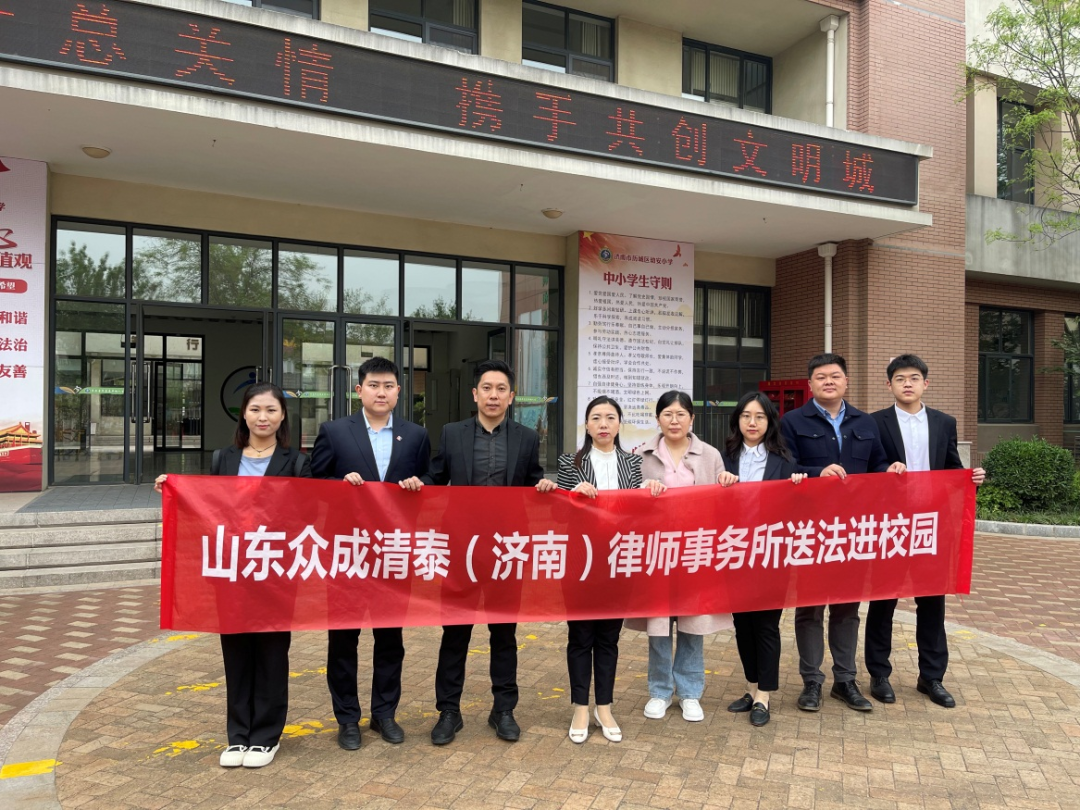

Zhongcheng Qingtai Jinan Region
Address: Floor 55-57, Jinan China Resources Center, 11111 Jingshi Road, Lixia District, Jinan City, Shandong Province
