


01
2023-06
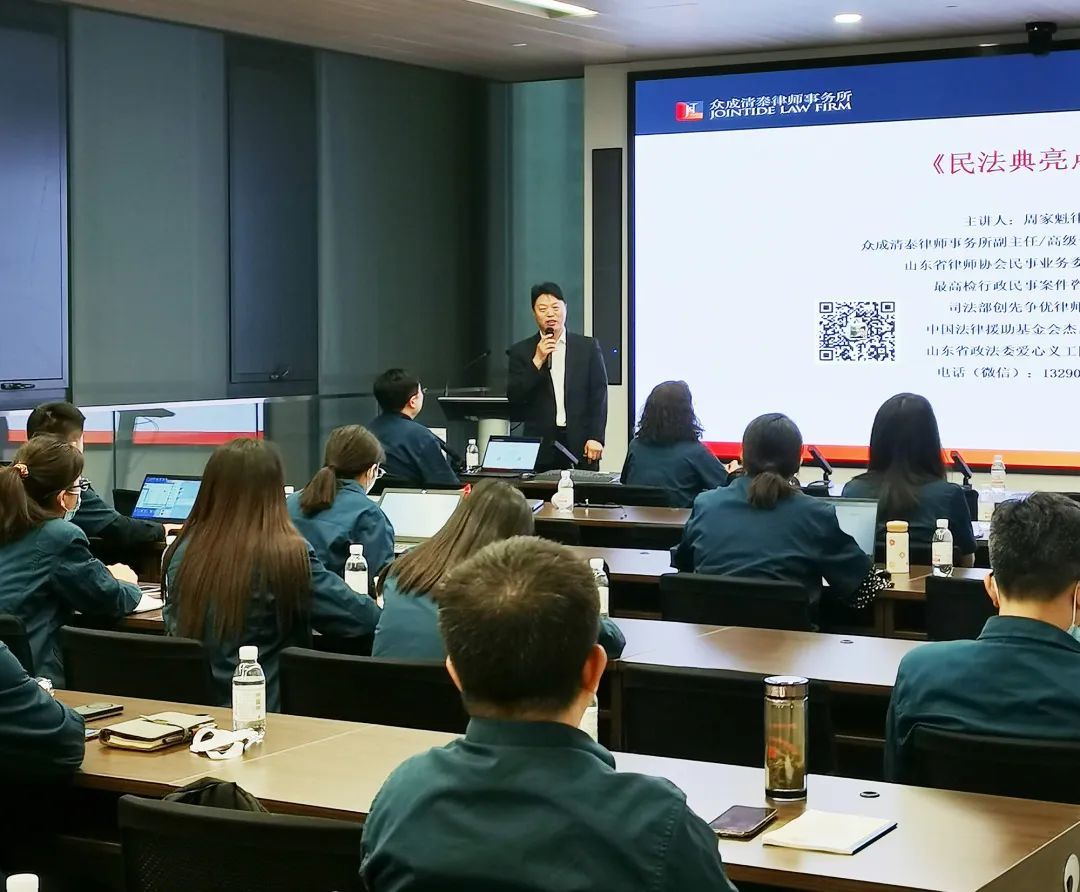
The Civil Code is a code with Chinese characteristics, reflecting the characteristics of the times and reflecting the wishes of the people. It is a "people-centered" civil code in the true sense. In order to thoroughly study and implement Xi Jinping's thought of the rule of law and implement the spirit of the General Secretary's important instructions on strengthening the study and publicity of the Civil Code, Sinotruk Group carried out a series of study and education activities around the publicity of the Civil Code in May 2023, setting off a new upsurge in law popularization. On May 27, 2022, the headquarters of CNHTC Group invited lawyer Zhou Jiakui, deputy director of Zhongcheng Qingtai Law Firm, to make a comprehensive and detailed interpretation of the key contents of the Civil Code with the theme of "Interpretation of Highlights of the Civil Code", so that more than 200 employees participating in the training online and offline can have a deeper understanding of the specific impact of the Civil Code on the company's operation and employees' lives, and enhance their awareness of the rule of law and rights, the knowledge of civil law has been popularized and the staff's awareness of legal risks has been improved. In this lecture, lawyer Zhou Jiakui interpreted the Civil Code for employees from two aspects: "the important impact of the Civil Code on the business environment and company operations" and "the important impact of the Civil Code on employees' lives. Through the general provisions, property rights, contracts, personality rights and tort liability part of the provisions of the fine, at the same time with the case to be analyzed for the company and employees in the company's operations and daily life may encounter legal risks, and the corresponding preventive measures. The Civil Code is an "Encyclopedia of Social Life". By focusing on learning the relevant legal knowledge of the Civil Code, especially the contract system and guarantee system that adjust the transaction relationship, the tort liability system that adjusts the tort claim relationship, and the agency system of market entities, etc. A series of systems have comprehensively strengthened the risk prevention awareness of the employees of Sinotruk Group and won unanimous praise. Zhongcheng Qingtai (Jinan) Law firm fully implements the spirit of the 20th CPC National Congress and carries out in-depth publicity and education on the rule of law. Actively assume the social responsibility of the law firm and organize lawyers to set up public welfare legal propaganda groups. Regularly carry out a series of public welfare legal publicity activities, such as the rule of law into the campus, the rule of law into the village, and the rule of law into enterprises, so as to enhance the concept of the rule of law among the whole people and achieve good social benefits.
2023-06-01
31
2023-05
On May 31, Zhao Kaiyong, senior partner of Zhongcheng Qingtai (Jinan) law firm, member of the Management Committee and director of the second Department of urban construction and real estate, was invited to carry out special legal training for Jinan Rail Transit Group Co., Ltd. on "legal risk prevention and control in the construction stage of construction project from the perspective of the employer. Based on his practical experience, lawyer Zhao Kaiyong started from nine aspects in the field of construction, including the prominent problems of notification and correspondence, construction period, quality, project cost and settlement, subcontracting, migrant workers' arrears of wages, project file management and construction contract dispute handling skills, the legal risks that may arise in the construction phase of the construction project and how to carry out risk prevention and control are explained. Combined with various typical cases, lawyer Zhao focused on the legal problems that may arise in the development of Jinan Rail Transit Group Co., Ltd., put forward coping strategies and professional suggestions from multiple angles, and answered the specific questions and questions raised by the staff one by one. Relevant departments of Jinan Rail Transit Group Co., Ltd., leaders of subsidiaries and relevant staff participated in the training, and the trainees spoke highly of lawyer Zhao's teaching.
2023-05-31

30
2023-05
Viewpoint | Analysis of late fees in corporate bankruptcy business
In recent years, the number of corporate bankruptcy cases has increased year by year. From accepting bankruptcy applications to declaring corporate bankruptcy, to corporate tax registration cancellation, a series of tax issues will be involved, which is easy to cause tax-related disputes. This paper discusses the problem of late fees involved in the business of enterprise bankruptcy. The nature of tax late fees formed before the acceptance of 1. bankruptcy cases. The Reply of the Supreme People's Court on the Issue of Whether the Claim for Confirmation of Claims by Tax Authorities on Late Fees Arising from Tax Arrears of Bankrupt Enterprises should be Accepted (Fa Shi [2012] No. 9) stipulates that the people's court shall accept the claim for confirmation of claims filed by tax authorities on late fees arising from tax arrears of bankrupt enterprises in accordance with the law. In accordance with the relevant provisions of the Enterprise Bankruptcy Law and the Tax Collection and Administration Law, the late fees incurred by the bankrupt enterprise due to the payment of taxes before the bankruptcy case is accepted are ordinary bankruptcy claims. Whether the social security late fees incurred before the acceptance of the 2. bankruptcy petition are bankruptcy claims. Article 3 of the (III) of the Supreme People's Court on Several Issues Concerning the Application of the the People's Republic of China Enterprise Bankruptcy Law (hereinafter referred to as the (III) for Judicial Interpretation of the Enterprise Bankruptcy Law) stipulates that after the bankruptcy application is accepted, the overdue fine arising from the debtor's outstanding payment, including the overdue interest and labor insurance premium that should be doubled if the debtor fails to perform the effective legal document, The people's court will not confirm it. Article 61 of the Provisions of the Supreme People's Court on Several Issues Concerning the Trial of Enterprise Bankruptcy Cases (Fa Shi [2002] No. 23) stipulates that the following creditor's rights are not bankruptcy creditor's rights: (2) After the people's court accepts the bankruptcy case, the debtor fails to pay the overdue fine for the amount due, including the overdue interest and labor insurance premium that the debtor should double if he fails to implement the effective legal documents. This provision is consistent with the spirit of Article 3 of the above-mentioned (III) on Judicial Interpretation of Enterprise Bankruptcy Law. Notice of the Second Civil Trial Division of the Higher People's Court of Jiangsu Province on Printing and Distributing the Guidelines for the Trial of Bankruptcy Cases (Revised Edition) (Su Gao Fa Dian [2017] No. 794) holds that: "7. bankruptcy claims and the order of repayment ...... The following claims do not belong to bankruptcy claims: First, the administrative and judicial organs impose fines, fines and other related costs on the debtor. Second, the debtor's failure to implement the effective legal instrument should double the delay interest and the late payment of labor insurance premiums. Article 54 of the Notice of Shenzhen Intermediate People's Court on Issuing the Guidelines for the Examination and Determination of Creditor's Rights in Bankruptcy Cases (No. 5 [2017] of Shenzhen Intermediate People's Court) also holds that:" The following claims declared by creditors shall not be determined: (1) fines, fines and other related expenses imposed on the debtor by administrative and judicial organs; (II) late fees for delay interest and labor insurance premiums that should be doubled if the debtor fails to perform the effective legal documents; ...... "Both documents provide that" delayed interest and late fees are not bankruptcy claims ". In the case of the dispute over the confirmation of ordinary bankruptcy creditor's rights between the yi county tax bureau of the state administration of taxation and Huangshan zhiheng investment co., ltd. [case number:(2019) wan 1023 minchu no 363], the tax authorities believed that according to article 3 of the (III) on judicial interpretation of enterprise bankruptcy law, "after the bankruptcy application is accepted, the overdue fine arising from the debtor's arrears includes the overdue interest and labor insurance premium that the debtor should be doubled if the debtor fails to fulfill the effective legal documents, if a creditor declares as a bankruptcy claim, the people's court shall not confirm it", and the bankruptcy claim shall be confirmed at the point in time of bankruptcy acceptance. That is, the late payment of social insurance premiums prior to bankruptcy acceptance is a bankruptcy claim. However, the People's Court of Yixian County, Anhui Province held that the provisions of the law did not reverse the late fees and double the deferred interest paid before the bankruptcy application was accepted, which could be recognized as bankruptcy claims. The late payment of social insurance premiums is punitive and has a specific object of implementation. If it is determined to be a bankruptcy claim, it is all creditors who are actually punished, which is contrary to the original intention of the measure and the spirit of the bankruptcy law to protect all creditors fairly. In the end, the court dismissed the tax authorities' claims. There has been controversy over whether the social security late payment fee arising before the acceptance of the bankruptcy application is a bankruptcy claim, with some judicial precedents determining it as a bankruptcy claim and some judicial precedents not confirming it as a bankruptcy claim. China is not a case law country, and the details of each case vary widely, the above-mentioned case of the judgment point of view provides a new way of thinking, that is, "social insurance premium late fees with a punitive, with a specific object of implementation. If determined as a bankruptcy claim, the actual punishment is all creditors, contrary to the spirit of the bankruptcy law fair protection of all creditors." In the bankruptcy business, it is recommended that the administrator should attach great importance to the tax late fees involved in the bankruptcy business, actively communicate and coordinate with the competent tax authorities, and avoid tax-related disputes or other liability disputes as far as possible. Deal with tax issues in bankruptcy proceedings in compliance with the law, effectively avoid the risk of practice, and promote the smooth progress of bankruptcy business.
2023-05-30
29
2023-05
In order to conscientiously implement the spirit of General Secretary Xi Jinping's important instructions on the work of national unity, give full play to the function of judicial administration, and do a solid job in public legal services, Shandong Zhongcheng Qingtai Law firm is under the strong guidance and active help of the Judicial Bureau of Renbu County, Xigaze City, Tibet, in late April 2023, a "National Unity Village Legal Adviser" group of 18 practicing lawyers was established, including Zhang Wei, Cheng Shoufa, He Zefeng, Zhang Chuanwei, Dou Xiaopeng, Zhao Jiao, Lu Zongju, Cai Benjie, Zhang Jun, Lin Jing, Zhang Wei, Lin Aili, Ge Xiaowei, Du Fengjun, Song Xiangxiao, Jin Zhengchun, Liu Wenwen and Wang Wei. Renbu County is located in the valley of the middle reaches of the Yarlung Zangbo River in southern Tibet, the northern slope of the middle section of the Himalayas and the southern slope of the eastern section of the Gangdise Mountains. The mountains are high and deep, and the ravines are vertical and horizontal. The highest peak is the southeast corner of Naichin Kang Sang Peak, which is 7191 meters above sea level. The county has a total area of 2124 square kilometers, the terrain is high in the east and low in the west, and the north and south are plateau mountains. Half of the county's area is above 4000 meters above sea level, the average elevation of 5 townships in the east is above 4000 meters, and the average elevation of 3 townships and 1 town in the west is above 3700 meters. Since the main legal service resources such as the Renbu County Public Legal Service Center are located in Dejilin Town, Tibetan compatriots living in remote areas cannot be resolved in time when facing legal problems due to inconvenient transportation restrictions. In early May, Zhongcheng Qingtai Renbu Branch actively communicated with Renbu County Justice Bureau, combined with the actual situation of various villages in Renbu County, to carry out the docking service of the lawyer team. Under the active communication and coordination of Zhongcheng Qingtai Renbu Branch, 18 lawyers and 73 villages in Baxiang Town, Renbu County have achieved pairing services, using "online and offline" or "offline" methods, with mainland lawyers acting as "online" lawyers and Renbu Branch lawyers acting as "offline" lawyers, providing free services to 73 administrative villages, the scope of services involves village governance according to law, legal consultation and legal aid, publicity and education on the rule of law, and participation in people's mediation. At present, all administrative villages in Renbu County have signed employment contracts with lawyers of Zhongcheng Qingtai Lawyers Group respectively, and issued letters of appointment of village legal advisers. Public signs are placed in conspicuous positions of villages, and the names and contact information of lawyers of national unity village legal advisers are announced, so as to provide villagers with free legal services of "national unity legal advisers", It is convenient to contact legal advisers in time to provide free legal advice for village committees, it has comprehensively formed a working structure with unified guidance from the county-level public law center and the general office of Zhongcheng Qingtai Law Firm, specific responsibilities of Renbu Branch and daily legal services, so as to further extend public legal services to the rural grassroots under the current limited legal resources. Through the activity of "national unity village legal adviser", we have further done a good job in the work of practicing lawyers as village legal advisers, solved the bottleneck problem of practicing lawyers in Renbu County, realized the sharing of legal resources between the mainland and Tibet, consolidated and developed socialist ethnic relations of equality, unity, mutual assistance and harmony, It provides a strong public legal service guarantee for rural revitalization. Zhongcheng Qingtai Lawyers Office will take the "National Unity Village Legal Advisor" activity as an opportunity to continuously deepen the construction of the rule of law in the countryside, continue to increase the intensity of rural law popularization, thoroughly implement the comprehensive promotion of the cause of national unity and progress, and forge the sense of the Chinese nation's community. Tibet has become a model area for national unity and progress and made greater contributions.
2023-05-29

29
2023-05
Viewpoint... The defense point of the crime of fund-raising fraud.
There is a rumor in the market: "Success is a legendary entrepreneur, and failure is a fund-raising fraud criminal." The company's operation and project development are inseparable from the support of funds. Therefore, fund-raising has become a means for many people to expand their business scale. However, in practice, some illegal personnel illegally raise funds by means of fraud, illegally occupy the funds raised by others, and cause economic losses to others, which will constitute the crime of fund-raising fraud. 1. fund-raising fraud legal provisions Article 192 of the Criminal Law stipulates that for the purpose of illegal possession, anyone who uses fraudulent methods to illegally raise funds shall be sentenced to fixed-term imprisonment of not more than five years or criminal detention and a fine of not less than 20,000 yuan but not more than 200,000 yuan; if the amount is huge or there are other serious circumstances, he shall be sentenced to fixed-term imprisonment of not less than five years but not more than ten years and a fine of not more than 50,000 yuan but not more than 500,000 yuan. The amount is particularly serious, he shall be sentenced to fixed-term imprisonment of not less than 10 years or life imprisonment, and shall also be sentenced to a fine of not less than 50,000 yuan but not more than 500,000 yuan or confiscation of property. Sentencing Rules for the Crime of 2. Fund-raising Fraud 1, the amount of individual fund-raising fraud in 100000 yuan or more is "large amount", the amount of unit fund-raising fraud in 500000 yuan or more is "large amount", should be filed for prosecution, sentenced to not more than five years of fixed-term imprisonment or criminal detention, and fined; 2, the amount of individual fund-raising fraud in 300000 yuan or more is "huge amount" (special circumstances are 240000), the amount of unit fund-raising fraud in 1.5 million yuan or more is "huge amount" (special circumstances are 1.2 million), sentenced to fixed-term imprisonment of not less than five years but not more than ten years, and fined; 3. If the amount of individual fund-raising fraud is above 1 million yuan, it is "extremely large" (800000 in special circumstances), and if the amount of unit fund-raising fraud is above 5 million yuan, it is "extremely large" (4 million in special circumstances), and shall be sentenced to fixed-term imprisonment of more than 10 years or life imprisonment, and fined or confiscated property; Other (particularly) serious circumstances refer to:(1) impersonating a state organ or public welfare organization to carry out fund-raising fraud;(2) causing the victim to commit suicide, mental disorder or other serious consequences;(3) the victim is mainly a disabled person, the elderly or a person who is incapacitated. The crime of 3. fund-raising fraud must have three elements at the same time. (1) for the purpose of illegal possession; (2) the use of fraudulent methods; 3. Illegal fundraising. 4. Fundraising Fraud Defense Point The first category, not guilty point Innocence point one, the perpetrator does not have the purpose of illegal possession. The Supreme People's Court on the trial of illegal fund-raising criminal cases of the specific application of law. The interpretation of several issues (2022) stipulates that the use of fraudulent methods to illegally raise funds under one of the following circumstances can be regarded as "for the purpose of illegal possession": (I) the funds raised are not used for production and business operations or are used for production and business operations and the scale of the funds raised is obviously out of proportion, so that the funds raised cannot be returned; (II) wantonly squandering fund-raising funds, resulting in the non-return of the fund-raising funds; (III) evades hiding with fund-raising funds; (IV) use the funds raised for illegal and criminal activities; (V) to withdraw, transfer funds, conceal property and evade the return of funds; (VI) concealing or destroying accounts, or engaging in false bankruptcy or bankruptcy to evade the return of funds; The (VII) refuses to account for the whereabouts of the funds and evades the return of the funds; (VIII) other circumstances in which the purpose of illegal possession can be determined. The purpose of illegal possession in the crime of fund-raising fraud should be determined by distinguishing the circumstances. If part of the illegal fund-raising behavior of the perpetrator has the purpose of illegal possession, the fund-raising money involved in this part of the illegal fund-raising behavior shall be convicted and punished as the crime of fund-raising fraud; if some of the illegal fund-raising joint crime has the purpose of illegal possession, if the other actors have no common intention and behavior of illegally possessing the fund-raising money, the perpetrator with the purpose of illegal possession shall be convicted and punished for the crime of fund-raising fraud. Performance that does not have the purpose of illegal occupation: (I) evidence in the record does not reflect the perpetrator's profligacy or illegal transfer of property. (II), after the turnover of funds, the actor takes positive measures such as personal fund-raising, settlement with the relative or confirmation of the amount of debt can confirm that the subjective purpose of illegal possession is not. The funds absorbed by the (III) actor are mainly used in normal production and business activities, and do not belong to the situation with the purpose of illegal possession. Not guilty point 2. the perpetrator did not use the "fraud method" "Fraud method" refers to the means by which the perpetrator uses fictitious fund-raising purposes and uses false supporting documents and high rates of return as bait to defraud fund-raising funds. In practice, the methods often adopted by the actors are: fabricating enterprises or enterprise plans that do not actually exist, forging relevant approval documents, and defrauding the trust of the public in the name of breeding, planting, and producing products that can obtain high returns. I believe that its investment will be able to get several times and dozens of times the return, but in fact, most of these are illusory. Objectively, the specific manifestations of the lack of fraudulent means of fund-raising are: (I) there is no evidence to prove that the perpetrator has the intention to commit fraud. (II) actors objectively did not commit fraud and subjectively did not have the common intent to defraud clients of their investments. The perpetrator of the (III) did not use fraudulent means such as fictitious fund-raising purposes, using false supporting documents and high rates of return as bait to obtain fund-raising funds. The (IV) actor's absorption of funds is a function arranged by the performing unit and is unaware of the purpose and whereabouts of the unit after receiving the money. The acquittal point 3. did not implement the illegal absorption of public deposits. The actor's loan object is his comrades, colleagues, relatives, friends and other specific personnel, not the social unspecific object, not the public. The point of not guilty 4. the argument of insufficient evidence As the crime of fund-raising fraud will inevitably involve the problem of amount calculation and verification, the appraisal opinions in the form of "report" and "calculation and verification report" are the key evidence of the crime of fund-raising fraud. Starting from the appraisal opinions, the argument of insufficient evidence is often effective. Defense lawyers can cross-examine whether the appraisal opinions have the qualification of evidence and the strength of proof through the entrusting unit, appraisal unit, appraisal method, process, materials and other aspects in the process of making the appraisal opinions. The second category, misdemeanor defense point: does not constitute the crime of fund-raising fraud, constitutes the crime of illegally absorbing public deposits. To determine whether the defendant constitutes the crime of fund-raising fraud, we should focus on the "coming" and "going" of funds. If the perpetrator only participates in the absorption of funds according to the arrangement of the unit, but does not know the purpose and whereabouts of the unit after receiving the money, he shall be convicted and punished for the crime of illegally absorbing public deposits, and shall not be classified as the crime of fund-raising fraud; If the whereabouts of the fund-raising funds have not been identified, it cannot be determined that the perpetrator has the purpose of illegal possession of the fund-raising funds. Category III, light points If the crime is light, it constitutes a unit crime, not an individual crime, and shall be investigated for criminal responsibility for the unit crime; The point of misdemeanor 2. the amount of the crime. The amount of fund-raising fraud should be calculated based on the amount actually defrauded by the perpetrator; the part that has been returned before the incident should be deducted; but the advertising fees, intermediary fees, handling fees, rebates, or expenses paid by the perpetrator for the implementation of fund-raising fraud activities For bribes, gifts and other expenses, they shall not be deducted; the interest paid by the perpetrator for the implementation of fund-raising fraud activities shall be included in the amount of the fraud, except for the principal. The third point of the light crime: the argument of status and role. The crime of fund-raising fraud mostly occurs in the form of gangs. The status, role and amount of money involved in each unit should be treated differently. Those who are not involved in fund-raising fraud within the unit should not be dealt with criminally. For those who are involved in fund-raising fraud, but are not the main responsible personnel in the unit, they should start with the amount of money involved and the amount of money (whether from relatives and friends), etc, distinguish from the main responsible person to get a lighter punishment.
2023-05-29
25
2023-05
On May 24, the 2023 provincial industrial and information system city tour law popularization activity (the third session) was held in Dongying City. The main purpose of this activity is to lead the digital transformation of industrial enterprises, help small and medium-sized enterprises to innovate and develop, promote the development of new economy, and provide policy support and legal guarantee for the transformation and upgrading of industrial economy and innovation and development. Relevant persons in charge of the Policy and Regulations Division of the Provincial Department of Industry and Information Technology, the Provincial Gazelle Enterprise Development Promotion Association, the Provincial Internet of Things Association, the Artificial Intelligence Association, the Dongying Industry and Information Department, and the heads of 114 enterprises in Dongying City participated in the event. Yin Huili and Zhang Qinbo, senior partners of Zhongcheng Qingtai (Jinan) Law Firm, and lawyers Li Shuang and Yao Runzi were invited to participate in this activity as members of the tour publicity team. The lecture was presided over by Zhang Zhibo, deputy director of the laws and regulations department of the provincial department of industry and information technology. Su Guanqun, secretary general of the provincial internet of things association and artificial intelligence association, analyzed the relevant measures and policies for the transformation of industrial internet-enabled enterprises. Zeng Dawei, secretary general of the provincial gazelle enterprise development promotion association, explained the cultivation and identification of gazelle (unicorn) enterprises. The meeting pointed out that the development of gazelle (unicorn) enterprises and industrial Internet is an important measure to promote the innovation and development of small and medium-sized enterprises, and is the key support for the digital transformation of the real economy. In recent years, the Provincial Department of industry and information technology has been committed to deepening the transformation of new and old kinetic energy, promoting the transformation and upgrading of traditional industrial enterprises, promoting the innovation and development of small and medium-sized enterprises, improving the innovation ability of enterprises, and steadily promoting the high-quality development of industrial economy. The forum was presided over by Zhang Zhibo, deputy director of the laws and regulations Department of the Provincial Department of Industry and Information Technology. Lawyers Yin Huili, Zhang Qinbo, Li Shuang and Yao Runzi of Zhongcheng Qingtai (Jinan) Law firm conducted legal physical examination for the enterprise. Through communication with participating enterprises, they gave on-site answers to contract disputes, infringement disputes, labor disputes and other issues encountered by the enterprise in the course of operation, it also puts forward corresponding legal suggestions on the risk prevention and control of various stages of project construction, intellectual property maintenance, equity investment and financing risk prevention and control. As the perennial legal adviser of Shandong Provincial Department of industry and information technology, Zhongcheng Qingtai law firm will actively help the transformation of new and old kinetic energy, promote the transformation and upgrading of enterprises, provide legal support in the process of enterprise development and innovation, help enterprises develop in the direction of gazelle (unicorn), and contribute legal professional strength to the digital transformation of industrial economy and the innovation and development of new economy in Shandong Province.
2023-05-25

23
2023-05
Abstract: The geo-economic development of the "Belt and Road" has not only increased investment opportunities in the region, but also brought more investment disputes. However, ISDS, as a mechanism to resolve investment disputes between investors and host countries, has gradually shown problems such as low efficiency, high cost and lack of transparency. Up to now, there is no international consensus on ISDS reform, and each reform measure has its own advantages and disadvantages, and it is not perfect. When choosing the reform mode of ISDS mechanism, China should adhere to the gradual reform of ISDS, and actively build the "Belt and Road" international investment dispute settlement institution and promote the ADR mechanism to protect the investment interests of Chinese overseas investors. Key words: The Belt and Road, ISDS reform, international investment, arbitration 1. Introduction In 2013, President Xi Jinping proposed the great strategy of "One Belt One Road", which aims to promote the reform of the global economic and trade governance system and promote the construction of a community of human destiny. China adheres to the concept of "consultation, co-construction and sharing". In the past nine years, China has signed 205 cooperation documents with 171 countries and international organizations to jointly build the "Belt and Road. [1] The degree of investment cooperation between China and countries along the route is gradually deepening, but in the context of political, cultural and economic diversification of various countries, disputes between investors and host countries are inevitable. [2] In recent years, with the increase in the number of cases referred to the International Centre for Settlement of Investment Disputes (ICSID), the investor-State dispute settlement mechanism (ISDS) is time-consuming, costly and less transparent. [3] As a result, the academic community began to pay attention to the shortcomings exposed by the ISDS mechanism and put forward many different suggestions for improvement, such as Anthea Roberts that there are three main ways to reform the ISDS mechanism: gradual, systematic and paradigm reform [4]. That is, to continue to follow the ISDS mechanism and to build on it, such as the establishment of an appellate body [5]; to abandon the existing ISDS in favor of an investment court or to abolish the ISDS mechanism altogether, thereby turning to the domestic judicial system. [6] In addition, the establishment of the "Belt and Road" international investment dispute settlement institution and specialized mediation institutions are conducive to the settlement of international investment disputes. However, each reform measure is imperfect, that is, it cannot meet the needs of all countries along the "Belt and Road". Therefore, it is the best policy to learn from all imperfect options and gradually innovate the international investment dispute settlement mechanism. This paper intends to start from the dilemma faced by ISDS, first of all, the analysis of the current ISDS mechanism of various shortcomings, such as low transparency, arbitrator impartiality can not be guaranteed. Secondly, based on the background of the "Belt and Road" and combined with the characteristics of the "Belt and Road" investment risk, the impact of the mainstream ISDS reform on the "Belt and Road" strategy is further discussed. Finally, from the perspective of China, this paper analyzes the imperfections of each reform mode, and puts forward some suggestions on the trade-off of the reform mode. Review of 2. ISDS Mechanism The main contradiction of international investment disputes is concentrated between investors and host countries, and the traditional dispute settlement mechanism between countries (such as WTO) is not enough to effectively solve the existing contradictions. The ISDS mechanism came into being in this context. (I) Brief Introduction of ISDS Mechanism ISDS refers to a way for investors to resolve investment disputes through arbitration in the belief that the host country has violated its obligations to protect the interests of investors in international investment agreements (IIAs) [7]. Investment disputes have existed since the beginning of people's ability to transport goods across borders. With the increase in international trade, the more economically developed countries are more likely to transfer their capital or goods to other countries, but the rise of nationalization movements in Latin America, Asia, Africa and other regions has made capital-exporting countries hesitate to continue to invest abroad without adequate legal guarantees [8]. For investors, in the absence of the ISDS mechanism, when the capital-importing country expropriates the assets of foreign investors, it is generally only through the domestic judicial or diplomatic relief of the host country. If the domestic court system of the host country is chosen to safeguard its own rights and interests, for the protection of domestic interests, the courts may not handle disputes in full accordance with the principle of fairness, which is not conducive to the protection of the interests of foreign investors [9]. Therefore, investors prefer to choose international arbitration to defend their rights and interests rather than domestic courts. [10] Under the framework of ISDS, investment disputes between investors and host countries can be arbitrated through an arbitral tribunal composed of non-host country nationals, a procedure that is more fair and effective [11]. The signing of the New York Convention in 1958 made foreign arbitral awards enforceable for signatory countries and promoted more investors to seek to defend their rights through arbitration. Germany and Pakistan signed a bilateral investment agreement (BIT) in 1959 to introduce ISDS clauses for the first time. After that, ICSID, an independent agency affiliated to the World Bank, and the United Nations Commission on International Trade Law (UNCITRAL) worked together to formulate ISDS rules and continuously put forward reform suggestions to reduce political interference in the settlement of investment disputes between investors and countries, thus making the ISDS mechanism more fair at the legal level [11]. Developing countries hope to help their economies develop through foreign investment, and foreign investors also open up the host country's market and make a profit in the process. The purpose of ISDS to protect the rights of foreign investors and promote international investment is consistent with the goal of mutual benefit for investors and countries [12], so an increasing number of bilateral and multilateral investment agreements, including the North American Free Trade Agreement (NAFTA), include ISDS provisions. Before the 1990s, IIAs hardly involved ISDS,[13] followed by a surge in foreign direct investment (FDI) and a rapid increase in the number of IIAs [14]. A total of 3360 IIAs have been signed by 2020 [15], and most of these BITs have adopted ISDS to resolve investment disputes [14]. The ISDS caseload has reached 1104 in 2020 [16]. (II) the defects of ISDS 1. Low transparency and lack of consistency in arbitral awards Although arbitration is an effective method to protect foreign investors from unfair treatment by domestic courts, and the high efficiency and confidentiality of the "final ruling" can protect "trade secrets", these two characteristics are the advantages of arbitration for justice, but it also brings troubles to the settlement of disputes between investors and the state. In the investment disputes between investors and countries, personal interests and public interests are inseparable. International investment arbitration has the characteristics of personal goods and is dominated by contracts and market forces, especially from the appointment of arbitrators. At the same time, international investment arbitration also has the characteristics of "public goods". The arbitration result should protect the public interest, because the arbitration content is closely related to the interests of citizens of a country [17], therefore, "trade secrets" should not have a central position in ISDS. Concerns about transparency reached a tipping point in 2007 when Bolivia submitted a withdrawal declaration to ICSID on the grounds of low transparency, followed by countries such as Ecuador, which also withdrew from ICSID [18]. In the ISDS mechanism, transparency is related to the disclosure of information, the notice of arbitration, the relevant procedural documents and their submission and final award, that is to say, ISDS has the disadvantages of not disclosing procedural documents, keeping the litigation process confidential, and making it difficult for citizens to know the arbitration information. [19] Although rules on transparency have been included in many IIAs, such as the EU's trade agreements with Singapore and other countries, the issue of transparency has been highlighted in the UNCITRAL Working Group III report, and there are ongoing attempts to reform how to improve transparency in ISDS [20], but with little effect. Low transparency not only affects the disclosure of information, but also reduces the predictability and consistency of arbitration results. There are many reasons for the lack of consistency in arbitral awards, such as the fact that arbitrations are based on different investment rules, the fact that BITs are vague and outdated, and the fact that different arbitral institutions may produce different results. However, transparency remains an important reason for the low predictability of the outcome of arbitration. In investment arbitration, the role of jurisprudence is significant. Although the award of ISDS is not binding on the subsequent arbitral tribunal, it is also the arbitrator's responsibility to maintain the stability of the decision. The arbitrator's inability to obtain the previous case in time makes it impossible for the arbitrator to hear the case with reference to the precedent when dealing with similar cases. In addition, the arbitrator will adopt different methods for the interpretation of the same clause, resulting in different or even opposite results. [21] 2, the cost of litigation is too high The cost of ISDS is divided into time cost and money cost. In 2014, Professor Daniel often made statistics on some cases of litigation. The average litigation time in the cases collected by Daniel often reached 48.9 months, and the average length of cases won by applicants was as high as 55 months. Especially in special circumstances, the litigation time exceeds 129 months, and the time cost is huge [22]. The cost of money can be broadly divided into the costs of the mediation phase, the costs of the arbitral tribunal, the fees of attorneys and the costs of compensation after the award. As early as 1960, Seidl-Hohenveldern argued that "international arbitration has advantages over a permanent foreign investment court, especially because it is less expensive and more attractive to foreign investors [23]." However, with the development of investment arbitration, the cost of arbitration has gradually increased. According to the report of the UNCITRAL Working Group III, the average cost of each party in an ISDS case is above $8 million and may exceed $30 million [24]. The expenses of the arbitration tribunal (mainly including the expenses paid to the arbitrators and the related expenses of the arbitration procedure) are one of the smaller expenses in the whole arbitration process. However, according to statistics, the expenses of the arbitration tribunal in NAFTA are between US $1 million and US $3 million, the expenses of the arbitration tribunal in ICSID cases are about US $1.04 million, and the UNCITRAL arbitration expenses are also US $1.4 million [14], which are not small expenses for investors. In addition, legal fees, expert witnesses and other costs are also quite expensive for both parties. Lack of impartiality of arbitrators ISDS arbitrations are ad hoc and, according to the ICSID rules on the composition of the arbitral tribunal, the arbitral tribunal is generally composed of three persons, one arbitrator appointed by one of the parties and the third arbitrator chosen by agreement or appointed by the arbitration center [25]. ISDS arbitration inherits international commercial arbitration, arbitrators are different from domestic court judges, on the one hand, they are not obliged to uphold the constitution and laws of the host country, so many scholars worry that arbitration will give foreign investors greater rights to challenge the public interest of the host country and even endanger national security. On the other hand, most of the judges of the courts are life-long or long-term, but many of the arbitrators in ISDS arbitral tribunals are lawyers, and the parties are required to pay them high arbitration fees. Arbitrators will inevitably be more attentive to their "employers" after accepting their appointments, thus maintaining long-term business [11]. In addition, the arbitrator's fee is more than $600 per hour, in which case the arbitrator will not immediately dismiss the case if it does not meet the arbitration criteria [26]. At the same time, due to the private nature of arbitration, arbitrators do not have to be as accountable to the public as judges, which poses a threat to the protection of the public interest of the host country. 4. Other defects Mediation is an important part in both court litigation and arbitration, which was originally an effective way to make up for the inefficiency of arbitration and save arbitration costs. However, according to ICSID data, a total of 11 cases were closed through mediation by 2021, which shows that mediation is less used in practice [27]. In addition, ISDS lacks an appeal mechanism and currently only allows for procedural review of arbitration under the Convention on the Settlement of Investment Disputes between States and Nationals of Other States (the Washington Convention), without a substantive review of the correctness and consistency of the outcome of the arbitration. 3. the Diversified Reform of the International Investment Dispute Settlement Mechanism of the Belt and Road Initiative For investors, the construction of a diversified investment dispute settlement mechanism can create the possibility for them to choose an optimal way in a variety of investment dispute settlement mechanisms in combination with the actual situation of the case, so as to resolve investment disputes peacefully, fairly and efficiently. For China, under the background of the "Belt and Road", insisting on promoting the development of a diversified investment dispute settlement mechanism can further protect national interests while escorting domestic investors. (I) advances ICSID reform In July 2019, China submitted to the UNCITRAL Working Group III the "China Proposal Document on the Reform of the Investor-State Dispute Settlement Mechanism", stating China's position. China believes: "Although the ISDS mechanism has problems such as lack of error correction mechanism, lack of stability and predictability, the investor-state investment dispute settlement mechanism is still an important solution to related problems, and it should be actively improved through reforms to enhance the parties' confidence in the mechanism." [28] In the absence of the establishment of a dedicated "Belt and Road" investment dispute settlement body, the gradual reform of ICSID will help to resolve investment disputes in China in the context of the "Belt and Road" strategy and lay the foundation for the establishment of a dedicated dispute settlement body in the future. 1. Establishment of an arbitration appellate body Beginning in the 1950 s, ISDS arbitration results gradually favored foreign investors. The State is obliged to balance the interests of foreign investors and the State, and excessive protection of investors is contrary to the principle of fairness [29]. The public law nature of investment disputes distinguishes them from commercial arbitration, so the characteristics of "final arbitration" cannot be adapted to investment arbitration. Commercial arbitration meets the requirements of both parties to arbitration for efficiency and protection of trade secrets, but in investment disputes between investors and countries, the interests of investors and the interests of the host country need to be protected equally, and even for the sake of protecting human health and the world environment, the public interest should be protected. Based on this, the establishment of the ICSID Appellate Body is conducive to balancing the interests of the parties. The idea of establishing an arbitration appellate body was proposed by the ICSID secretariat as early as 2004. UNCITRAL Working Group III proposed a variety of proposals for the operation of the Appellate Body, including the scope of review of appeals, the circumstances in which appeals may be made, the effectiveness of appeals, and the time frame [30]. The model of WTO Appellate Body can be used for reference when designing ICSID Appellate Body. For example, the Appellate Body consists of three or seven persons and separates the first-instance arbitrators from the Appellate Body staff. There is a strict time limit of 12 months from the filing of an appeal to the decision. The scope of the appellate review also does not have to re-examine the whole case, only "errors of law" and obvious errors of fact. At the same time, the role of the ICSID secretariat is an important part of ensuring consistency in ICSID dispute settlement procedures and outcomes [31]. Increased transparency of ICSID As discussed above, the high privacy of international investment arbitration can lead to a reduction in the consistency and predictability of arbitration, and therefore, since the revision of the ICSID Arbitration Rules in 2006, it has been proposed.
2023-05-23
22
2023-05
Early summer is full of passion. On May 21, 2023, after fierce competition, Zhongcheng Qingtai (Jinan) team successfully advanced to the quarterfinals of the football match with the first result of the group after the fierce competition in the fourth group match! On May 13, the third Jinan lawyer five-a-side football match kicked off in Jinan Jingrui Football Park. This football match was organized by Jinan Lawyers Association, with 20 teams and more than 200 lawyers participating. The competition adopts the method of "group stage single round elimination". The 20 teams are divided into four groups and will start a nearly one-month schedule. Zhongcheng Qingtai (Jinan) team is in group a with Beijing Deheng, Guohao Jinan, Beijing Bairui and Wenyuange FC. In the case of losing the first game, the football players adjusted their mentality in time and actively prepared for the game. After four fierce competitions in the group stage, they finally scored 9 points with three wins and one loss, and the first result of the group was successfully advanced to the quarterfinals! The football players on the field are full of momentum, high morale, and brilliant. The Ching Ching Tai cheerleaders off the field cheered and cheered! On May 28th, the Zhongcheng Qingtai (Jinan) team will compete in the 1/4 finals with the second place in Group C in Jingrui Football Park. I look forward to the wonderful performance of the players!! Sunset to mountains and seas, football to youth. May every player in this competition start with interest, be longer than love and be loyal to persistence. In the busy work, happy work, healthy life!
2023-05-22

22
2023-05
Introduction The entry of an enterprise into different bankruptcy proceedings (including liquidation, reorganization and reconciliation) will have different effects on the performance, termination or termination of the labor contract. Declared bankruptcy, labor contract termination; bankruptcy reorganization or reconciliation, labor contract can be terminated. However, whether the labor contract is naturally terminated or terminated, or terminated or terminated by notice (or agreement), the current law does not make clear provisions, the administrator in practice also has different practices. This paper intends to sort out the legal basis, time node, way of termination or termination of labor contract in different bankruptcy proceedings, and the arrangement of relevant rights and obligations, in order to provide reference for the administrator. Dissolution or Termination of Labor Contract in 1. Bankruptcy Liquidation Dissolution of labor contract before (I) bankruptcy declaration After the enterprise enters the bankruptcy liquidation procedure, some administrators notify the employees in writing to terminate the labor contract on the basis of the time when the court accepts the bankruptcy application; some administrators notify the employees in writing to terminate the labor contract on the basis of the time when the enterprise stops business after entering the bankruptcy liquidation procedure; some administrators notify the employees in writing to terminate the labor contract after investigating and understanding the basic situation of the employees of the enterprise; Some administrators, after the enterprise enters the bankruptcy liquidation procedure, negotiate with the employee to terminate the labor contract. Termination of labor contract after declaration of (II) bankruptcy After the enterprise is declared bankrupt by the people's court, some managers think that the labor contract will be terminated naturally on the day when the ruling is declared bankrupt, and there is no need to notify the employees in writing; some managers think that the labor contract will be terminated on the day when the ruling is declared bankrupt, but it is necessary to notify the employees in writing of the termination of the labor contract; some managers think that after the ruling is declared bankrupt, it is necessary to notify the employees in writing to terminate the labor contract. (III) Dissolution or Termination of Labor Contract Manager Practical Operation Suggestions 1, before the declaration of bankruptcy practical operation recommendations. (1) The base date for the termination of the labor contract. The law does not specify the benchmark date for the termination of labor contracts by enterprises in bankruptcy liquidation proceedings. Under the premise of maximizing the interests of creditors, the manager may, on the basis of factors such as whether the enterprise continues to operate, whether there is a possibility of liquidation to reorganization or settlement, and the understanding of the situation of employees, decide on the base date for the termination of the labor contract. (2) The manner in which the labor contract is terminated. First, negotiate the termination of the labor contract. According to the provisions of Article 36 of the Labor Contract Law, the labor contract shall be terminated through negotiation with the employees. Second, the enterprise unilaterally terminates the labor contract. If the enterprise and the employee cannot negotiate to terminate the labor contract, the enterprise may notify the employee in writing to terminate the labor contract in accordance with Article 19 (12) and (14) of the "Regulations on the Implementation of the Labor Contract Law. Before notifying the termination of the labor contract in writing, the enterprise shall notify the labor union of the reasons for the termination in advance, pay economic compensation to the employees, issue a certificate of termination of the labor contract, and go through the procedures for the transfer of archives and social insurance relations. Third, economic layoffs. According to Item (II) of the first paragraph of Article 41 of the Labor Contract Law, if an enterprise unilaterally reduces more than 20 employees or reduces less than 20 employees but accounts for more than 10% of the total number of employees of the enterprise, it shall explain the situation to the trade union or all employees 30 days in advance, and after listening to the opinions of the trade union or employees, the reduction plan may be reported to the labor administrative department, The labor contract can be terminated through negotiation or unilaterally. 2, after the declaration of bankruptcy of the practical operation recommendations. (1) Notify the termination of the labor contract in writing. The view that the labor contract is terminated naturally after the declaration of bankruptcy is not in line with the actual situation that the administrator needs the cooperation of the employees to manage the property and business affairs of the enterprise, and it is also easy to dispute with the employees about the termination of the labor contract. The termination of the labor contract after the declaration of bankruptcy should be understood as the legal cause of the termination of the labor contract. The administrator shall notify the employee in writing to terminate the labor contract on this ground, or enter into an agreement with the employee to terminate the labor contract, issue a certificate of termination of the labor contract to the employee, pay economic compensation, handle the handover of work and transfer of social security file relationship. According to Professor Wang Xinxin of the School of Law of Renmin University of China [1], there are cases in which enterprises continue to operate in bankruptcy liquidation, reconciliation or reorganization proceedings. With the permission of the people's court or the resolution of the creditors' meeting, if the enterprise needs to continue to operate, the declaration of bankruptcy means the natural termination of the labor contract, and it is obviously not feasible for the worker to leave without asking whether to continue to operate or not. It is more feasible to regard the declaration of bankruptcy as one of the statutory reasons for terminating the labor contract. When to terminate the labor contract depends on when the administrator handles the relevant procedures for terminating the labor contract with the laborer after the legal cause occurs. (2) The date on which the bankruptcy ruling is declared shall be the date of termination of the labor contract. In practice, there is a dispute that the termination date of the labor contract is the date of the ruling, the date of service of the ruling, and the date of service of the notice of termination of the labor contract. Taking "Item (IV) of Article 44 of the Labor Contract Law" as the key word, 19 judgment documents of the Intermediate People's Court were retrieved from the Weike Advance Judgment Document Database,(2020) Lu 11 Civil Judgment No. 394 of the People's Republic of China and most other judgment documents held that the labor contract was terminated on the date of the civil ruling declaring bankruptcy;(2018) A few judgment documents, such as Lu 17 Min Zhong No. 2209 Civil Judgment, held that the labor contract was terminated on the date of service of the civil order declaring bankruptcy. The labor contract shall be terminated on the date on which the notice of termination is deemed to have arrived without the judgment document. Document No. 36 of the "People's Court Bankruptcy Procedure Legal Document Style (Trial)" issued by the Supreme People's Court stipulates that the civil ruling for the declaration of enterprise bankruptcy shall take effect from now on. After the enterprise is declared bankrupt, the time node of the termination of the labor contract is the date on which the civil ruling of bankruptcy is made. In summary, after the enterprise is declared bankrupt by the people's court, the administrator shall promptly notify the employees in writing of the termination of the labor contract, and the labor contract shall be terminated from the date of the decision to declare bankruptcy. Dissolution of Labor Contract in 2. Bankruptcy Reorganization (I) Bankruptcy Reorganization Model and Labor Contract Dissolution 1. Surviving reorganization and whether the labor contract is terminated Professor Wang Xinxin believes that the debt burden should be solved by means of debt relief, deferred settlement and debt-to-equity swap, supplemented by the improvement of corporate governance structure and management, the reduction or increase of registered capital, and even the transformation of business or the replacement of assets, so as to achieve the purpose of enterprise reconstruction and regeneration. Its iconic feature is to maintain the legal personality of the original enterprise and reorganize within the shell of the original enterprise, although the shareholders of the enterprise may change [2]. (1) Keep the labor contract. On September 11, 2018, Company A entered bankruptcy reorganization proceedings. During the reorganization period, the manager did not terminate the labor contract with 80 employees on the basis of "continuing to operate and retaining the necessary employee reserves in case of starting production at any time. On June 3, 2019, eight companies, including Company A, entered into substantive consolidation and reorganization proceedings. On September 30, 2020, the Bankruptcy Court ruled to approve the substantial merger reorganization plan and terminate the bankruptcy reorganization proceedings of eight companies. During the implementation of the reorganization plan, Company A terminated the labor contract with all employees [3]. According to the purpose of the reorganization and the requirements of the reorganization plan, Company A retained the labor contract with the employees during the reorganization period, and the labor contract was completely terminated during the implementation of the reorganization plan. (2) termination of the labor contract. On November 9, 2017, Company B entered into bankruptcy reorganization proceedings. During the reorganization, the manager of Company B formulated the employee placement plan in accordance with Article 41 of the Labor Contract Law, and decided to terminate the labor contract with all employees from June 1, 2018 [4]. According to the purpose of reorganization, Company B terminates the labor contract with all employees during the reorganization. 2, liquidation reorganization and labor contract is terminated. Liquidation reorganization, the theoretical and practical circles have not yet had a precise meaning. According to some law firms [5], liquidation reorganization is the auction, distribution, etc. of the debtor's property by reference to liquidation proceedings in the reorganization of an insolvent enterprise, without conversion to liquidation proceedings; or, the liquidation of the debtor's property as part of the reorganization plan. The liquidation of the debtor's property does not necessarily lead to the extinction or non-extinction of the business entity. According to some law firms [6], liquidation reorganization is to refer to the bankruptcy liquidation procedure to obtain the ordinary debt settlement rate, and on this basis, to introduce strategic investors, eliminate the excess part, to achieve the rebirth of the enterprise. The efficiency value of liquidation reorganization and the advantages of the rescue function of reorganization proceedings, the disposal of the debtor's assets to realize the settlement of claims, and the retention of the debtor's corporate legal personality. (1) Keep the labor contract. On December 29, 2016, the People's Court of Shanghai Pudong New Area issued (2016) Shanghai 0115 Civil Ruling No. 7-8, approving the reorganization plan of Company C and terminating the reorganization procedure. The reorganization plan stipulates that Company C will dispose of the old main business assets as a whole by means of liquidation reorganization, retain the new manufacturing business and production service business, and the reorganization entity will still survive [7]. During the implementation of the reorganization plan, the reorganization entity continued to operate new manufacturing business and production service business, and retained labor contracts with some employees. On September 20, 2022, the People's Court of Rugao City, Jiangsu Province issued a civil ruling (2020) Su 0682 Po No. 20 and approved the liquidation reorganization plan of Ding Company. The reorganization plan stipulates that Ding's assets are divided into reorganization assets and disposal assets, and the reorganization assets are separated from the disposal assets and the company's debts. After evaluation, the restructured assets are disposed of through online bidding, and the one with the highest bid price is the restructured investor. After the reorganization investor pays the auction price to the manager, the transferee transfers 100 per cent of the shares of the company to form a restructured new company. The restructuring investor and the new company shall not be liable for the debts of the company, and the restructuring investor shall be responsible for the property management and business affairs of the new company. The labor contracts between Ding and the six employees were retained until the auction of the restructured assets was completed [8]. According to the purpose of reorganization and the requirements of the reorganization plan, during the reorganization period and the implementation of the reorganization plan, Company C and D retain or partially retain the labor contract with the employees. (2) termination of the labor contract. On August 8, 2022, the Intermediate People's Court of Ningde City, Fujian Province issued a civil ruling (2020) Min 09 Breaking No. 2 quater, approving the liquidation reorganization plan of Company E and terminating the reorganization procedure. The reorganization plan stipulates that the reorganization investor will provide funds to carry out liquidation reorganization of Company E. The nature and subject qualification of the company will remain unchanged. The reorganization investment funds will be used to pay bankruptcy expenses, common debts and pay off debts. The reorganization investor will obtain 100 of the equity of Company E and the actual control of corresponding assets (excluding monetary assets) in accordance with the reorganization plan approved by the court, and the debtor's liabilities will be stripped in accordance with the reorganization plan. During the implementation of the reorganization plan, negotiate with all employees to terminate the labor contract, pay off the wages owed and pay economic compensation [9]. In accordance with the purpose of the reorganization and the requirements of the reorganization plan, Company E retains the labor contract during the reorganization and terminates the labor contract during the implementation of the reorganization plan. 3, the sale of reorganization and labor contract is terminated. Sale reorganization, also known as business transfer reorganization, is to sell all or a major part of the debtor's dynamic business to others so that it can continue to operate and survive in the new enterprise, and to pay off creditors with the consideration of the transfer, that is, the continuing business value, and the liquidation income of the untransferred legacy property, that is, the liquidation value [10]. (1) Keep the labor contract. On July 5, 2021, the People's Court of Lengshuitan District, Yongzhou City, Hunan Province issued a civil ruling (2019) Hunan 1103 Breaking No. 2 bis, approving the company's equity sale reorganization plan. The reorganization plan stipulates that the overall assets of the company will be listed on the Ali bankruptcy assets auction platform with an estimated value of 30,508,365.06 yuan as the starting price. The auction proceeds will be used to pay the reorganization expenses and pay off all kinds of debts according to the provisions of the reorganization plan, and the reorganization investors will acquire 100 percent of the shares of the company. The nature of the company's legal person and the qualification of the market subject will remain unchanged, and all intangible assets such as production qualification, system certification and patents will be retained; the company's production is non-stop, the team is not scattered, the market is not lost, and it continues to operate [11]. In accordance with the purpose of the reorganization and the requirements of the reorganization plan, the company has retained the labor contract with the employees during the reorganization and the implementation of the reorganization plan. (2) termination of the labor contract. On March 20, 2019, the Intermediate People's Court of Liaoyuan City, Jilin Province issued a civil ruling (2018) Ji 04 Min Po No. 3-6, approving the asset sale reorganization plan of the company and terminating the reorganization procedure. The reorganization plan provides for the full settlement of the claims owed by GG to its employees, and the reorganization investor as a whole acquires all of GG's effective assets and receives all of its employees [12]. According to the purpose of the reorganization and the requirements of the reorganization plan, the company will terminate the labor contracts of all employees during the implementation of the reorganization plan, which will be accepted by the reorganization investor. 4, pre-reorganization and labor contract is terminated. Pre-reorganization means that in order to timely and effectively connect with judicial reorganization, when the relevant parties apply to the people's court for bankruptcy reorganization, they request the people's court for support on the grounds that the debtor's out-of-court reorganization can be realized in a short period of time. The people's court shall review the legality and feasibility of the relevant application plan, and agree that within the breaking application procedure, the relevant parties shall hire a professional intermediary agency or apply to the people's court to appoint a temporary administrator, A procedural mechanism for the people's courts to provide appropriate legal guidance, supervision and necessary judicial coordination [13]. (1) Keep the labor contract. On March 10, 2022, the People's Court of Changshu City, Jiangsu Province issued (2021) Su 0581's No. 6 and No. 121 Decisions to initiate pre-reorganization of Xin Company and Ren Company in accordance with the law. On September 8, 2022, the court issued (2022) Su 0581's civil rulings No. 64 and No. 65, holding that during the pre-reorganization period, the two companies had clearly intended investors and submitted a pre-reorganization plan. Although the secured creditor's rights group and the ordinary creditor's rights group did not pass the pre-reorganization plan, the two companies still had reorganization value. Therefore, the court ruled to accept the bankruptcy reorganization of Xin Company and Xin Company on October 19, 2022, the court made a civil ruling (2022) Su 0581 No. 64 and No. 65, ruling that the two companies merge and go bankrupt and reorganize. On February 22, 2023, the court issued (2022) Su 0581 Po No. 64 and No. 65 six civil rulings, ruling to approve the reorganization plan of the two companies and terminate the reorganization procedure. The pre-reorganization plan stipulates that after the interim administrator submits the pre-reorganization plan to the creditors for a vote, it applies to the court for a ruling to transfer to the reorganization procedure, and then formulates a draft reorganization plan on the basis of the pre-reorganization plan. After the draft reorganization plan is approved by the creditors' meeting and approved by the court ruling, the reorganization investor and investment amount are determined through online bidding. After the restructuring investor pays the consideration to the administrator, acquires 100 percent of the equity interest in the two companies and the corresponding corporate assets, retains the legal personality of the two companies, and the business
2023-05-22
20
2023-05
In order to further strengthen the publicity and education of community law popularization, meet the legal needs of the majority of residents, and improve the residents' concept of the rule of law, on the morning of May 19, 2023, Cai Weizhong, deputy director of Zhongcheng Qingtai (Jinan) law firm, and Wang Yan, director of the second Department of financial investment, led the lawyers of the department to carry out the "face-to-face" public welfare publicity activities in Jinping Jiayuan community, Lixia, Lixia, Lixia, Jinan. The lawyer team set up a temporary public welfare law popularization and convenience point, provided free legal consultation for residents, solved the related livelihood problems raised by the residents on the spot, such as network sales disputes and housing sales contract disputes, and advocated that the majority of residents should act in accordance with the law and express their demands in a rational and legal form. At the same time, the team lawyers selected typical cases for hot topics such as private lending, house leasing, family marriage and so on, and distributed them to community residents in the form of leaflets and explained them accordingly. The development of this public welfare legal service activity not only helped the residents of the community to solve the legal problems faced in their work and life, but also raised more residents' awareness of learning, abiding by and using the law, and realized the "face-to-face" law popularization of sending the law home and public welfare convenience, which has been widely concerned and praised by the residents.
2023-05-20


Zhongcheng Qingtai Jinan Region
Address: Floor 55-57, Jinan China Resources Center, 11111 Jingshi Road, Lixia District, Jinan City, Shandong Province
