


21
2022-07
1. issues raised The "double reduction policy" not only causes training institutions to be unable to perform education and training contracts, but also has a serious impact on other business-related contracts signed by training institutions, such as rental contracts, property contracts, labor contracts, procurement contracts, franchise contracts, etc. Whether the impact of the "double reduction policy" on the above-mentioned contractual relationship is also force majeure, or whether the rules of change of circumstances should be applied, or whether it should be a commercial risk, so how the parties to the dispute should allocate responsibility, the author tries to do the following analysis. 2. jurisprudence analysis The relevant concepts of force majeure have been analyzed in the previous article, and the following is only a discussion on whether the "double reduction policy" belongs to the "change of circumstances" practice. 1. Definition According to Article 533 of the the People's Republic of China Civil Code, the change of circumstances means that after the establishment of the contract, the basic conditions of the contract have undergone major changes that the parties cannot foresee at the time of the conclusion of the contract and are not commercial risks. If the continued performance of the contract is obviously unfair to one of the parties, the adversely affected party may renegotiate with the other party; if the negotiation fails within a reasonable period of time, the parties may request the people's court or the arbitration institution to modify or terminate the contract. The people's court or the arbitration institution shall, in light of the actual circumstances of the case, modify or rescind the contract in accordance with the principle of fairness. According to the above definition, whether the "double reduction policy" is a change of circumstances should consider whether it meets the following four elements in the specific contractual relationship: (1) The "time" element The situation refers to all the objective facts that are the basis or environment for the establishment of a legal act, and the objective facts that occurred before the conclusion of the contract have constituted the basic conditions for the conclusion of the contract, and the parties set their rights and obligations on this premise, indicating that the contracting parties voluntarily bear the risks that may arise. (Wang Liming, Yang Lixin, Wang Yi, Cheng Xiao, "Civil Law" (6th Edition), Law Press, 2020, p. 682.) Therefore, the application of the change of circumstances rule should be considered when rescinding contracts signed before the promulgation of the "double reduction policy"; contracts signed after the promulgation of the "double reduction policy" should be regarded as the acceptance of the "double reduction policy" by both parties and should no longer be used as a reason to claim relief of liability. (2) "Unforeseeable" elements To judge whether the change of situation is "unforeseen", on the one hand, the professional ability of the party in this field should be considered, and the professional ability should not exceed its ability. Although the training institutions are professional institutions in the field of education and training, they have a strong professional ability to deal with business risks. However, it is difficult for any training institution to predict national policies that go beyond commercial risks. This raises the question of whether a change in circumstances is "unforeseeable", which is another aspect to consider, I .e. what is a commercial risk. Commercial risks are inherent in the market system (Guiding Opinions on Several Issues Concerning the Trial of Civil and Commercial Contract Disputes under the Current Situation (Fa [2009] No. 40)), and commercial risks in the education and training industry should mainly come from factors such as the educational environment, the economic environment and market competition. The state's regulation of the industry should consider whether it is a commercial risk according to the degree of regulation. The author believes that if it is only a policy that promotes the standardized development of the industry and guides the industry's charging standards, it should be a commercial risk; if the national policy is sufficient to change the industry model, causing the vast majority of practitioners Unable to continue operating, it should not be a commercial risk. (3) "Non-imputable" elements The fact that caused the change of circumstances should be an objective fact that cannot be attributed to the parties, and the parties are not at fault for the occurrence of the fact, so the parties do not have the problem of liability for breach of contract. The "double reduction policy" is a policy formulated by the state for the continuous regulation of off-campus training, which can be decided by both parties to the contract and should belong to the "non-imputable" element. (4) Continued performance of the contract is "manifestly unfair" to one of the parties" The change of circumstances system is designed to balance the interests of the parties and to free the adversely affected party from the obvious unfairness that may result from the continued performance of the contract. The "apparent unfairness" that constitutes a change of situation must include the following four aspects: 1. The apparent unfairness must reach the level that the relationship between the rights and obligations of both parties obviously violates the principle of fairness and equal compensation; 2. The result of apparent unfairness must be borne by the parties to the contract. 3 Judging whether there is apparent unfairness shall be based on the time when the debtor performs the debt; 4 There must be a considerable causal relationship between the change of circumstances and the result of apparent unfairness. (Chief Editor of the Leading Group for the Implementation of the Civil Code of the Supreme People's Court: Understanding and Application of Civil Code Contracts, People's Court Press, 2020 edition, pp. 483-484.) The promulgation of the "double reduction policy" makes it difficult for training institutions to make profits through training in business disciplines, and requiring training institutions to continue to perform their contracts will result in a large amount of inaction and no return, in line with the above-mentioned "obviously unfair" elements. Below, the author combines specific cases to analyze the application of the change of circumstances rule in contract disputes caused by the "double reduction policy" policy. 3. case analysis (I) housing lease contract dispute 1. The Intermediate People's Court of Jinan City, Shandong Province (2022) Lu 01 Civil Judgment No. 878 held that the "double reduction policy" has obvious impact on discipline off-campus training institutions, and the performance of the contract between the two parties constitutes the cause of the change of circumstances. Therefore, xxx Education issued a "Notice of Withdrawal of Rent" to xxx Company, requesting to terminate the contract and actually vacate and return the house on October 16, 2021, which is relatively reasonable. However, xxx Education's early termination of the contract objectively caused certain economic losses to xxx Company. Based on the actual situation of this case and the principles of fairness and reasonableness, xxx Education's request for xxx Company to return the over-paid rent is not supported. The Civil Judgment No. 2486 issued by Guangzhou Intermediate People's Court of Guangdong Province (2022) Yue01 Minzhong holds that after the implementation of the "double reduction" policy, Wu X cannot continue to operate education and training, and its contract purpose cannot be realized. Moreover, as a newly issued policy of the state, the "double reduction" is implemented with great strength and short preparation period, which is indeed a major change that both parties cannot foresee when signing the lease contract, has exceeded the scope of general commercial risk, if the continued performance of the case-related lease contract, for Wu x there is a clear unfairness. Therefore, the first instance found that the termination of the contract could not be attributed to either party of Wu x and Guangzhou xx culture communication co., ltd, which was not improper. In the housing lease contract, the relevant provisions of force majeure or change of circumstances shall be applied to the purpose of the contract. If the contract clearly stipulates that the purpose of leasing housing for training institutions is subject training, the purpose of subject training has been discussed above, and the "double reduction policy" should be identified as a force majeure factor. The training institution shall have the right to propose the termination of the contract and shall not be liable for compensation. If the purpose of the contract is not stipulated in the contract, the leased house can still be used for other business activities, it is not appropriate to directly determine that the "double reduction policy" leads to the failure to achieve the purpose of the contract, and the force majeure rule is not applicable. However, the "double reduction policy" does make it impossible for training institutions to continue to make profits through the operation of education and training business. If they propose to terminate the contract on the grounds that they will no longer continue to operate, the change of circumstances rule shall apply. In this case, the landlord shall refund the corresponding rent, and the training institution shall not pay the liquidated damages or be unable to obtain the deposit for not notifying the termination of the contract in advance, but the training institution shall compensate the landlord for the loss caused by the early termination of the contract. (II) join the cooperation contract dispute Beijing No. 3 Intermediate People's Court (2021) Beijing 03 Civil Judgment No. 16658 held that the matter stipulated in the "Cooperation Contract" is to set up children's English training, and the party carrying out the training needs to have education and training qualifications. Yuan Heng xx Company does not have the above training qualifications, and based on the "double reduction policy" relevant departments no longer approve companies whose business scope includes education and training, so Yuan Heng xx Company actually does not have the conditions to continue to perform the "Cooperation Contract. The court of first instance ruled that the "Cooperation Contract" no longer has the realistic conditions for continued performance and should be canceled. There is no improper, and the court confirmed it. Joining cooperation is a common business model adopted by training institutions. In order to earn brand usage fees, the brand partners recruit students by using brand influence, and the two sides cooperate to carry out education and training business. The "double reduction policy" stipulates that all discipline training institutions should be registered as non-profit institutions, so the profit purpose of the contract between both parties is difficult to achieve, in line with the relevant provisions of force majeure, both parties have the right to propose to terminate the contract. After the termination of the contract, the franchisee shall not continue to use the brand party's brand operation, the brand party shall, in accordance with the other cost calculation terms agreed in the contract, deduct the expenses payable by the franchisee during the use of the brand, and return the remaining part. (III) sales contracts, service contracts, etc. The People's Court of Yiling District, Yichang City, Hubei Province (2021) E 0506 Min Chu Civil Judgment No. 2863 held that before the "double reduction policy" was issued, the basic conditions of the contract had undergone major changes that the parties could not foresee at the time of the conclusion of the contract and did not belong to commercial risks, which constituted a change of situation according to law. Combined with the actual situation of the case, the plaintiff claimed a loss of 20160 yuan, the House does not support. In the long-term operation process, training institutions will sign long-term cooperation contracts with upstream and downstream units in the training industry, such as purchasing teaching materials, teaching software, advertising, etc. As training institutions are unable to continue to operate or make profits in the course of operation due to the influence of the "double reduction policy", requiring training institutions to continue to perform the above-mentioned contracts does not have any positive significance for the operation of training institutions. on the contrary, it will cause further deterioration to training institutions that have difficulties in operation. Therefore, the impact of the "double reduction policy" in such contractual relations is in line with the change of circumstances, and the training institution has the right to terminate the contract through consultation or judicial procedures. At this time, the unperformed part of the contract shall no longer be performed by both parties, and the training institution shall pay the corresponding expenses for the part that has been performed by the other party, and the necessary upfront costs paid by the other party for the performance of the contract shall also be compensated by the training institution. In summary, for non-education and training contract contract disputes, the "double reduction policy" may constitute force majeure, may also constitute a change of circumstances, it is necessary to combine the specific purpose of the contract can be achieved, whether the contract can continue to perform and other elements to judge how it is applied in the specific contractual relationship. If it is determined that the change of circumstances rules are applicable, the training institution shall, in addition to paying the corresponding expenses according to the performance of the contract, compensate the other party for the losses caused by the early termination of the contract. The loss should be limited to those that are clearly evidenced and does not include expected gains, liquidated damages, etc. In short, the responsibilities of all parties should be reasonably distributed under the principle of equality and fairness to achieve overall fairness and justice.
2022-07-21
20
2022-07
Presentation of 1. issues Article 584 of the Civil Code adopts the principle of full compensation for damages for breach of contract, including the actual loss and the loss of expected benefits arising from the breach, and the expected benefits and the available benefits can basically be used synonymously, referring to the benefits that can be obtained after the full performance of the contract. Compared with the actual losses, the expected loss of interest has not yet occurred, and its amount is highly uncertain in the context of the complex and volatile market environment and the uneven management level of the project's contractors. For the construction contract, in judicial practice, the breach of contract direction claims that the expected benefits are mostly rejected by the court because of the lack of evidence or insufficient evidence, and there are also a small number of judgments to calculate the amount of expected benefit damage, but has not yet formed a unified applicable standard. In the event of a breach of contract in the construction contract, what method should the contracting party calculate the expected loss of interest on the basis of Article 584 of the Civil Code? 2. view of judicial adjudication In judicial practice, the expected loss of interest is mainly calculated in the following categories: First, the court determines the amount of compensation for the loss of expected benefits based on the profits set out in the information exchanged between the parties. (1) The people's court shall, with reference to the profits set out in the tender documents, determine the expected loss of interests in accordance with the principles of fairness and good faith, taking into account the degree of fault of the parties and the expected interests and other comprehensive factors. Such as: Jiangxi Provincial Higher People's Court (2017) Ganmin Zhong No. 325 Huatai Construction Engineering Co., Ltd., Ganzhou Development Zone Construction Investment (Group) Co., Ltd. construction project construction contract dispute case. (2) The court, taking into account the performance of the contract in question, the degree of fault of the parties and the expected interests and other comprehensive factors, shall, in accordance with the principles of fairness and good faith, determine the compensation for the loss of profits by reference to the fixed profits in the sub-table of the contract price list. For example, Xinjiang Uygur Autonomous Region Higher People's Court (2018) Xinmin Final No. 524 Qinghua Group Xinjiang Coal Chemical Co., Ltd. and Beijing Xinyuan Guoneng Technology Group Co., Ltd., Ningxia Qinghua Coal Chemical Group Co., Ltd. and other construction project contract disputes. (3) The court shall determine the amount of compensation for the loss of expected profits by reference to the profit margin stated in the confirmation of the amount of work. Such as Yueqing Municipal People's Court (2018) Zhejiang 0382 Minchu No. 10847 Yueqing Baixiang Construction Engineering Company and Yueqing Dejia Real Estate Co., Ltd. construction contract dispute. Second, in the case of the existing evidence can not accurately determine the expected loss of interest, the court combined with the case, the expected loss of interest. For example, Shengzhou Municipal People's Court (2017) Zhejiang Yixia Construction Co., Ltd. and Shengzhou Yinhe Industrial Investment Co., Ltd. Construction Contract Dispute Case No. 4444 of Zhejiang 0683 Minchu. Third, the people's court shall determine the amount of compensation for the expected loss of interest according to the appraisal opinion of the project profit. For example, Jiangsu Huai 'an Intermediate People's Court (2019) Su 08 Min Zhong 601 Jiangsu Hongrui Real Estate Development Co., Ltd. and Huai 'an Zhengda Doors and Windows Co., Ltd. and Yan Zhongjun Construction Project Construction Contract Dispute. Whether discretionary or appraised, there are significant differences in the calculation of expected benefits, and there are calculations in judicial practice as shown in the following table: Table 1 The calculation of expected benefits used in judicial practice. In the case that the calculation of the expected benefit damage compensation is not clearly defined, the above six cases respectively adopt six different methods to determine the specific amount of the expected benefit damage compensation, which has important reference significance for judicial practice. However, for different construction contract disputes, the method used to calculate the specific amount of expected loss of interest is itself a dispute. Therefore, it is necessary to further analyze the advantages and disadvantages of different calculation methods. 3. legal analysis Some of the above-mentioned calculation methods of compensation for damage to expected interests are adopted by judicial practice, some are reasonable in theory, and have been applied to varying degrees, which play a positive role in the calculation of compensation for damage to expected interests, but there are also disadvantages. (I) identification calculation method The appraisal calculation method advocates to determine the specific amount of expected benefits by entrusting appraisal. Although the appraisal opinion is relatively fair to the parties to the contract, the appraisal is also an estimation of the benefits that may be generated in the future. There are also subjective activities of the appraiser. Due to the difference in appraisal level, different appraisers may draw different conclusions. Secondly, the basic materials required to apply for appraisal may not be complete for each case, at this time, the appraisal cannot determine a standard, and the appraisal agency has to choose the facts, which may also lead to the deviation of the appraisal opinions, and even the situation of "reviewing by appraisal"; in addition, some appraisal opinions only have the amount of compensation for losses. Without the facts and methods based on the appraisal process, it is inevitable that the parties have doubts about the objectivity and scientificity of the appraisal opinions. (II) comparison calculation and analogy calculation. Both comparative calculation and analogy calculation can provide relatively definite profit margin. The former refers to the profit margin of other parts of a project, while the latter refers to the profit margin of other projects undertaken by the contractor or the profit margin of the same industry, which is in line with the principle of predictability for the contractor, but after all, it is the profit margin of the project completed by the contractor, which does not include the possible risks in the performance of the contract. Secondly, the profit margin of the case is not representative, objectively, the proportion may be out of proportion to the unperformed part of the contract, thus becoming the main reason for the contractor's defense. If reference is made to the profit margin of construction projects in the same industry, it is obviously unfair to contractors whose production costs are lower than the industry average cost and whose profit margin is higher than the industry average. (III) difference calculation method The most important feature of the difference calculation method is that it conforms to the reasonable expectations of both parties, but for the specific construction project contract, it may not exist the applicable basis. The difference calculation method may not have set a reasonable minimum price for the project, and for the fixed profit calculation method, the parties to the construction contract may not use this as the basis for the valuation of the contract. (IV) estimation method or discretionary method The estimation method or the discretionary method have the same characteristics, emphasizing the risks that may exist in the process of contract performance. However, the so-called comprehensive multiple factors of these two calculation methods are too abstract, and the subjectivity is too strong as a judgment standard. The discretion of the referee is relatively large. For similar cases, different judges may come to different calculation results, which is obviously unfair to the parties to the contract. For contracts that cannot continue to be performed due to the contractor's breach of contract, the expected loss of interest is often expressed as the profit that can be obtained after the completion of the remaining part of the project, and there is a method of calculating the expected benefit damage as described above in theory or judicial practice. Different calculation methods have their own advantages and disadvantages, and should be applied or combined according to the circumstances of the case. In addition, there is a form of breach that may result in a loss of expected benefits, I .e., the contractor's breach of contract resulting in a delay in the duration of the contract and the damage to the contractor's expected benefits. 4. advice from our lawyers In theory and judicial practice, it is difficult to say which calculation method is the most appropriate for different cases, each has its own advantages and disadvantages, so the parties should advocate the most favorable calculation method. The method of appraisal calculation requires the parties to apply to the people's court. From this point of view, the parties still have some initiative in applying the appraisal calculation method, but they must have the complete materials needed for appraisal and choose the authoritative appraisal institution. In addition, for the technical problems that may exist in the appraisal, it is not appropriate to just listen to the "one family's words". When the basis and standards of the appraisal are controversial or unclear, especially for contracts with a large amount of subject matter involved, the appraiser should be applied to appear in court in accordance with the provisions of the procedural law to explain the situation. For highly professional issues, an expert assistant can be applied for cross-examination. For the parties to the claim for damages for expected benefits, the application for appraisal is a preferred method of application. If the court agrees to the appraisal application for the expected loss of interest, it will generally adopt the appraisal conclusion of the expected interest as the basis for determining the facts of the case; if the court rejects the appraisal application, it is equivalent to sending a signal to the parties that they are "looking for another basis. Therefore, in the absence of a clear agreement on the amount or calculation of the expected loss of interest and no other evidence to prove the existence and amount of the expected loss of interest, the appraisal opinion, as a type of statutory evidence, will undoubtedly become an important basis for the decision. Although the method of comparative calculation and analogy calculation can calculate specific results according to specific data or formulas, the choice of "reference" in analogy calculation has become a more critical issue than whether to choose this method. If the profit difference between the completed part of the project and the uncompleted part or between different projects is too large, if the application of the analogy calculation method is obviously unfair to a party. Therefore, if the income of each unit project or sub-project in a single project is relatively balanced, the method of comparative calculation can be selected. For similar construction projects with relatively stable income and little change, the expected benefits are better in the calculation of the profit margin of the construction project by analogy. For individual enterprises whose profit level is comparable to the development of the industry, there is also room for analogy with the profit margin of the same industry. The difference calculation method is in line with the reasonable expectations of the parties, and to a certain extent can also be regarded as the agreement of the parties for future profits, in line with the requirement of predictability of the expected benefit damage. Therefore, if the tenderer in the tender documents set a reasonable minimum price for the construction project, the difference between the bid price and the reasonable minimum price as the specific amount of the expected benefits in the selection and application of the above-mentioned method has incomparable advantages. The estimation method and the discretionary method are flexible and can adapt to the specific circumstances of the case to the greatest extent. Although there is a problem of too much subjectivity, if the amount of the subject matter involved is not too large, it will not draw excessive discretionary results, and it will help improve the efficiency of dispute resolution, and will not cause new losses. It has the advantages of application. Thus, the imputation or discretionary approach would provide a "reluctant" relief to the party losing the expected benefit if it could be proved that the loss of the expected benefit did exist or that the same conclusion could be reached through a presumption of fact, even if the fact became an immune fact for reasons of common knowledge or other statutory reasons, and the exact amount could not be calculated. In addition, also based on the characteristics of too strong subjectivity, these two methods should be "final" in the choice of application, that is, the exhaustion of the above-mentioned methods still can not calculate the amount of compensation for the loss of expected benefits, but there is an expected loss of benefits can choose to apply. Different calculation methods in the choice of application and no difference, need to be based on the principle of fairness and good faith, combined with the specific circumstances of the case, the performance of the contract, the degree of fault of the parties and other comprehensive factors to make a better balance of interests of both sides of the judgment, choose one application or combination of use.
2022-07-20
19
2022-07
Abstract: The Civil Code and the forthcoming revision of the Company Law will transform the liquidation obligor of a limited liability company from a shareholder of a limited liability company to a director. This change is reasonable. However, there are some disadvantages in practice, and the fairness of the distribution of responsibilities and the operability of the actual implementation are not completely uncontroversial. After the implementation of such provisions, the risk of directors performing their duties increases, and appropriate risk prevention measures should be taken. Keywords: liquidation obligor director performance risk prevention measures 1. Foreword The liquidation obligor refers to the subject who, according to its specific legal relationship with the company, shall bear the relevant obligations of "organizing the liquidation" of the company after the company has a legal or agreed liquidation cause, and shall bear the corresponding liability to the victim of the relevant rights in the event of failure to organize the liquidation of the company in a timely manner. The concept is different from the "liquidator" in that one is the organizer, the other is the executor, or expressed as the initiator, leader, and the other is the executor of the transaction. In 2021, the concept of "liquidation obligor" was formally proposed for the first time in the Civil Code. Prior to this, the Company Law and the (II) Law on Judicial Interpretation had continued the relevant provisions on "liquidation group", and its connotation should be consistent with that of "liquidation obligor". Understand. With the introduction of the Civil Code and the revision of the Company Law, there is a greater probability that the liquidation obligor of a limited liability company will change from a shareholder of a limited liability company to a director of the company in the future. This kind of change has advantages and disadvantages, this paper on the directors to assume the responsibility of the liquidation obligor is fair and reasonable in the operation of the transaction. Definition of the liability of the 2. liquidation obligor The definition of the liability of the company's liquidation obligor and the issue of liability for non-performance of the liquidation obligation are regulated by the (II) for Judicial Interpretation of the Company Law. The 2008 edition of the "(II) for Judicial Interpretation of the Company Law" stipulates: "The shareholders of a limited liability company, the directors and controlling shareholders of a joint stock limited company fail to establish a liquidation group within the statutory time limit to start liquidation, resulting in the devaluation, loss, damage or loss of the company's property. If the creditor claims that it is liable for compensation for the company's debts within the scope of the losses caused, the people's court shall support it in accordance with the law. If the shareholders of a limited liability company, the directors and controlling shareholders of a limited liability company are negligent in fulfilling their obligations, resulting in the loss of the company's main property, account books, important documents, etc., and cannot be liquidated, and the creditors claim that they are jointly and severally liable for the company's debts, the people's court shall support it in accordance with the law. If the above-mentioned situation is caused by the actual controller, and the creditor claims that the actual controller shall bear the corresponding civil liability for the company's debts, the people's court shall support it in accordance with the law". The Legislative Evolution of the Conversion of Liquidation Obligor of 3. Limited Companies At the beginning of the promulgation of the Company Law, some business entities in market economic activities chose to leave when they encountered operational difficulties, which seriously violated the interests of creditors and damaged the normal market transaction order and honest and trustworthy business atmosphere. In order to put an end to this phenomenon, the 1993 edition of the Company Law stipulates: "if a company is dissolved in accordance with items (I) and (II) of the preceding article, a liquidation group shall be established within 15 days, the liquidation group of a limited liability company shall be composed of shareholders, and the liquidation group of a joint stock limited company shall be determined by the general meeting of shareholders; if a liquidation group is not established within the time limit, the creditor may apply to the people's court to designate relevant personnel to form a liquidation group to carry out liquidation. The people's court shall accept the application and promptly designate members of the liquidation group to carry out liquidation". The legislative purpose of such a provision is to safeguard the rights of creditors and to preserve the legal order of distribution among interested parties in the distribution of the company's surplus assets. At the beginning of the company law legislation, the liquidation obligor (in this fashion, the liquidation obligation is expressed as "the establishment of a liquidation group") is a shareholder of a limited liability company, which has a certain historical background and rationality. Subsequently, the above provisions were retained in both the 1999 and 2004 editions, and the reasons for the statutory liquidation of the company were adjusted in the 2005 edition, but the liquidation obligor did not make any adjustments. The 2013 and 2018 versions have not been adjusted since then. In 2021, the Civil Code, based on the new economic and social development, provides for liquidation obligors in due course, which is different from the Company Law: "In the event of the dissolution of a legal person, the liquidation obligor shall promptly form a liquidation group for liquidation, except in the case of merger or separation." At this time, the current Company Law still recognizes shareholders as liquidation obligors. If the new law is superior to the old law, the director shall be the liquidation obligor in accordance with the provisions of the Civil Code. However, if the principle of lex specialis is superior to the general law, the shareholders should be the obligor of liquidation in accordance with the provisions of the company law. In order to avoid such contradictions, the Civil Code also stipulates: "If laws and administrative regulations provide otherwise, they shall be in accordance with their provisions". The purpose of this provision is to leave room for the periodic waiting for the revision of the Companies Act. Subsequently, in the "Draft Amendment to the Company Law (Draft for Comment)" issued by the Standing Committee of the National People's Congress on December 24, 2021, it is clearly stipulated that directors are liquidation obligors, and it is clear that shareholders do not belong to the scope of liquidation obligors. The liquidation obligor shall form a liquidation team for liquidation within 15 days from the date of dissolution. The liquidation group shall be composed of directors, unless the articles of association provide otherwise or the shareholders' meeting adopts a resolution to elect another person. If the liquidation obligor fails to perform the liquidation obligation in time and causes losses to the company or creditors, it shall be liable for compensation ". Based on the evolution of the above article, it can be roughly accurate to judge that the directors of a limited liability company will become the liquidation obligor of the limited liability company in the future and bear the legal responsibility for liquidation. However, the author analyzes that the directors of a limited liability company bear the obligation of liquidation, and there is still some controversy. Logic Analysis of 4. Liquidation Obligor from Shareholders to Directors Prior to the introduction of the Civil Code, the liquidation obligations of limited liability companies were held by shareholders. The implicit logic of the legislative adjustment of the Civil Code should be understood as follows: First, shareholders do not participate in the operation and management of the company, only to bear limited liability to the extent of the amount of capital contribution, through the resolution of the shareholders' meeting to make decisions on the company's major operations or investment behavior. Shareholders, as liquidators, to a certain extent, are contrary to the company's independent legal personality and violate the basic principle of separation of ownership and management rights. Second, because shareholders do not participate in the operation of the company, it is difficult to grasp the company's more comprehensive and in-depth relevant business information, can not timely judge whether the liquidation procedure should be initiated. Third, some minority shareholders (or financial investors with more shares) have no control over the company, it is difficult to control their resolutions at the shareholders' meeting level, they have not been appointed at the board level, and they cannot start the liquidation procedure in time (without control or even knowledge) after encountering illegal withdrawal of capital contributions or unfair related transactions by major shareholders, but it is unfair to bear joint and several liabilities that cannot start the liquidation procedure in time. Fourth, the board of directors, as the executive body under the shareholders' meeting, shall directly participate in and control the company's business behavior, have a relative understanding of the company's operating conditions, and control the company's core financial information and management tools relatively convenient. In summary, the obligation of liquidation by directors is reasonable relative to shareholders, especially to shareholders without actual control. However, based on the actual situation of the current operation of the board of directors of some enterprises, the author believes that for some cases, there are certain unfairness and operational risks for directors to assume liquidation obligations. Analysis of the disadvantages and hidden dangers of 5. directors acting as "liquidation obligors" Although the change of liquidation obligor from shareholders to directors has certain comparative advantages, there are also certain unreasonable factors for directors to act as liquidation obligors. First, in the current market environment, the directors of the company are mostly the "spokesmen" appointed by the superior shareholders, whose actions are subordinate to the superior shareholders and do not have independence, so the transformation of the liquidation obligor from a shareholder to a director may not be able to avoid malicious delay in liquidation, destruction of the books and other vicious acts. In addition, it should be noted that in the draft amendment of the new version of the company law, the relevant provisions on the decision-making matters of the board of directors have been deleted, which is only expressed as "the board of directors is the executive body of the company, and the exercise of the functions and powers beyond the functions and powers of the shareholders' meeting as stipulated in this law and the articles of association of the company." Under the influence of the general concept of "who contributes, who makes decisions", the future shareholders to increase the scope of decision-making matters of the shareholders' meeting will be called an overall trend, directors in the new environment, the right to independent decision-making is relatively small, the risk of losing decision-making independence increases. Second, in the event of a malicious infringement of the interests of creditors, the ability of directors to bear joint and several liability will generally be significantly lower than that of shareholders. In a general limited liability company, the majority of directors are appointed by superior shareholders, and in general, the amount of personal property of directors is difficult to compare with that of superior corporate shareholders. Superior shareholders are natural persons, and generally there is an employment-like relationship between shareholders and directors, which is evident in their solvency. In a few cases, the shareholder and the director are actually one person and there is no question of impairment of solvency. On the whole, however, the expectation of creditors to pursue joint and several liability to obtain the amount of compensation has been reduced. Third, as a director, his responsibilities and benefits do not want to match. In most cases, with the exception of the chairman, the directors themselves do not hold permanent positions within the company. The way to perform his duties is to attend the board of directors regularly or irregularly, to consider the issue and to vote on it with prior notice. If the shareholder is a legal entity, the director generally has a permanent full-time position within the superior shareholder and a part-time director in the subordinate company, and is generally not remunerated. If a director acts as a liquidation obligor, under such serious legal liability, the director must pay real-time attention to the company's operating conditions, and his legal liability and labor obligations are magnified and do not match the benefits he receives. Fourth, directors do not necessarily have the facilities to liquidate the portfolio. In the general business process of a company, the board of directors does not convene frequently. The regular organization that organizes the company's production and operation activities is the general manager or the general manager's team. It is common to convene the board of directors only several times a year. Under such conditions, directors may not be able to keep abreast of the reasons for liquidation that have arisen, nor may they have access to the core information and management tools for organizing liquidation, such as the company's books and official seal. There is a relatively high likelihood of a shareholder or a day-to-day operator of the company suffering from a malicious violation of the law. Fifth, in the case of a large number of directors, the issue of mutual disengagement and the allocation of responsibilities needs to be addressed. The current company law stipulates that the number of directors of a limited liability company should be 3-13. The draft of the company law only stipulates that "more than 3 people", and the upper limit control of the number of directors is deleted. In the case of a large number of directors, it is doubtful which director will take the lead in initiating the formation of the liquidation team. In addition, if the liquidation is not organized in a timely manner, resulting in losses to creditors, whether all directors bear undifferentiated joint and several liability, or find the corresponding rules for distribution, still need to be discussed in the academic community. Risk Avoidance Measures 6. Directors Can Take In order to avoid the above potential drawbacks and possible risks, from a practical point of view, the author believes that the following measures can be tentatively taken to avoid risks according to the actual situation of different enterprises: First, as a director of the company, the shareholders' meeting shall be required to clarify the specific system for the daily management of the company to report the production and operation status and financial status to the directors in the form of the articles of association. The general manager, chief financial officer and other relevant management personnel shall promptly submit the relevant information to the members of the board of directors in the event of a statutory liquidation or resolution of liquidation of the company. Second, as a director of the company, it should be clear with the company's superior shareholders, in the relevant acts involving the liquidation of the company, the director should have absolute autonomy, not to the will of the superior shareholders as a transfer. Third, the directors shall, as far as possible, take up real positions in the management of production and operation in the management structure of the company, and shall be remunerated accordingly. Fourth, among the directors, the articles of association or other effective forms shall be used to agree on the "first responsible person" of the liquidation group and the mechanism for the distribution of responsibilities in the event of failure to liquidate in a timely manner. Fifth, in the company's articles of association, it should be clear that after the directors issue the notice to organize the liquidation group, all relevant personnel should cooperate unconditionally and clarify the relevant responsibilities of the key personnel of the liquidation group. For example, the chief financial officer should provide financial books and relevant credentials in a timely manner; The person in charge of the recruitment department and the marketing department shall provide the company with contracts that have been performed, not performed and being performed in a timely manner; the general manager shall, in accordance with the requirements of the board of directors, employ external institutions (accounting firms, law firms, etc.) in the form of contracts in a timely manner and pay remuneration for liquidation affairs. 7. epilogue Under the modern corporate governance system of separation of ownership and management rights, it is reasonable for directors to assume the responsibility of the liquidation obligor of a limited liability company relative to shareholders. However, in the current economic practice, the objective environment for directors to independently exercise decision-making power and participate in the company's operation and management is relatively poor, so certain risk prevention measures should be taken after the new legal provisions come into effect.
2022-07-19
18
2022-07
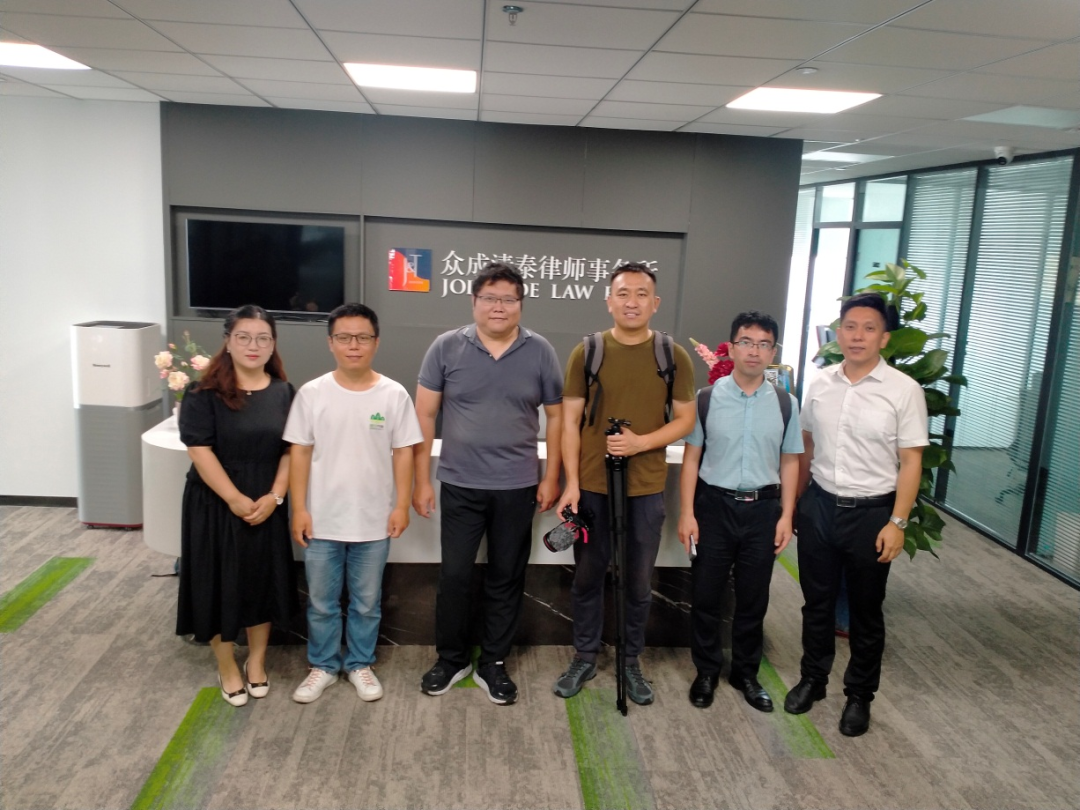
On July 17, Ouyang Mingzhe and Guo Peng, deputy directors of Shandong News Network, Guo Yongqi, executive director of Jinan Lvxing Qilu Environmental Protection Public Welfare Service Center, and Yan Zhonglai, project director, Zhongcheng Qingtai (Jinan) Law Firm, interviewed and filmed the environmental civil public interest lawsuit filed by Jinan Lvxing Qilu Environmental Protection Public Welfare Service Center as the plaintiff. This case is represented by Zhang Kai, a partner of Zhongcheng Qingtai Jinan Institute and deputy director of the Public Welfare Executive Committee. Lawyers Zhang Kai and Xue Xinxin from Jinan Institute of Zhongcheng Qingtai cordially received the film crew and took relevant photos of the case through case discussion and mock court. Because the case is still in the trial stage, the whole shooting process for the details of the case is not involved. This water pollution public interest litigation case is the first environmental public interest litigation case filed by Green Line Qilu as the plaintiff. Our public welfare lawyer team will join hands with environmental protection public welfare organizations to contribute to the protection of the ecological environment and the practice of the "two mountains" theory.
2022-07-18
17
2022-07
The Status Quo and Reasons of the Hot Digital Collections in 1. Artist Beeple's NFT encrypted art work "Everydays:The First 5000 Days" looks like a two-dimensional code from a distance, but this is the witness of the author's 13-year oil painting career. All the digital pictures of oil paintings in his creative career are collected together to actually form a new work. This composite picture has unique value. The work was sold by the auction agency Christie's for $69.34 million. This is the world's first sky-high art to be auctioned in the form of NFT. Then celebrities from all walks of life into the bureau, the international market NFT hot. NFT, all known as Non-Fungible Token, refers to non-homogenized tokens, which are the only encrypted digital tokens used to represent digital assets. Non-homogenization is different from the well-known bitcoin. NFT is not a coin, but a unified marking standard for marking digital assets, which can be traded on a platform recognized by all parties. Because of its tradable financial-like function, NFT is restricted from trading in the country in order to prevent all kinds of risks and violations that may arise. Based on the compliance review, it is called "digital collection" in the domestic market ". In October 2021-all works on Ant and Tencent's NFT platform were renamed "Digital Collections", and the NFT statement will not be repeated in the industry. After the market burst into flames, speculators have added fuel to the flames. The hot digital collections have changed their identities and playing methods. The random flowers are becoming more and more attractive. As of June 2022, there are more than 500 domestic digital collection platforms. It is estimated that the market size of China's digital collections will exceed 50 billion RMB by 2023. For digital collections, it is necessary to conduct a calm analysis, so as not to stray into the depths of the flower. 2. Digital Collections and Digital Collections Platform (I) domestic and foreign digital collections are based on blockchain technology, there are obvious differences, which is also the source of risk for investing in digital collections. One of the main differences between domestic digital collections and foreign NFTs is that foreign NFTs are based on public chains, while domestic digital collections are mostly based on alliance chains, I .e. "partially decentralized" blockchains run by some TMT (which are technology, media and communications) companies. According to the degree of decentralization, the descending order is public chain-alliance chain-private chain. The alliance chain is between the public chain and the private chain, and only communicates with part of the characteristics of blockchain technology-partial decentralization. Take the digital collection platform as an example, the user is based on the account password login platform, personal account all assets rely on the platform, rather than independent existence. If the platform fails, given that the collection does not have a physical counterpart, its digital characteristics lead to the risk of the user's digital collection disappearing. (II) Digital Collections Platform Type Customary according to the size can be divided into three categories: The first category: Ant, Tencent, Baidu, Jingdong and other Internet companies launched platforms, such as whale exploration, magic core, most of them have also developed their own block chain. With the resources and technology endorsement of large factories, the head effect of this kind of App platform is obvious. Based on the different degrees of supervision, but there are slight differences among them, Tencent's "magic core" App, represented by Tencent, has not opened a secondary market at all, and the collection cannot be transferred. Ant's "Whale Exploration" App, as the representative, has not opened a secondary market, but has set up a "transfer" function. Users can "free transfer" the collection to others after 180 days of purchase (considering the actual situation, it should be after offline transaction is completed), stimulate private secondary market demand; The second category: platforms supported by state-owned capital and official media organizations, such as Xinhua News Agency's "Xinhua Digital Tibet" platform, and "Zebra China" controlled by Chengdu TV Station, which is currently the focus of attention 」. The third category: ordinary small platform, need to third-party technology companies to buy on-chain services. The platform's income mainly comes from the primary market income of the first digital collection, but if it cannot be traded in the secondary market, the digital collection can only become a "collection" without trading value, so some platforms bring their own secondary trading market or use "consignment" and "transfer" as trading intermediaries to promote the circulation of digital collections. Therefore, the acquisition and circulation of digital collections are completely dependent on the platform and cannot be freely traded, so investment needs to be treated calmly. Intellectual Property Nature of 3. Digital Collections For music, art, pictures, models, etc. can be digitized as "collections", or works that exist in the online world can be directly converted into digital collections. For digital collections, they can be divided into the following categories: first, the digitization of cultural works of art in the real world; The second is the direct creation of digital works in the online world; The third is the integration of real world and virtual world works. The fourth is to enable a piece of work at will but the platform gives it various VIP privileges, which are called "platform enabling" works. But no matter what form it is, it can never go beyond the intellectual property rights of its creators. The digital collection of Xu Beihong's paintings released by Tencent's "magic nuclear" has triggered a copyright dispute. This set of Xu Beihong's digital ink horse collection has a total of 8 items, all of which are selected from Xu Beihong's most famous running horse theme. Each item of the collection was sold out immediately after the magic core was released in limited quantities. Xu Beihong Art Museum issued a statement stating that some of the original works of the digital collection sold by certain digital platforms in the name of Mr. Xu Beihong are counterfeit works, some cannot provide complete traceability evidence, and some works have nothing to do with Mr. Xu Beihong. And made it clear that the Magic Nuclear did not authorize the distribution of the digital collection of Xu Beihong's paintings. Magic Nuclear stated that their authorization came from the owner of Xu Beihong's works-Beijing Imperial City Art Exchange Center. The Copyright Law stipulates that the right to exhibit works of art shall be enjoyed by the owner of the original, but the transfer of ownership of the original does not change the ownership of the copyright of the work. That is to say, the original holder of the magic nuclear does not enjoy any copyright rights other than the exhibition right, although the magic nuclear defense has passed the 50-year protection period. However, if the name of Xu Beihong is not part of Xu Beihong's work, or if the part of the painting is digitized, it will involve infringement of the right of authorship and the right to protect the integrity of the work (the right to protect indefinitely), and the digitization of infringing works cannot enjoy legal rights either. Therefore, digital collections must first solve the problem of intellectual property authorization. If the relevant intellectual property rights enter the public domain beyond the protection period, another problem is that they cannot obtain exclusive rights, that is, all platforms can issue digital collections with the same content, which will cause any platform to fail to realize its promised limited distribution, and the value will inevitably be greatly reduced. In this way, it is all the more necessary for digital collection buyers to polish their eyes. All kinds of problems that need to be treated calmly in the heat of 4. digital collection The (I) platform does not comply with its commitments, and there is a risk of devaluation in excess of the number. On July 13, 2022, digital collection players found that they had grabbed the "Good-looking City Carnival" issued by a certain digital collection platform, with a limited number of 500 copies marked. However, after communicating with each other, the buyers found that the quantity was very different. After checking that they actually distributed 825 collections on the same day, the platform apologized to the buyers and compensated or refunded them. Obviously, the value of digital collections lies in their limited and rare, but given the extremely low cost of digitization, the fulfillment of their limited commitments depends entirely on the platform's own control and credibility. The low threshold for the construction of (II) digital collection platforms has led to the proliferation of various platforms. 30000 yuan can build the digital collection platform of H5 web page in 3 days, and then connect to the alliance chain to provide the chain service to operate. So since the digital collection heat wave is bound to inspire all kinds of small and medium-sized platforms have been launched, but will eventually be a big wave of sand, digital collection platform is ultimately the credibility of the winner, but after all, squandering gradually attractive eyes, easy to produce all kinds of trading risks. Digital collections should look for platforms with good reputation to trade, and should not be swallowed by bait for immediate benefits. (III) digital collection dealers manipulate prices, collectors cut leeks Digital collection dealers often first attract users with low-priced collections, and then make high-priced transactions to attract users to buy at high prices and become caterers. When the user sells the collection, there is no one to take the dish, and the leeks are cut and locked up smoothly. For investors committed to digital collections can not be ignored, so such transaction regulators are not yet able to intervene, easy to be done into the set. If suspected of fraud and other economic crimes, should immediately report to deal with the loss. (IV) digital collections have intellectual property defects, resulting in no collection value The digital collection itself is plagiarized and belongs to infringing works, which can not be protected after digitization. Its value is equal to zero. Therefore, the purchase of digital collections should verify the legality and authenticity of copyright authorization, to avoid a basket of water. Since copyright has 17 rights, even if there is a real authorization, it is necessary to see whether there are necessary rights of reproduction, distribution and information network dissemination, or consult professional lawyers for review. (V) digital collections can only confirm the digital collection itself, but cannot confirm the identity of the owner, stolen difficult to recover Like Jay Chou's "boring ape" stolen incident is not a case. "Although the digital signature technology used in the blockchain ensures that the private key is difficult to break, hackers still have a way to obtain user information. Once it is acquired, the transaction defaults to the right to dispose of it. After the digital collection changes hands, it is impossible to judge the true identity of the holder, so the "boring ape" has been resold many times and cannot be recovered. The security of digital collections remains a problem, is not foolproof, is not traceable, and since the consideration paid by the trader can claim bona fide acquisition. 5. meta-universe is just a mapping of the real world, and more rules are needed to form a square circle. Some people are excited to see the arrival of the era of "meta-universe", but it is actually just a mapping of the real world, and it is also a process manipulated by people in the real world. Of course, it is inevitably related to the real world and cannot get rid of laws, regulations, and policies. Constraints. The digital collection industry is in the ascendant and is conducive to the dissemination of works and value realization, but the rules always lag behind reality, there is still no unified regulatory standards and regulations, the competent authorities have not defined, it is more difficult to form a collaborative regulatory force, resulting in frequent risks, which is also one of the reasons for this paper's cold thinking about the hot phenomenon. On April 26 this year, the China Internet Finance Association and other three departments jointly issued the "Initiative on Preventing Financial Risks Related to NFT", which clearly proposed to eliminate the financialization risks of NFT and reconfirmed the restriction of its financial functions. In April this year, the China Mobile Communications Federation Yuanuniverse Industry Committee issued the "self-discipline requirements on standardizing the healthy development of the digital collection industry", which raised the issue of competition order and market stability. On June 30, cultural central enterprises, IP institutions and nearly 30 Internet technology companies such as Ant, Tencent, Baidu and Jingdong jointly launched the "Digital Collection Industry Self-discipline Development Initiative" in Beijing to oppose secondary transactions and speculation and reach a consensus on promoting high-quality development of the industry. Public power organs, state-owned institutions, science and technology enterprises have realized the original growth of all kinds of chaos, some people in the risk of seeking money to wander the edge, some people get chestnuts in the fire, both lose, some people get stuck as they wish to cut leeks ...... It seems that in the complex interest disputes really need to think calmly.
2022-07-17
16
2022-07
On July 16, 2022, all colleagues in Zhongcheng Qingtai Jinan region gathered in the office area of Jinan China Resources Building to hold a 2022 work summary meeting for the first half of the year, summarize and sort out the work results of the first half of the year, arrange the work tasks for the second half of the year, and jointly seek a blueprint for future development. The meeting, with the theme of "inheriting and keeping the right and striving for progress", was held in the form of a combination of online and offline, and was presided over by lawyer Shi Guangbo, deputy director of Zhongcheng Qingtai Jinan Regional Management Committee. The meeting began with a welcoming ceremony for the new 21 colleagues. The new colleagues introduced themselves and made their entry speeches one by one. The participants welcomed the new members to join the Zhongcheng Qingtai family with warm applause. After the welcoming ceremony, all branches of Zhongcheng Qingtai Jinan region reported their work in the first half of 2022 and put forward their work plans for the second half of 2022. In the first half of the year, all branches achieved gratifying results in business income generation, market expansion, team building, professional development, and integration of total branches, and the development trend was healthy and good. Lawyer Du Wentang, Director of Jinan Regional Administrative Committee, made a report on the work of Jinan Region in the first half of 2022 on behalf of the Administrative Committee. Director Du elaborated the theme meaning of "Inheritance, Keeping Positive and Forging Ahead", from the aspects of party building leadership, management system improvement, market expansion and business income generation, professional construction, young lawyers' growth, large-scale construction, development layout, public welfare undertakings, cultural inheritance, etc. Summarized the main work achievements in the first half of the year, put forward the existing problems and deficiencies, and put forward the work ideas for the second half of the year around the year, and arrange a number of specific tasks. Later, lawyer Geng Guoyu, director of Jinan Institute and director of Jinan Regional Strategy Committee, made a speech at the meeting. Director Geng analyzed the economic and social development situation and the development trend of the industry, and pointed out that the lawyer industry is facing challenges and opportunities in the new economic cycle environment. He affirmed the achievements of Jinan in the first half of the year, encouraged all colleagues to keep their mission in mind, keep simple and upright, adhere to professionalism, learn and practice, refine internal skills, optimize services, improve management and platform empowerment, analyze the market, strengthen learning, build professionalism and prevent risks, to be a good lawyer to the satisfaction of the party and the people. In the first half of 2022, in the face of a new round of new crown epidemic impact, domestic and foreign economic environment impact and many other uncertain factors, Zhongcheng Qingtai Jinan region still maintained a sustained, growth, good and stable development situation. The movement of Dapeng is not the lightness of a feather; the speed of Qiji is not the strength of one foot. The achievements come from the trust and support of our customers and the hard work of every colleague. In the second half of 2022, Zhongcheng Qingtai will continue to keep in mind its mission, join hands with customers, take firm steps, make persistent efforts, and strive to create a brilliant year!
2022-07-16

15
2022-07
On July 14, 2022, Yang Dongmei, Secretary of the Party Committee and General Manager of Zaozhuang Branch of Shandong Xinhua Bookstore Group Co., Ltd., Yu Guimin, Deputy General Manager, and Assistant General Manager Li Feng and Zhang Fan visited Zhongcheng Qingtai (Jinan) Law Firm for exchange and guidance. Liu Baoxi and Wang Yehua, senior partners of Zhongcheng Qingtai Jinan Institute, warmly received the visiting leaders. Lawyers Liu Baoxi and Wang Yehua extended a warm welcome to the leaders of Zaozhuang Branch of Shandong Xinhua Bookstore Group Co., Ltd., and introduced in detail the party building culture, development process and professional team of Zhongcheng Qingtai Law Firm to the leaders of Zaozhuang Branch of Xinhua Bookstore Group, and put forward new ideas and ideas for further strengthening cooperation and exchanges between the two sides. General Manager Yang Dongmei expressed his gratitude to Zhongcheng Qingtai Law Firm for the warm reception, and communicated with the cooperation between the two parties. He expressed his appreciation and affirmation of the spirit, team building and professional capabilities of Zhongcheng Qingtai lawyers, and hoped to cooperate with Zhongcheng Qingtai. Further strengthen cooperation to achieve mutual benefit and win-win results. This visit has enhanced the understanding between the two sides, and will further strengthen exchanges and cooperation in the future, seek more business convergence points, and strengthen resources and business docking.
2022-07-15

14
2022-07
1. issues raised In July 2021, the General Office of the Central Committee of the Communist Party of China and the General Office of the State Council issued the "Opinions on Further Reducing the Burden of Students' Homework and Off-campus Training in the Compulsory Education Stage" (hereinafter referred to as the "Double Reduction Policy"). Strict restrictions are imposed on extracurricular training, which makes it difficult to continue to perform the education and training contracts signed between training institutions and trainees. The situation in the contractual relationship should belong to the change of circumstances or force majeure, so the dispute between the parties to the contract should be how to allocate responsibility, the author refers to the specific case, and combined with the provisions of the law, try to do the following analysis. 2. relevant referee views As of the date of the author's completion, the keyword "double reduction policy" was searched on the China Judgment Document Network. The cause of the case chose "education and training contract dispute" and 644 judgments could be found. The author chose the representative regional court's judgment views as follows: 1. Beijing No.2 Intermediate People's Court (2022) Beijing 02 Minzhong No. 33 Civil Judgment held that xx Company failed to fulfill its obligation to provide training services as agreed. Due to the influence of the "double reduction" policy, it does not have the qualification to provide subject training, which makes Wang xx's contract purpose unable to be realized. Wang xx's request for refund of training fees and teaching materials has factual basis. 2. The Shenzhen Intermediate People's Court of Guangdong Province (2021) Yue 03 Min Zhong No. 36292 Civil Judgment holds that xx Company is unable to provide normal course teaching due to the influence of national policies in the contract involved, which is difficult to realize the purpose of the contract due to reasons not attributable to both parties. xxx has the right to apply for xx Company to assume the obligation of refund according to the agreement. 3. The People's Court of Weihai Economic and Technological Development Zone, Shandong Province (2022) Lu 1092 Minchu No. 200 Civil Judgment held that xx Education said it was unable to continue to provide course training services due to the "double reduction" policy. Zhu xx asked Bolai Company to refund the remaining training fees, which was actually a request to terminate the contract. The reason was justified and the court allowed. In other court judgments, although the reasoning part is slightly different, the judgment result is basically the same, that is, the contract cannot continue to be performed and should be terminated, and the training institution should refund the corresponding fees. It can be seen that the court basically held that the "double reduction policy" made it difficult to achieve the purpose of the contract between the two parties, the contract should be terminated at the request of the parties, the content of the unperformed is no longer performed, the two parties do not bear any responsibility, in line with the relevant provisions of the Civil Code of force majeure. 3. jurisprudence analysis 1. Article 180 of the Civil Code stipulates that force majeure is an objective situation that cannot be foreseen, avoided and overcome, and that the "double reduction policy" meets the above elements in the contractual relationship of education and training. Since the resumption of the college entrance examination in 1977, off-campus training institutions have been born together. As of the promulgation of the "double reduction policy", off-campus training institutions have been developing continuously for more than 40 years. Although the state has issued many documents to regulate, such as the implementation opinions of the Ministry of education on standardizing education fees and further controlling the work of arbitrary education fees in 2008, and the opinions on standardizing the development of off campus training institutions issued by the general office of the State Council in 2018, the above documents are aimed at emphasizing the orderly development of off campus training institutions. However, the promulgation of the "double reduction policy" has no warning at all, and its restrictions on the access rules, training time, training content and other aspects of off-campus training are also extremely strict, making it difficult for the vast majority of off-campus training institutions to continue their business. For the "double reduction policy" of the promulgation of the time and the extent of the impact, the off-campus training institutions themselves, of course, difficult to predict. "Double reduction policy" as a mandatory national policy document, out-of-school training must be fully implemented, can not be avoided or overcome. Therefore, at the objective level, the "double reduction policy" should be force majeure to the operation of off-campus training institutions. 2. The result of the "double reduction policy" in the education and training contract relationship is that the purpose of the contract cannot be realized and both parties cannot continue to perform the content of the contract, which is in line with the provisions of Article 563 of the Civil Code. The main purpose of the trainees signing the education and training contract is to use the rest day to learn subject knowledge from the school teachers hired by the training institution, and the purpose of the educational institution is to obtain benefits through subject training for the trainees. In the "double reduction policy", "existing discipline training institutions are uniformly registered as non-profit institutions", "off campus training institutions are not allowed to take up national legal holidays, rest days and winter and summer holidays to organize discipline training", "training institutions are not allowed to rob school teachers with high salaries; provisions such as" personnel engaged in subject training must have corresponding teacher qualifications "directly prohibit off-campus training institutions from hiring school teachers to conduct subject training for students on rest days. as a result, the purpose of the education and training contract signed by both parties cannot be achieved. Therefore, the "double reduction policy" should be force majeure for the education and training contract between the training institution and the trainees, and the parties have the right to change or terminate the contract. 4. legal consequences After the promulgation of the "double reduction policy", how to terminate the education and training contract signed between the training institution and the trainees, how to allocate the responsibilities between the two parties after the termination of the contract, and whether the training institution must refund all the course fees, the author thinks that it should be handled separately according to the specific situation. 1. If the training institution or the trainee proposes to terminate the contract, the contract shall be terminated when the notice of termination arrives at the other party. Article 563 of the Civil Code stipulates that the parties may terminate the contract under any of the following circumstances: (1) the purpose of the contract cannot be achieved due to force majeure. This right to terminate the contract belongs to the right of formation, which is the right of the right holder to make the civil legal relationship occur, change and eliminate according to the unilateral meaning. In the contractual relationship between education and training, the cost of class hours and the hours used are determined by both parties, and the result that the course cannot continue to be completed is relatively clear. The direct termination of the contract is conducive to the termination of the rights and obligations of both parties as soon as possible, but also conducive to saving judicial costs. After the termination of the contract, the training institution will no longer teach the trainees and shall immediately refund the cost of the unused class hours. If the training institution fails to refund within the specified time, it shall bear the corresponding liability such as paying interest and compensating the loss of the trainees according to the degree of its fault. With regard to the calculation of class hours, the price per class hour shall be calculated according to the total class hours agreed in the contract. If the contract includes a gift of lessons, if the lesson time fee is calculated according to the unit price stipulated in the contract, the lesson time fee exceeds the actual value of the course. Therefore, the donated and purchased courses can be taken as the total class hours, and the unit price per class hour can be obtained by dividing the total training fee paid by the students by the total class hours, and then multiplying the unit price by the actual course time used to obtain the training fee that the students should pay. With regard to other expenses such as teaching materials, it shall be decided whether to return them according to the actual performance. If the training institution has delivered the teaching materials to the trainees or has purchased the teaching materials for delivery to the trainees, it shall be deemed that the contract has been fulfilled. If both parties terminate the contract due to force majeure, there is no fault in the performance of the contract, and the teaching material fee shall not be refunded. If the teaching materials have not been delivered, the training institution shall be required to provide time evidence to prove the purchase of the teaching materials, such as purchase contracts, payment vouchers, etc. If the training institution cannot prove that the teaching materials have been purchased after the trainee proposes to terminate the contract, it shall be deemed that the contract has not been fulfilled and the performance shall not be continued, and the training institution shall refund the teaching material fee. 2. If the training institution or the trainees propose to terminate the contract, they shall not be liable for breach of contract. Force majeure is a statutory exemption, and article 590 of the Civil Code provides that if a party to a contract is unable to perform the contract due to force majeure, it is partially or fully exempted from liability. Even if the contract contains clauses such as "when the trainees terminate the contract in advance, the training institution can deduct the handling fee", it should not take effect, so as to prevent the trainees from being unable to safeguard their legal rights due to lack of time, money and legal knowledge. Similarly, the training institution only needs to refund the unused course fees of the trainees and is not liable for breach of contract due to the inability to provide training services. 3. The reason why the purpose of the contract cannot be realized is not entirely caused by the "double reduction policy", and the corresponding responsibility shall be borne according to the fault of both parties. Article 590 of the Civil Code If force majeure occurs after the party delays in performance, it shall not be exempted from liability for breach of contract. If the training institution is unable to provide training services normally before the promulgation of the "double reduction policy", the training institution shall bear the liability for breach of contract. In addition to refunding the lesson time fee, it shall also refund other expenses such as teaching material fee and pay corresponding liquidated damages. If the trainees fail to use the specified class hours within the time stipulated in the contract due to their own reasons, the contract cannot be performed due to the trainees' own fault, and the refunded expenses shall be calculated according to the class hours stipulated in the original contract by both parties: if the class hours stipulated in the original contract are after the promulgation of the "double reduction policy", the training institution shall refund all the expenses because they cannot be completed completely due to force majeure. Before the promulgation of the "double reduction policy" for the class hours agreed in the original contract, if both parties fail to reach a consensus on adjusting the training time, the trainees shall bear all the responsibilities, and the training institution does not need to refund the part of the class time fee. If both parties reach a consensus on adjusting the training time, the responsibility shall be distributed according to the principle of fairness and part of the class time fee may be refunded. In summary, the "double reduction policy" directly leads to the legal inability to perform the training service contract, and the relevant rules of force majeure should be applied. Under the premise of the principle of equality and fairness, the existing laws should be used flexibly to allocate the responsibilities of both parties. It is necessary to protect the interests of students, and training institutions should not be required to bear too much responsibility, so as to take into account the interests of all parties and promote the development of a harmonious society.
2022-07-14
14
2022-07
On the morning of July 14, Meng Xuefeng, Secretary of the Party group of Jinan Private Economic Development Bureau, Zhang Tao, member of the Party group and deputy director, Pei Ling, director of the statistical evaluation department, and man Xiaoyong, director of the office, visited Zhongcheng Qingtai (Jinan) law firm for discussion and exchange. Han Honggang, director of Zhongcheng Qingtai General Office, Geng Guoyu, director of Zhongcheng Qingtai Jinan Office, Zhao Kaiyong, director of the Second Real Estate Department, Zhang Kai, deputy director of the Public Welfare Executive Committee, and lawyer Xiaoyan, a partner, warmly received and held discussions. Director Geng Guoyu first introduced the basic situation of our institute, and combined with the actual situation, gave a comprehensive introduction on the way lawyers provide legal services for private enterprises, as well as the problems and suggestions in providing legal services for private enterprises. Secretary Meng Xuefeng listened to our achievements and relevant suggestions in serving private enterprises, fully affirmed his professional achievements, social welfare, and serving private enterprises, and put forward guiding suggestions on how law firms can better serve private enterprises. During the discussion, the two sides had in-depth exchanges on public welfare legal services for private enterprises, legal physical examination, promotion of legalization of private enterprises, compliance review, collective bonds and other financing methods, as well as the establishment of "think tanks" for the development of private enterprises, and the discussion achieved good results.
2022-07-14

13
2022-07
With the rapid economic and social development and the abundance of private capital, the private lending market has become increasingly active. At the same time, private lending disputes related to "professional lending" are also increasing day by day, and the identification of "professional lending" is the focus of review in such cases. There are different understandings with difficulties in judicial practice. This article will combine the Supreme Law and the relevant cases of the local court, the "professional lender" identification standards and judicial ideas to sort out, hoping to be able to handle such cases to help. 1 The concept of a professional lender. Professional lenders refer to units that have not obtained the approval of the financial regulatory authorities and do not have the qualifications to issue loans, but lend funds to unspecified objects in society to earn high interest, and the lending behavior has the characteristics of business and regularity, as well as individuals who take lending as their important source of income and regularly lend to unspecified objects and earn high interest. Professional lending and private lending are to lend money to charge interest for the behavior content, professional lending is illegal, not the content of the behavior is illegal, but its behavior is illegal, that is, the actor in the absence of financial qualifications in the case of financial institutions business mode of normal lending to non-specific objects. 2 The relevant legal provisions of professional lenders. 1. Article 1 of the Opinions of the Supreme People's Court, the Supreme People's Procuratorate, the Ministry of Public Security, and the Ministry of Justice on Several Issues Concerning the Handling of Criminal Cases of Illegal Lending, in violation of national regulations, without the approval of the regulatory authority, or beyond the scope of business, for the purpose of making profits, Regularly granting loans to unspecified objects in the society and disrupting the order of the financial market, in accordance with the provisions of item (IV) of Article 225 of the Criminal Law, convicted and punished. In the provisions of the preceding paragraph, "regularly granting loans to unspecified objects in society" refers to lending funds to unspecified people (including units and individuals) more than 10 times in the name of borrowing or other names within 2 years. 2. Article 19 of the the People's Republic of China Banking Regulatory Law No entity or individual may establish a banking financial institution or engage in the business activities of a banking financial institution without the approval of the banking regulatory authority under the State Council. 3. Article 53 of the Minutes of the National Conference on Civil and Commercial Trials of Courts A legal person who has not obtained the qualification to lend in accordance with the law to engage in private lending, as well as an unincorporated organization or natural person who engages in private lending in the form of private lending, shall be deemed invalid in accordance with the law. If the same lender engages in paid private lending multiple times within a certain period of time, it shall generally be recognized as a professional lender. 4. Article 13 of the Provisions of the Supreme People's Court on Several Issues Concerning the Application of Law in the Trial of Private Lending Cases shall be deemed invalid under any of the following circumstances: (1) taking loans from financial institutions for on-lending; (II) on-lending funds obtained by borrowing from other profit-making legal persons, raising funds from employees of the unit, or illegally absorbing deposits from the public; (III) lenders who have not obtained the qualification to lend in accordance with the law provide loans to unspecified objects in society for the purpose of profit; (IV) the lender knows or should know in advance that the borrower's loan is used for illegal and criminal activities and still provides loans; (V) violates the mandatory provisions of laws and administrative regulations; (VI) violates public order and good customs. 5. Zhejiang Higher People's Court, Zhejiang Provincial People's Procuratorate, Zhejiang Provincial Public Security Department, etc.<依法严厉打击与民间借贷相关的刑事犯罪强化民间借贷协同治理的会议纪要>Article 2 of the Notice is included in the "List of Professional Lenders", and the following conditions should generally be met: 1. Based on the number of cases closed for three consecutive years, the same or related plaintiffs are involved in more than 20 private lending cases in civil litigation in the same basic court (including pre-litigation mediation, the same for the following), or more than 30 private lending cases in civil litigation in the same intermediate court and the basic courts under the jurisdiction; 2. In the same year, the same or related plaintiff is involved in more than 10 private lending cases in the civil litigation of the same basic court, or more than 15 private lending cases in the civil litigation of the same intermediate court and the basic courts of the jurisdiction; 3. In the same year, the same or related plaintiffs are involved in more than 5 private lending cases in the same intermediate court and the basic courts under their jurisdiction with a cumulative amount of more than 1 million yuan, or more than 3 private lending cases with a cumulative amount of more than 10 million yuan; 4. If two or more of the following conditions are met and the number of cases reaches more than half of the provisions of items 1 and 2, it can also be identified as a professional lender:(1) the debit note is in a uniform format;(2) The defendant defends that the plaintiff is not the actual lender or the plaintiff requires the principal and interest to be paid to a third party;(3) The principal of the loan is claimed to be delivered in cash without other evidence;(4) The interest on the loan is withheld when the principal is delivered or the interest actually paid by the defendant is significantly higher than the agreed interest;(5) The plaintiff himself refuses to appear in court without justifiable reasons or makes a false statement of the facts of the case when he appears in court. 6. "Opinions of the Higher People's Court of Jiangsu Province on Establishing a List System of Suspected Professional Lenders (for Trial Implementation)" Article 2 When trying private lending cases, the first thing to do is to inquire about related cases. The same lender and its actual controlled related parties are the plaintiffs. If there are more than 5 private lending cases sued by the people's courts at all levels in the province within one year, the lender shall be included in the list of suspected professional lenders. Those who can be preliminarily identified as professional lenders through the trial of cases or other means shall not be subject to the above-mentioned restrictions on the number of cases. 7, "Tianjin Higher People's Court on the issuance.<天津法院民间借贷案件审理指南(试行)>Article 21 of the Notice of the Lender who has not obtained the qualification to lend in accordance with the law and has repeatedly engaged in paid private lending within a certain period of time may generally be deemed to constitute a professional lending act. Private lending contracts formed as a result of professional lending practices are invalid. Professional lending is business and for-profit. In the trial of private lending cases, it is possible to comprehensively determine whether the lender is commercial according to the number of times the lender lends within a certain period of time, the number of private lending cases brought by the same plaintiff or related plaintiffs, the degree of formatting of the loan contract, whether the lender publicly promotes, publicizes or expressly indicates the willingness to lend, the amount of borrowing and interest, and other factors. If the same plaintiff or related plaintiff files more than 5 private lending cases with the city's courts within two years, or if the lender lends funds to an unspecific person in society more than 3 times within two years, it can generally be determined that the lender's lending behavior is commercial. If the loan contract stipulates interest, service fees, consulting fees, management fees, liquidated damages and other related expenses, or if the borrower has actually paid the above-mentioned expenses, the lender shall be determined to lend the money for profit. Occasional lending by a lender whose primary or day-to-day business does not involve lending, or by a lender who does not lend for profit on the basis of a human relationship, does not constitute a professional lending practice. 8. The Intermediate People's Court of Rizhao City, Shandong Province "Implementation Opinions on Establishing a List System of Suspected Professional Lenders" The same plaintiff sued more than 5 private lending cases in this court within one year, or the same plaintiff sued private lending in different courts within one year. More than 10 cases, or more than 15 plaintiffs in different courts in the city in the past three years, will be included in the "List of Suspected Professional Lenders". 3 The Judicial Identification Standard of Professional Lenders (1) Determination of the number of private lending cases filed from the same plaintiff or associated plaintiff. The economic development of different regions is different, and the provisions on the number of cases involved by the lender are different, which should be determined in accordance with the relevant provisions of the region and in combination with the relevant jurisprudence of the region. [Case] (2021) Lu 14 Min Zhong No. 867 Zhang Wulin, Cui Shuangshuang and Other Private Loan Disputes In the opinion of the Court, Zhang Wulin advocated that Yin Yuanhao lend usury, arbitrage transfer, to lend as a business, the guarantee loan contract is invalid. After investigation, from August 2013 to January 2019, "Yin Yuanhao and his wife Liu Lanying" were 6 cases involving private loans for the plaintiff, with a total amount of 14 cases as high as 3.85 million yuan. In the second instance, Yin Yuanhao admitted that the 400000 yuan loan used in this case was a loan from Xia Xiangdong; and (2020) Lu 1424 Minchu No. 1475, this case and (2015) Linshang Chuzi No. 1327, 1328 cases 7 loans are standard contracts, agreed to interest, comprehensive rates, late fees, liquidated damages and other disguised high interest charges. Yin Yuanhao and his wife Liu Lanying have repeatedly engaged in paid private lending for a certain period of time, so Yin Yuanhao should be identified as a professional lender in accordance with the law, and the 400000 yuan loan contract between him and Zhang Wulin is invalid. [Case] (2021) Lu 14 Min Zhong 1291 Sun Baosheng and Shi Pingping Dispute over Right of Recourse The Court believes that from 2015 to 2021, Xiao Dezhi and Yuan Chunzhen, as plaintiffs, had a total of 10 private lending cases within the jurisdiction of Dezhou Intermediate People's Court, and the loan contracts in the 10 cases were all unified standard contracts. Xiao Dezhi and Yuan Chunzhen's behavior of lending money to unspecified people many times does not conform to the normal state of private lending between natural persons, and its characteristics of lending as a business are obvious. Comprehensive investigation of the litigation cases in the form of borrowing, interest rate agreement, etc., the Court determined that Xiao Dezhi, Yuan Chunzhen belongs to professional lenders, its loan contract signed with Sun Baosheng, Shi Pingping invalid. (2) From the lender's behavior. The formatting of the loan contract, the public publicity of the borrower's willingness to lend, the actual payment of interest greater than the agreed payment of interest, etc., may be recognized as a professional lender even if the amount and number of cases involved do not meet the relevant standards. [Case] (2020) Supreme Famin Shen No. 5797, Wei Feng and Li Jun Guarantee Contract Dispute Case The Court believes that, first of all, according to the facts ascertained 1. the second instance of this case, in addition to this case, it has been ascertained that Wei Feng had a total of 9 loan contract disputes involving litigation from 2013 to 2015, involving a loan amount of more than 0.1 billion yuan, indicating that Wei Feng had provided loans to others many times during this period, and the loan amount was huge, and his borrowing behavior was repetitive. The monthly interest rate agreed upon in each loan contract is relatively stable, and the liquidated damages after overdue are charged at 2 ‰ per day, indicating that the loan contract format signed by Wei Feng with others is stable and used repeatedly. In terms of the content of the interest and default payment stipulated in the loan contract, Wei Feng's interest on borrowing from others and the interest on the default payment have reached the upper limit of the legal protection of the private lending interest rate, and his behavior has a business nature. [Case] (2019) Yu 08 Min Zhong No. 2695 Li Shengli and Zhang Ying, Cao Mingjiang and Han Jinghui Dispute over Loan Guarantee Contract The court believes that since 2016, Li Shengli has filed 39 lawsuits in the court of first instance and the people's court of Shanyang district of Jiaozuo city over private loans, guarantee contracts and implementation objections, involving 121 person-times, and these personnel have no significant characteristics, which is sufficient to confirm the fact that Li Shengli is providing funds to unspecified groups of people in the society. In the whole process of lending funds, the loan contract, IOU, receipt and so on are highly stylized, and only need to fill in the main contents such as the name and amount of the borrower, which can also reflect Li Shengli's business characteristics of taking borrowing as his business... Judging from the above characteristics, Li Shengli should belong to a professional lender. (3) From the relationship between the lender and the borrower. Professional lenders lend to social non-specific objects, that is, the borrower and the lender do not have a relationship, kinship and other specific relationships. [Case] (2019) Supreme Famin Shen No. 1500 Wang Hua and Wang Guochen Private Lending Dispute The court held that Wang Guochen made reasonable explanations for the large number and large amount of bank transactions, such as 142 bank financial transfers, 191 cash withdrawals at the counter, 25 transfers between Wang Guochen and his spouse Qi Moumou, 18 mutual transfers of bank cards under Wang Guochen's own name, and 6 bank card purchases. Wang Hua argued that Wang Guochen had no evidence to prove that "as many as 71 people were involved in the transaction", and he failed to submit evidence of the identity of Wang Guochen as a "professional lender" by the relevant authorities. To sum up the above three points, for the Wang Guochen Bank has a large number of transactions and a large amount, the possibility of its legal capital transactions cannot be ruled out, nor can it be determined in this case that Wang Guochen's behavior is a "professional lender. [Case] (2020) Lu 14 Min Zhong No. 3287 Li Hu and Shandong Magi Food Co., Ltd. confirmed the dispute over the invalidity of the contract The Court held that Li Hu and Shandong Maggie Food Co., Ltd. argued that the original judgment was wrong in the application of the law, that Wei Haibing belonged to a professional lender, and that the private lending contract involved in the case should be invalid, for which the existing evidence was not sufficient to prove it. Professional lenders are those who do not have the approval of the financial regulatory authorities, do not have the qualifications to issue loans, and use lending as an important source of income for a certain period of time, and regularly lend to unspecified objects in order to earn high interest rates. Lending behavior is repetitive and recurring, and the purpose of borrowing is business. In this case, the loan relationship involved the person involved in the case has a family relationship and is not a socially unspecified object. The appellee also made a corresponding explanation of the financial transactions with others. The evidence given by the appellant does not prove that Wei Haibing has the above-mentioned characteristics in the professional lender's determination. The appellant also did not provide evidence of the identity of Wei Haibing's professional lender by the relevant authorities. During the trial of the second instance, the appellant did not have new facts and reasons, nor did he submit valid evidence to support his claim. The court did not support the appellant's appeal request. Conclusion After the lender is identified as a professional lender, the relevant loan contract is invalid, but the borrower shall still return the principal portion of the loan to the lender. For the lender, being identified as a professional lender is not only a loss of interest, but also may be investigated for criminal responsibility for the crime of illegal business operation according to the relevant provisions of the Supreme people's Court, the Supreme people's Procuratorate, the Ministry of Public Security and the Ministry of Justice. In addition, professional lenders are often prone to "routine loan" fraud, illegal fund-raising, usury, intentional injury, illegal detention, intentional destruction of property, provocation and other criminal acts, need to pay attention to the relevant risks.</天津法院民间借贷案件审理指南(试行)></依法严厉打击与民间借贷相关的刑事犯罪强化民间借贷协同治理的会议纪要>
2022-07-13

Zhongcheng Qingtai Jinan Region
Address: Floor 55-57, Jinan China Resources Center, 11111 Jingshi Road, Lixia District, Jinan City, Shandong Province
