


27
2023-03
The first creditors' meeting of Shandong Jirui Real Estate Co., Ltd. was successfully held.
At 9:30 a.m. on March 24, 2023, under the auspices of the People's Court of Jiyang District, Jinan City, the first creditors' meeting for bankruptcy liquidation of Shandong Jirui Real Estate Co., Ltd. (hereinafter referred to as Jirui Real Estate or debtor) was successfully held. The meeting was held through a combination of online and offline, and the voting items were passed with a high vote rate, and the agenda of the meeting was successfully completed. On December 26, 2022, the People's Court of Jiyang District, based on the application of the Jirui Real Estate Liquidation Group, ruled to accept the bankruptcy liquidation case of Jirui Real Estate, and appointed Shandong Zhongcheng Qingtai (Jinan) Law Firm and Shandong Zhenlu Certified Public Accountants Co., Ltd. Served as the joint manager of Jirui Company. At the meeting, the administrator made the "Phased Work Report on Performing Duties", "Report on Requiring the Creditors' Meeting to Verify Creditors' Claims", "Report on Requiring the Creditors' Meeting to Review the Administrator's Remuneration Plan", "Property Management and Price Revaluation Plan", etc. And submitted to the creditors' meeting for deliberation. After all the voting creditors voted, the voting proposal was passed with a high vote in favor, and the agenda was successfully completed. After accepting the appointment as a member of the manager of this case, Shandong Zhongcheng Qingtai (Jinan) Law Firm has always adhered to the working principle of "according to law, standardization, efficiency and fairness", and completed all tasks diligently and dutifully: received and reviewed all declared claims in accordance with the law; carefully and comprehensively investigated all the debtor's property, carried out proper management, and promoted other work in accordance with the plan and requirements. The working methods and attitudes of Zhongcheng Qingtai lawyers with diligence, loyalty, and active communication have won unanimous praise from the people's courts and creditors. Zhongcheng Qingtai (Jinan) Law Firm Introduction to the Insolvency Legal Affairs Team As a provincial-level bankruptcy administrator, Zhongcheng Qingtai Jinan Institute has accumulated rich theoretical and practical experience in bankruptcy business in recent years, and the bankruptcy cases it undertakes have been highly appraised and recognized by relevant courts, competent authorities, creditors and so on. it has made positive efforts for Shandong Province to implement the new concept of development, promote the transformation of new and old kinetic energy in Shandong Province, and promote high-quality economic development. Zhongcheng Qingtai Jinan Institute will continue to give full play to its service advantages of specialization, teamwork and standardization, actively undertake important and difficult bankruptcy cases in Shandong Province, focus on the center, serve the overall situation, and have the courage to take responsibility, so as to contribute to the construction of a high-quality modern economic system. Representative Performance: The case of merger and reorganization of 27 companies including Qixing Group Co., Ltd. Shandong Zhonghong Real Estate Limited Bankruptcy Liquidation Case Reorganization Case of Linyi Beicheng Real Estate Co., Ltd. Pre-reorganization of Qingdao Jialongteng Real Estate Co., Ltd. Pre-reorganization of Linyi Ludi Shanhua Tourism Development Co., Ltd. Yangxin Eurasia Group Co., Ltd. and other 23 companies merger and reorganization case. Shandong Shengda Coating Materials Co., Ltd. and other five companies merger and reorganization case. Shandong University of Science and Technology Dingxin Electronic Technology Co., Ltd. and other four companies merged and reorganized. Merger and reorganization of 12 companies including Baoshida International Holding Group Co., Ltd. Shandong Yuehai Zizun Real Estate Co., Ltd. and other 14 companies merged and reorganized. Juye County Jinxu Real Estate Development Co., Ltd. bankruptcy reorganization case. Leling Yutai Real Estate Development Co., Ltd. bankruptcy liquidation case. Reorganization of Rizhao Huayi Construction Engineering Co., Ltd. Heze Guangyuan Copper Belt Co., Ltd. Reorganization Case Case of Bankruptcy Liquidation of Jinan Casting and Forging Machinery Research Institute Co., Ltd. Shandong Bogda Real Estate Co., Ltd. bankruptcy liquidation case. Jinan Shanghe County Weaving Factory Bankruptcy Liquidation Case Jinan Sunshine Real Estate Co., Ltd. bankruptcy liquidation case. Jinan Sanchuan Eco-tourism Development Co., Ltd. Bankruptcy Liquidation Case Shandong Yizhi Real Estate Development Co., Ltd. bankruptcy liquidation case. Juye Evergrande Real Estate Co., Ltd. bankruptcy liquidation case. Bankruptcy Liquidation Case of Binzhou Hongtai Real Estate Co., Ltd. Jiangsu Runyuan Shan County Real Estate Co., Ltd. bankruptcy liquidation case. Shandong Huicheng Chemical Co., Ltd. Bankruptcy Liquidation Case Bankruptcy Liquidation Case of Shandong Timber Group Corporation Bankruptcy and Liquidation Case of Shandong Production Material Corporation Jinan Fudi Wood Co., Ltd. Bankruptcy Settlement Bankruptcy and Liquidation of Yankuang Group Continental Machinery Co., Ltd. Shandong Jiutiangong Ejiao Products Co., Ltd. Bankruptcy Liquidation Case
2023-03-27

23
2023-03
With the promotion of urbanization and infrastructure development in China, people have higher demand for urban infrastructure. As part of the infrastructure, street lights, garden lights and other lighting facilities have evolved from simply providing traditional lighting to providing beautifying the urban landscape, enhancing the image of the city and the role of traditional lighting. In recent years, among the newly-built infrastructure facilities in various cities, lighting facilities with different images and diversified functions have repeatedly become the highlights that attract people's attention; at the same time, in the development process of lighting facilities, they are not only faced with legal issues common to traditional manufacturing industries, such as contract disputes, bidding business, etc., but also faced with legal affairs related to technology and design, such as intellectual property layout, rights protection, etc, zhongcheng Qingtai Jinan Institute of Wisdom Lighting Industry Team has various professional backgrounds, theoretical knowledge and practical experience related to it, and can provide customers with full-process legal services. The "14th Five-Year Plan for National Urban Infrastructure Construction" determines that infrastructure should promote a green and low-carbon model, improve the safety and durability of facilities; at the same time, adjust measures to local conditions and implement policies in accordance with the city to improve the level of intelligent management and control of urban infrastructure construction and operation, and improve Infrastructure supply quality and operational efficiency. This means that urban infrastructure, including lighting facilities, will further develop towards intelligence, differentiation and high-end. The smart street lamp industry is a subdivision industry in infrastructure construction, but the problems involved are complex and comprehensive. In addition to the legal issues related to traditional manufacturing, as a technology-intensive industry, it also involves inventions and industrial design. Furthermore, related intellectual property issues such as patents, copyrights, and trade secrets are highlighted. In this process, enterprises should do a good job in the layout of intellectual property rights, so that their products have market competitiveness. At the same time, it can also effectively bind itself and not be tainted by others; at the same time, with the development of China's infrastructure, the infringement of lighting facilities is gradually increasing, how to protect their own rights more effectively, is also a difficult problem in front of the right holders. In addition, in the process of research and development, production and market development, how to avoid the risk of infringing on the rights of others is also a problem that cannot be ignored. In addition to legal education, the lawyers of the intelligent lighting industry team of Zhongcheng Qingtai Jinan Institute all have science and engineering education background. Before practicing as a lawyer, the team lawyers worked as engineers in famous enterprises and institutions in China, or worked in judicial organs for many years, and have rich experience in science and technology and judicial practice. The team lawyers have been deeply engaged in legal services related to the smart lighting industry for more than ten years. They can provide high-quality and efficient legal services in the whole process from product design, intellectual property layout to rights maintenance and prevention of malicious competition from competitors. Over the years, they have represented hundreds of cases nationwide for famous lighting enterprises in our province, which not only recovered a lot of economic losses, but also effectively enhanced the popularity and reputation of the client's products in the industry. Team Member Profile Mou Xun Senior partner, director of the second department of Jinan known production, leader of the intelligent lighting industry team. Expert of the Expert Committee of the Intellectual Property Case Guidance Research (Beijing) Base of the Supreme People's Court, member of the Intellectual Property Professional Committee of the National Lawyers Association, and chairman of the supervisor of the Shandong Patent Agency Industry Association. With the qualification of lawyer and patent agent, he has unique advantages and rich practical experience in enterprise patent strategy design, risk diagnosis, patent writing and application, patent invalidation, infringement litigation, integrated circuit layout design, etc. The cases handled have been selected into the Supreme People's Court's 2019 China Court Technology Intellectual Property Typical Cases, Shandong Higher People's Court's 2019 Top Ten Intellectual Property Cases, Jinan Intermediate People's Court's 2019 Top Ten Typical Intellectual Property Cases, Supreme People's Court's 2018 Typical Intellectual Property Cases, Shandong Higher People's Court's 2018 Typical Intellectual Property Cases, State Intellectual Property Office's 2018 Ten Typical Patent Administrative Protection Cases, the lawyer team led by lawyer Mou Xun is listed in the TOP10 of 2017 patent civil litigation and TOP10 of 2018 trademark civil litigation jointly launched by the Ministry of IPRdaily. Ma Xuqian Practicing lawyer, Bachelor of Law from Shandong Normal University, has worked in a municipal judicial organ for many years and has rich practical experience. The successful case was selected as one of the "Top Ten Intellectual Property Administrative Litigation Cases in China"; it has successively provided legal services to many famous companies such as Luneng Group, Shandong Energy Group, Jinan Samsung Lighting Technology Co., Ltd., and Shandong Chuangwei Group. Zhu Bin Practicing lawyer, patent agent, member of the Intellectual Property Law Business Committee of Shandong Lawyers Association, and a bachelor's degree in computer science. He has been deeply involved in intellectual property cases for more than ten years, and has handled hundreds of professional intellectual property cases. In addition, he has handled a large number of regular cases such as marriage and family, traffic accidents, labor disputes, and damage compensation. He has rich experience in litigation. Mao Xiang Teacher of Shandong University of Political Science and Law, part-time lawyer, Doctor of Law of Zhongnan University of Economics and Law; holds the qualification of patent agent, and has a bachelor's degree in geological engineering. The field of teaching research and practice is mainly intellectual property law. He has represented many intellectual property rights litigation cases, participated in a number of policy and legislative research projects in Shandong Province and Guangdong Province as the main writer, and published many journal papers. Corning Trainee lawyer, Master of Law, Shandong University of Finance and Economics. He has worked successively in a provincial judicial organ and a grass-roots government organ, and has rich practical experience.
2023-03-23

23
2023-03
[Abstract]] In practice, in order to transfer or avoid the owner's project payment risk, construction enterprises often agree with the sub-supplier "back-to-back" contract terms. The legal nature and effect of "back-to-back" contract terms are controversial, and there are no uniform rules of judicial adjudication. The author thinks that the key to identify and deal with the "back-to-back" contract terms should be based on the basic principles of good faith, fairness and reasonableness, and to prevent the abuse of the "back-to-back" contract terms. Construction enterprises should pay attention to the design and application of "back-to-back" contract clauses in specific contracts, and actively and properly solve the disputes caused by "back-to-back" contract clauses. Subject words] Construction enterprise sub-supplier "back-to-back" contract terms. Since 2019, real estate policy and market changes, coupled with the superimposed effect of the new crown epidemic, have put greater market pressure on construction companies. At the same time, the "downstream" sub-suppliers of construction enterprises are increasingly lacking reasonable "patience" for their receivables, and the number of litigation or arbitration disputes against construction enterprises by sub-suppliers has increased significantly, which has created a greater "squeeze" pressure on construction enterprises. In order to transfer or avoid the owner's project payment risk, construction enterprises often agree on "back-to-back" contract terms with sub-suppliers. On the basis of combing the manifestation, nature and effect of the "back-to-back" contract terms, this paper puts forward some opinions and suggestions on the design and application of the "back-to-back" contract terms of construction enterprises, and actively and properly solves the disputes caused by the "back-to-back" contract terms. The form of "back-to-back" contract terms between 1. construction enterprises and sub-suppliers. In this paper, the sub-supplier of construction enterprises is not a strict concept of legal subject, mainly refers to the construction enterprises in its contracted construction projects of subcontracting, subcontracting, affiliated units or individuals, as well as materials, equipment, labor supply units or individuals and other broader subjects. "Back-to-back" contract terms appear in contracts of a variety of natures, such as subcontracting, subcontracting, affiliation, sale and lease, between construction enterprises and sub-suppliers. And "back-to-back" contract terms are not clearly defined in law. Therefore, in practice, the "back-to-back" contract terms are expressed in a variety of forms, the following are several common forms of expression: 1, the owner to the construction enterprise payment is a prerequisite for the construction enterprise to pay the sub-supplier. In the case of "(2020) Supreme Court Minzhong No. 106", the subcontracting contract stipulates that "60% of the completion settlement amount of the subcontracting project shall be paid within 45 days after the completion settlement and the final audit entrusted by the employer is qualified (and the contractor has received the corresponding project payment from the employer for 15 working days)... If the construction unit (employer) fails to pay the contractor on time, the contractor fails to pay the subcontractor according to the time agreed in the contract. When the project payment, it is not considered a breach of contract by the contractor". Shanghai No. 2 Intermediate People's Court "(2021) Hu 02 Min Zhong No. 392" case in the subcontracting contract stipulates that "if the construction unit fails to pay the project progress payment and project settlement payment to Party A, the period for Party A to pay the project progress payment and project settlement payment to Party B shall be extended accordingly, and Party A shall not be liable for breach of contract". 2. The settlement price of the subcontract is based on the settlement price between the construction enterprise and the owner, and a certain percentage of the "floating rate" or "management fee" is taken ". In the case of "(2008) Zhe Min Yi Zhong Zi No. 192" of Zhejiang Higher People's Court, it is stipulated in the subcontract that "the relevant settlement shall be subject to the terms of the contract and settlement basis signed between Party A and Party C (the owner's unit)"; (2021) Su 13 Min Zhong No. 1107 "case of Suqian Intermediate People's Court of Jiangsu Province stipulates in the team contract that" the total contract price of the project is provisional, and the final price shall be subject to the audit price of the audit unit after completion and acceptance, and the downward floating rate of the project concession is 5.7. The project valuation method is implemented by the national 2004 list valuation standard and Jiangsu Province 2004 valuation table, and the relevant funds are implemented by the terms of the construction party's large contract ". 3. The settlement and payment of the sub-supplier shall be carried out in accordance with the settlement and payment agreed in the contract between the construction enterprise and the owner. In this case, there is often a "back-to-back" contract clause "agreement is unclear. In the case of "(2021) Beijing 03 Minzong No. 7492" of Beijing No.3 Intermediate People's Court, the subcontract stipulated that "the contract between Party A and Hesheng Company shall be attached to the contract (the payment method shall be paid according to the back-to-back payment method between Party A and Hesheng Contract)". The court held that "there is no specific agreement on the back-to-back payment method, so it shall be deemed that both parties to be unclear"; in the case of "(2008) Zhe Min Yi Zhong Zi No. 192" of Zhejiang Higher People's Court, the subcontracting contract stipulates that "the relevant settlement shall be subject to the contract terms and settlement basis signed by Party A and Party C (the owner unit)", but it does not stipulate a specific payment time. The court does not support the construction enterprise that "the project price involved in the case shall be subject to the payment time determined in the general contracting contract, the claim that the conditions under which the sub-supplier demanded payment for the work were not fulfilled. 4, serial sales contract, lease contract in the "back-to-back" contract terms. "Back-to-back" contract terms are commonly found in layers of subcontracted construction contracts, but in contract practice, "back-to-back" clauses also appear in serial sales contracts and lease contracts, and their manifestations are similar to those in construction contracts. The "back-to-back" contract terms are similar, and the essence of the terms is still the agreement of the buyer to transfer the risk to the seller. In the case of "(2021) Supreme Fa Min Shen No. 5750" of the Supreme People's Court, the second paragraph of Article 9 of the procurement contract stipulates that "Party B (Sinopec Fujian Branch) shall pay the full purchase price within 2 working days after receiving the end-user payment and the VAT invoice issued by Party A (Advanced Oil Depot Company) according to the settlement quantity". The legal nature of the "back-to-back" contract terms between 2. construction enterprises and sub-suppliers. Regarding the legal nature of "back-to-back" contract clauses, there are currently three views: conditional clauses, term clauses and neither conditional nor term clauses. (I) conditional terms Some viewpoints hold that whether the owner can pay the construction enterprise project funds is an uncertain fact, whether it will eventually happen and when it will happen are uncertain. Therefore, the nature of "back-to-back" contract clauses should be determined as conditional clauses according to Articles 158 and 159 of the Civil Code. Whether the agreed payment terms are fulfilled determines whether the sub-suppliers' payment claims should be supported. In the case of Ji Min Wu Zhong Zi No. 182 (2014) of Jinan Intermediate People's Court of Shandong Province, the court held: "Judging from the smooth performance of the contract and the purpose of agreeing on this clause, Shandong Road and Bridge Company's general contract for the project of Section I of Liangji Canal Bridge Project on Taibelou West Road in Jining City amounts to more than 0.2 billion yuan. If Shandong Road and Bridge Company needs to pay the subcontractor in advance before receiving the payment from the owner, shandong Road and Bridge Company is very difficult to have such ability to pay. Therefore, it was agreed that Shandong Road and Bridge Company would pay Chongqing Zhixiang Company after receiving the payment from the owner for the subcontracted project, which was conducive to the smooth performance of the contract and was equivalent to sharing the risk between the two parties. Article 15.5 of the contract stipulates:" Party A shall pay the project funds to Party B in a timely manner after receiving the project funds allocated by the owner. If the owner unit fails to allocate Party A's project funds in time, Party A has the obligation to actively pursue the project funds from the owner, but Party A shall not bear any liquidated damages and interest caused by the delay in payment to Party B. "The agreement also reflects from the side that Chongqing Zhixiang Company agrees that Shandong Road and Bridge Company will pay the project funds to Chongqing Zhixiang Company after receiving the project funds paid by the owner. From the perspective of trading habits and the principle of good faith, Shandong Road and Bridge Company applies for the owner to pay the project payment period by period according to the project progress and the quantities completed by each subcontractor. The supervision unit issues the payment certificate after examination. The owner allocates the project payment to Shandong Road and Bridge Company according to the payment certificate, and Shandong Road and Bridge Company pays the project payment to the relevant subcontractors according to the payment certificate. To sum up, although Chongqing Zhixiang Company's construction project has been completed and delivered to the acceptance, Shandong Road and Bridge Company has also applied for the owner to pay the corresponding amount, but whether the owner pays the corresponding amount determines whether Shandong Road and Bridge Company's payment terms are fulfilled and whether Chongqing Zhixiang Company's payment claim should be supported". (II) term clause The view is that the owner's payment is a fact of certainty and that the owner's payment of the works is only a matter of the length of the payment period, so the nature of the "back-to-back" contract clause should be recognized as a term clause in accordance with the provisions of Article 160 of the Civil Code. The problem with this view is that there is no clear deadline for the contractor to obtain payment from the owner, and in practice construction companies often take measures to delay the payment deadline and evade their obligation to pay to the sub-supplier. "However, in the contract with a time limit in Article 46 of the Contract Law, there is no provision for the parties to improperly accelerate or delay the arrival of the time limit, which makes the subcontractor unable to rely on when facing the general contractor maliciously evading the payment obligation. The provisions of Article 45, paragraph 2, of the Contract Law have to be applied by analogy, causing embarrassment in the application of the law". (III) is neither conditional nor term. According to this view, the conditions and time limit stipulated in Articles 159 and 160 of the Civil Code refer to the conditions and time limit attached to civil legal acts, and the achievement of the conditions determines the entry into force or expiration of the civil legal act, and the arrival of the time limit determines the entry into force or expiration of the civil legal act. If the "back-to-back" contract terms are understood as the conditions and periods attached to civil legal acts, then the entire subcontract has not yet entered into force or the entire "back-to-back" contract terms have not yet entered into force before the attached conditions are fulfilled or the attached period arrives, which is obviously contrary to the original intention of the construction enterprise to formulate the "back-to-back" contract terms. Therefore, the "back-to-back" contract clause is neither conditional nor term clause, it is only the agreement of the parties to the contract on the time of payment. The author agrees with this view. If the "back-to-back" contract terms are understood as the conditional terms and term terms stipulated in Articles 59 and 160 of the Civil Code, then the "back-to-back" contract terms stipulated in the subcontract have not yet taken effect before the attached conditions are fulfilled or the term expires. At this time, the construction enterprise cannot oppose the payment request of the sub-supplier according to the "back-to-back" contract terms, obviously contrary to the original intention of the construction enterprise to enter into "back-to-back" contract terms. "The 'back-to-back' clause, as a clause in the subcontract, is clearly not an 'attached condition' of the subcontract as a whole, and does not affect the validity of the subcontract as a whole, whether or not the owner makes the corresponding payment". Therefore, the "back-to-back" contract clause is neither conditional nor a term clause, it is only the agreement of the parties to the contract to pay, is the construction enterprise in order to reduce or exempt itself from liability for breach of contract to develop a risk-sharing clause. 3. the validity of "back-to-back" contract terms between construction enterprises and sub-suppliers As for the validity of the "back-to-back" contract terms, currently only the "Beijing Higher People's Court's Answers to Several Difficult Questions about the Trial of Construction Contract Dispute Cases" (Jinggao Fa [2012] No. 245) affirms the validity of the "back-to-back" contract terms. Article 22 of the "Answers" stipulates: "The subcontract stipulates that after the settlement between the general contractor and the employer and the employer pay the project payment, if the general contractor then pays the subcontractor for the work, the agreement is valid. If the subcontractor is unable to obtain the project funds in time due to the delay in settlement or delay in exercising its due claims, the subcontractor shall support the subcontractor's request for the general contractor to pay the outstanding project funds. The general contractor bears the burden of proof for the settlement between it and the contractor and the fact that the contractor has paid for the work". However, there are different views on the validity of "back-to-back" contract clauses in judicial practice. (I) analysis of the terms of the "back-to-back" contract itself. 1, hold the view that its effectiveness is affirmed. (1) The terms of the "back-to-back" contract are in line with the principle of party autonomy and do not violate the mandatory provisions of the law. The parties enter into a contract with their true intentions, as long as they do not violate the mandatory provisions of laws and regulations and shall be valid. In the case of Dan Min Yi Zhong Zi No. 00442 of the Intermediate People's Court of Dandong City, Liaoning Province (2015), the court held: "The subcontract between the appellant China Metallurgical Geological Exploration Company and the appellee China Metallurgical Shen Exploration Company stipulates that the general contractor will pay the project fund to the subcontractor after the general contractor and the employer have settled the project fund and the employer has paid the project fund. The content of this clause does not violate the mandatory provisions of the law, It is the consensus of both parties' judgment on the risk, according to the agreement made by the well-known industry rules and construction habits of the construction market, this clause reflects the autonomy of the parties, conforms to the principle of voluntary equality in civil law, and should be a valid clause." (2) In a "buyer's market" environment, the existence of "back-to-back" contract terms is reasonable. In the case of Sanmin Zhongzi No. 199 (2014) of the Intermediate People's Court of Sanmenxia City, Henan Province, the court held: "In the current construction market environment where the construction market is in an absolute buyer's market, the owners are large, and the phenomenon of owners defaulting on the project price is becoming more and more common, in order to transfer the risk that the owners cannot pay, construction enterprises set up clauses in subcontracts with' the premise of owner payment', usually called back clauses, the clause has a certain rationality and legality, so the agreement is valid." In Beijing Haidian District People's Court (2019) Beijing 0108 Minchu No. 17584 case, the court also held that "Article 6, paragraph 3 of the subcontract involved stipulates that' if the owner unit delays the payment time to Party A, Party A will postpone the payment to Party B '. This agreement is to transfer the risk that the general contractor cannot pay the owner in the current market environment where the construction market is in the buyer's market and the owner defaults on the project payment, however, the clause of' presupposes payment by the owner' is set in the subcontract, which is usually called" back-to-back "clause. This clause has certain rationality and legality, so the agreement is valid. However, if the subcontractor fails to obtain the project payment in time due to the delay in settlement or delay in exercising its due creditor's rights, the subcontractor requires the subcontractor to pay the overdue project payment, it shall be supported." (3) The terms of the "back-to-back" contract are in line with the trading habits and the principle of good faith and should be considered legal and valid. In the Jinan Intermediate People's Court (2014) Jimin Wuzong Zi No. 182 case, the court held: "The back-to-back clause agreed by both parties reflects from the side that Chongqing Zhixiang Company agrees to Shandong Road and Bridge Company to pay the project payment to Chongqing Zhixiang Company after receiving the project payment from the owner for the subcontracted project. From the point of view of trading habits and the principle of good faith, Shandong Road and Bridge Company applies to the owner for payment of the project funds period by period according to the project progress and the quantities completed by each subcontractor. The supervision unit issues the payment certificate after examination. The owner allocates the project funds to Shandong Road and Bridge Company according to the payment certificate, and Shandong Road and Bridge Company pays the project funds to the relevant subcontractors according to the payment certificate." 2. Hold the view that negates its effectiveness "Back-to-back" contract terms are the "buyer's market" in which construction companies take advantage of their dominant position,
2023-03-23
23
2023-03
In order to further deepen the cooperative relationship, give full play to the leading role of party building, enhance the awareness of party members to operate in accordance with the law and operate in compliance, and promote the steady development of rural commercial banks, recently, the party branch of the Dongcheng branch of the CPC Jinan Rural Commercial Bank Co., Ltd. and the seventh party branch of the CPC Shandong Zhongcheng Qingtai (Jinan) Law Firm signed an agreement on party building and co-construction. Lawyer Tang Xiangdong fully affirmed the results of the sincere cooperation between the two parties and the significance of this party building and co-construction activity, and gave expectations for the next step of party building and co-construction between the two parties. In the event, the party branches of the two sides conducted in-depth exchanges on their respective business development cooperation needs, and signed a party building agreement. Zhongcheng Qingtai (Jinan) Law Firm thoroughly implemented the business development model led by party building. In this cooperation, Lawyer Zhao Bin gave an in-depth explanation on the impact of the Civil Code on banking business, and focused on the key points that should be grasped in the two aspects of property rights and contracts. In the Q & A session, the account manager of the Rural Commercial Bank seized the opportunity to face-to-face with the lawyer to consult on common contracts, mortgages and other issues in daily work, and the lawyer gave detailed answers.
2023-03-23

23
2023-03
The wind contains new ideas, and spring comes to life. At 9: 48 on March 23, 2023, the commencement ceremony of fine decoration of the newly expanded office floor of Zhongcheng Qingtai (Jinan) Law Firm was successfully held on the 57th floor of China Resources Building, 11111 Jingshi Road! Du Wentang, director of the administrative committee of Zhongcheng Qingtai (Jinan) Law Firm, He Zefeng, deputy director, Ma Shibin, member of the administrative committee, and partners Huang Zhangcun and Jin Feng jointly opened the important moment of the commencement ceremony of the renovation of the newly expanded office! Director of Management Committee of Zhongcheng Qingtai (Jinan) Law Firm Du Wentang knocked on the corner and started the commencement ceremony. In order to meet the needs of large-scale and professional development of law firms, Zhongcheng Qingtai (Jinan) Law Firm newly purchased the 57th floor of China Resources Building for office use. After the decoration is completed, the office area of Jinan CBD China Resources Building will be used continuously on the 55,56 and 57 floors. The office area of nearly 7,000 square meters is all self-owned. It is committed to creating a more high-end, comfortable and modern office environment for lawyers and providing professional and high-quality legal services for customers. 2023 is the first year to fully implement the spirit of the 20th National Congress of the Communist Party of China, and the year when Zhongcheng Qingtai set sail for development. Zhongcheng Qingtai (Jinan) law firm will continue to take root in the professional, deep-cultivated field, drop son star Han. In the future, we will, as always, seize the opportunity and take advantage of the situation! Do not forget your initiative mind, go forward bravely!
2023-03-23

22
2023-03
Viewpoint... The application of bankruptcy claims set-off rights and legal analysis.
The application of the right of set-off of 1. bankruptcy claims. The debt claimed by the (I) must be established before the bankruptcy petition is accepted. Article 40 of the Enterprise Bankruptcy Law stipulates: "If a creditor has a debt to the debtor before the bankruptcy petition is accepted, it may claim set-off from the administrator". When creditors learn that their debtors are on the verge of bankruptcy or have filed for bankruptcy, most creditors will try to pre-empt individual settlement. Therefore, Article 40 of the Enterprise Bankruptcy Law strictly stipulates the time of establishment of the debt claimed by the bankruptcy set-off right, and the debt established before the bankruptcy application is accepted can exercise the right of bankruptcy set-off. (II) claims for set-off are subject to confirmation in insolvency proceedings According to the basic principle of set-off, the parties claim that set-off should be based on the clear and undisputed amount of mutual negative claims and debts. Specifically, in bankruptcy set-off, the active creditor's rights claimed by the parties must also be the bankruptcy creditor's rights confirmed by bankruptcy procedures. Otherwise, the preconditions for bankruptcy set-off are not met. Even if the parties apply to the administrator for bankruptcy set-off, the set-off claim is not established, thus the issue of whether and when bankruptcy set-off takes effect is not involved. (III) insolvency set-off rights do not have a prohibition of set-off. Article 40 of the Enterprise Bankruptcy Law stipulates: "...... shall not be set off under any of the following circumstances: (1) the debtor of the debtor obtains the creditor's rights of others against the debtor after the bankruptcy petition is accepted; (II) the creditor is aware of the fact that the debtor is unable to pay off the debts due or the bankruptcy petition and is liable to the debtor; however, except for the creditor who bears the debt because of the law or the reasons that occurred one year before the bankruptcy application; (III) the debtor of the debtor knows that the debtor is unable to pay off the debts due or the bankruptcy application, he obtains the creditor's rights against the debtor; however, the debtor of the debtor obtains the creditor's rights because of the law or the reasons that occurred one year before the bankruptcy application. Article 40, paragraph 1, of the Enterprise Bankruptcy Law once again clarifies the issue of the time of establishment of the debt in paragraph 1, and the debt that can be set off in bankruptcy is limited to the amount established before the bankruptcy petition is accepted. After the bankruptcy of the debtor, some creditors can only be partially paid off or even unable to be paid off. If the debtor of the bankrupt enterprise buys the creditor's rights from other creditors of the bankrupt enterprise at a relatively low price at this time, and then eliminates its obligation to pay off the bankrupt enterprise by claiming the right of set-off, it will damage the fair compensation rights of other creditors. Article 40, paragraph 2, of the Enterprise Bankruptcy Law makes it clear that the malicious liabilities of creditors cannot be offset. If it is known that the bankrupt enterprise is unable to pay off the debts due or has filed an application for bankruptcy, it is still liable to the debtor, and it is presumed in law that the creditor intends to exercise the right of set-off and in bad faith to bear the debt to the debtor, which shall not be set off. There is an exception to this paragraph, I .e., if a creditor is burdened with a debt for reasons specified by law or for reasons that occurred one year before the application for bankruptcy, it may be considered that the creditor is not in bad faith and is not prohibited by law. Article 40, paragraph 3, of the Enterprise Bankruptcy Law makes it clear that claims acquired in bad faith by the debtor's debtor cannot be set off. If the debtor of the debtor's business is allowed to offset the creditor's rights obtained against the debtor's debts with the debtor's debts when he knows that the debtor is unable to pay off the debts due or has filed an application for bankruptcy, it means that the debtor of the debtor's business is relieved of its debt service obligations, and its claims are paid off in priority, thus damaging the fair compensation rights of other creditors. Article 44 of the (II) Provisions of the Supreme People's Court on Several Issues Concerning the Application of the the People's Republic of China Enterprise Bankruptcy Law stipulates that if, within six months before the bankruptcy application is accepted, the debtor is unable to pay off its due debts, is insolvent or obviously lacks solvency, but still pays off individual creditors under the circumstances of paragraphs 2 and 3 of Article 40 of the Enterprise Bankruptcy Law, if the administrator files a lawsuit with the people's court within three months from the date of acceptance of the bankruptcy application, the set-off shall be invalid. The right of set-off of (IV) bankruptcy is not limited by the maturity of the debt, the type of the subject matter, etc. According to the provisions of Article 43 of the (II) of the Supreme People's Court on Several Issues Concerning the Application of the the People's Republic of China Enterprise Bankruptcy Law, the exercise of the right of set-off in bankruptcy is different from the exercise of the right of set-off in civil law, and the set-off of bankruptcy claims is not subject to the restriction of whether the debt is due or not, nor does it require the same type and quality of the subject matter of the debt. 2. guidance case The retrial applicant Sichuan Jiaxin Trading Co., Ltd. (Jiaxin Company) and the respondent Minfa Securities Co., Ltd. (Minfa Securities), the third party in the first instance, Shanghai Hante Enterprise Development Co., Ltd. (Hante Company), and the third party in the first instance, Shanghai Feige Industrial Co., Ltd. (Feige Company). Case No. (2016) Supreme Famin No. 404 (I) basic case On September 26, 2003, Feige and Schwab signed a "Transfer Agreement", agreeing that Feige will transfer 8983 standard natural rubber warehouse receipts to Schwab at a transfer price of $808470000, and Schwab will compensate Feige's warehouse receipts for an expected return of $205935275, totaling $1014405275. Later, from October 23 to November 6, 2003, Hante Company transferred 1014405275 yuan to Schwab Company in 16 times. Schwab Company transferred all the funds to Feige Company on the same day, and Feige Company transferred the warehouse receipts to Schwab Company. The above-mentioned transactions after investigation, confirmed that the above-mentioned transactions are false transactions, the flow of funds and water system cycle reverse account formation, the transaction of Hante Company, Feige Company are the actual wholly-owned holding company of Minfa Securities. Later, Carlson disposed of all warehouse receipts and received a price of $575947704.97. In addition, there is a real financial exchange between Schwab and Minfa Securities, which owes Schwab 425500000 yuan and interest. After the risk of Minfa Securities broke out, the state set up a working group to carry out the administrative clean-up of custody; on July 8, 2008, the Fuzhou Intermediate people's Court ruled to accept the bankruptcy case of Minfa Securities and transferred it to bankruptcy liquidation. On January 8, 2009, the manager of Minfa Securities sued Jiaxin Company in order to collect foreign claims, requiring Jiaxin Company to pay 1014405275 yuan for the transfer of warehouse receipts to Minfa Securities, and 698905275 yuan and interest on the arrears after the exchange of 315500000 yuan between the two parties. After the judgment of the Fuzhou Intermediate Court of the first instance, both parties appealed. The second instance revoked the original judgment and sent it back for retrial. In the first instance, the application for change of Minfa Securities was retried, requiring Jiaxin to return the warehouse receipt. If it cannot be returned, it will compensate for the loss at the market price. After the first trial of the retrial, it was decided that the contract between the two parties was invalid due to violation of the law. Jiaxin Company paid Minfa Securities warehouse receipt disposal amount of 575947704.97 yuan and interest. Schwab appealed to the Fujian High Court against the judgment of the first instance, demanding that the difference between the two parties' financial transactions be offset by 425500000 yuan in the return of the warehouse receipt disposal. After hearing, the court of second instance held that there was no evidence to prove that Schwab had declared creditor's rights to the manager of Minfa securities, and there was no evidence to prove that Schwab had issued a notice of claiming offset to the manager of Minfa securities. Moreover, both parties still had disputes over the amount of creditor's rights of capital exchange, which did not belong to the same legal relationship as the case and did not belong to the trial court of the case. Therefore, the first instance. Schwab refused to accept the judgment of the second instance and applied to the Supreme Court for a retrial. The retrial of Jiaxin Company held that Jiaxin Company had already issued a notice of set-off to Minfa Securities, and in the first instance, Minfa Securities took the initiative to request set-off in the application. Both parties carried out reconciliation in the first instance, and the non-objection part was confirmed. Minfa Securities replied that the creditor's rights and debts of the capital exchange between the two parties have nothing to do with this case and should be dealt with separately. Minfa Securities has never agreed to Schwab's claim of offset. Moreover, Schwab's liabilities to Minfa Securities occurred only after the court determined that the contract was invalid. After the court accepted the bankruptcy of Minfa Securities, they shall not be offset according to the provisions of the Enterprise Bankruptcy Law. Moreover, Minfa, no bankruptcy set-off claims were received either. (II) focus of controversy The focus of the dispute in the retrial of this case is: Should Schwab's claim of 425500000 yuan to Minfa Securities be supported by its claim to offset the amount payable to Minfa Securities? (III) judicial viewpoint The retrial court, in combination with the actual situation of the case, divided the focus of the dispute as follows: 1) As to whether Schwab has declared claims and claims of set-off? The retrial court held that the bankruptcy liquidation of Minfa Securities has gone through two stages of administrative liquidation and bankruptcy liquidation, which should be treated as an organic whole. The expressions of intent of both parties in each stage can be regarded as the handling of the relationship between creditor's rights and debts, and its litigation claims and reasons also reflect that Minfa Securities has objections to the amount of offset claimed by Jiaxin. It can therefore be concluded that Schwab has claimed a claim against Minfa Securities and claimed an offset. 2) Is the claim that Schwab claims to set off a claim that cannot be set off? According to article 40 of the Enterprise Bankruptcy Law, the debts allowed to be set off in insolvency proceedings shall be debts already incurred prior to the acceptance of insolvency and shall not be the three non-set-off circumstances provided for in paragraph 2. In this case, the debts claimed by Schwab Company to be offset occurred between 2001 and 2005, while the bankruptcy case of Minfa Securities was accepted on July 8, 2008, which is in line with the creditor's rights that can be offset under the bankruptcy law. 3) Can different types of claims claim bankruptcy set-off? In this case, the claims claimed by Minfa Securities to Jiaxin Company are based on the legal relationship of return compensation after the transfer agreement is invalid, and the liabilities of Minfa Securities to Jiaxin Company are based on the legal relationship of the exchange of funds between the two parties, not the creditor's rights and debts arising from the same legal relationship. However, according to article 43 of the Judicial Interpretation II of the Bankruptcy Law, the claims and debts set off in bankruptcy need not be of the same type and the same legal relationship. Therefore, in this case, the creditor's rights and debts between Schwab and Minfa Securities are not based on the same legal relationship and do not affect the bankruptcy set-off. 4) Does this case constitute an initiative by the administrator to set off? Article 41, paragraph 2, of the Judicial Interpretation II of the Bankruptcy Law stipulates that the administrator shall not voluntarily claim to set off claims and debts. The legislative purpose is to consider the right of set-off as a right of creditors and can be allowed to exercise or give up. However, the administrator's initiative to claim set-off will benefit individual creditors, reduce the bankruptcy property, objectively disadvantage the majority of bankruptcy creditors, and is inconsistent with the administrator's duty to act for the common interests of rights creditors. In this case, Minfa Securities filed a lawsuit after the outbreak of securities risk, the task force intervened in the reconciliation with Jiaxin Company, and the manager of Minfa Securities filed a lawsuit to collect external claims and increase the debtor's property, which should not be identified as constituting the administrator's active exercise of the right of bankruptcy set-off. 5) Does not set-off in this case lead to obvious unfair consequences? The normative intent of the bankruptcy set-off system is to simplify the mutual payment relationship between the parties and prevent non-objection litigation, and to prevent the unfairness of the creditor's debt to the bankrupt enterprise after the debtor's enterprise has been declared bankrupt, and the claim can only be paid in proportion. In this case, the trial court asked Schwab to claim its rights separately not only violated the normative intent of the bankruptcy set-off right system, but even the unjust result that Schwab could not be paid off at the same time as the full repayment of the warehouse receipts involved in the case. To sum up, the Supreme Court retrial judgment: in support of Schwab's claim to exercise the right of bankruptcy set-off, Schwab paid 150447704.97 yuan and interest payable after set-off to Minfa Securities. 3. relevant legal provisions the People's Republic of China Enterprise Bankruptcy Law Article 4 Where a creditor claims the set-off of claims and debts, it shall comply with the circumstances stipulated in Article 40 of the Enterprise Bankruptcy Law, except for those that have been set-off in accordance with the relevant laws before the implementation of the Enterprise Bankruptcy Law. Article 40 If a creditor has a debt to the debtor before the bankruptcy petition is accepted, it may claim set-off with the administrator. However, no set-off shall be allowed under any of the following circumstances: The debtor of the (I) debtor obtains the creditor's rights of others against the debtor after the bankruptcy petition is accepted; (II) the creditor is aware of the fact that the debtor is unable to pay off the debts due or the bankruptcy application, it is liable to the debtor; however, the creditor is liable for the debt because of the law or for reasons that occurred one year before the bankruptcy application; (III) the debtor's debtor acquires a claim against the debtor if it is aware of the fact that the debtor is unable to pay its debts as they fall due or that the bankruptcy petition is filed; except where the debtor's debtor acquires the claim because of the provisions of the law or for reasons that occurred one year before the bankruptcy petition. (II) of the Provisions of the Supreme People's Court on Several Issues Concerning the Application of the the People's Republic of China Enterprise Bankruptcy Law Article 41 When a creditor exercises the right of set-off in accordance with the provisions of Article 40 of the Enterprise Bankruptcy Law, it shall make a claim of set-off to the administrator. The administrator shall not take the initiative to set off the mutual liabilities of the debtor and creditors, except to the extent that the set-off benefits the debtor's property. Article 42 After the administrator receives the notice from the creditor claiming the debt set-off, if there is no objection after examination, the set-off shall take effect from the date of receipt of the notice by the administrator. If the administrator has an objection to the claim of set-off, it shall file a lawsuit in the people's court within the agreed time limit for the objection or within three months from the date of receiving the notice of claiming the debt set-off. If it is filed within the time limit without justifiable reasons, the people's court shall not support it. If the people's court decides to reject the invalid set-off claim brought by the administrator, the set-off shall take effect from the date on which the administrator receives the notice claiming the set-off of the debt. Article 43 The people's court shall not support the creditor's claim for set-off and the administrator raises objection for the following reasons: (1) when the bankruptcy application is accepted, the debt owed by the debtor to the creditor has not yet expired; When the (II) bankruptcy application is accepted, the debt owed by the creditor to the debtor has not yet expired; The (III) parties have different types and qualities of the subject matter of mutual liabilities. Article 44 Within six months before the acceptance of the bankruptcy application, the debtor has the circumstances specified in the first paragraph of Article 2 of the Enterprise Bankruptcy Law, and the debtor and individual creditors pay off the individual creditors by offset, and the offset claims and debts belong to one of the circumstances specified in items (2) and (III) of Article 40 of the Enterprise Bankruptcy Law. The administrator shall file a lawsuit with the people's court within three months from the date of acceptance of the bankruptcy application, claiming that the offset, the people's court should support it.
2023-03-22
20
2023-03
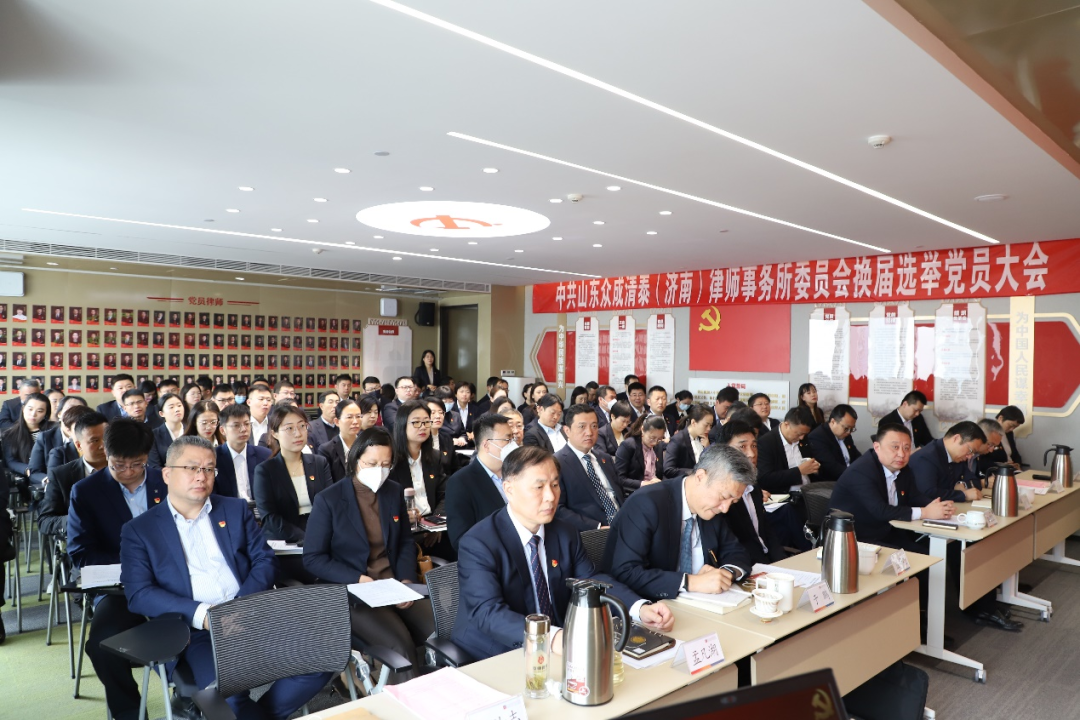
On March 25, 2023, the general election meeting of the committee of the CPC Shandong Zhongcheng Qingtai (Jinan) Law Firm was held in the party member activity room of the law firm. Comrade Zhuang Xuliang, deputy secretary of the Party Committee of Jinan's lawyer industry, attended the meeting to guide the meeting. The meeting was presided over by Comrade Li Ruzhi and all Party members attended the meeting. General Election Conference Site Comrade Li Ruzhi presided over the meeting According to the constitution of the Communist Party of China, the Interim Regulations on the election of grass-roots organizations of the Communist Party of China and the relevant provisions of the party's election, the term of office of the second committee of Shandong Zhongcheng Qingtai (Jinan) law firm has expired. In accordance with the deployment requirements of the party committee of the Jinan lawyer industry, a general meeting of all party members was held for a general election. Comrade Geng Guoyu's Report on the Work of the Party Committee The conference opened amid the majestic national anthem. Comrade Geng Guoyu led all party members to study the "Communiqué of the Second Plenary Session of the 20th Central Committee of the Communist Party of China" and made a work report to the conference on behalf of the Second Committee of the Shandong Zhongcheng Qingtai (Jinan) Law Firm of the Communist Party of China. Reviewed and summarized the achievements of the party building work of Zhongcheng Qingtai (Jinan) Law Firm in the past five years, and put forward suggestions for the main work of the next party committee. Comrade Geng Guoyu said: studying and implementing the spirit of the 20th CPC National Congress is an important task for party organizations at all levels for some time to come. The work of the new party committee has a long way to go. It is recommended to focus on strengthening ideology, organization, brand building, and party building guarantees. The party committee of the law firm will unite more closely under the strong leadership of the party committee of the Municipal Bureau of Justice and the party committee of the municipal lawyer industry., Around the work goals proposed by the higher-level party committee, further understand the situation, clarify responsibilities, emancipate the mind, pioneer and innovate, and do a good job of the party building of the law firm with more full work, accelerate the development of law firms and strive to build a strong international regional firm! Comrade Meng Fanhu conveys document spirit Comrade Meng Fanhu conveyed to all party members the spirit of the document "Opinions on Adhering to the Party's Overall Leadership and Strengthening Party Building in the City's Lawyers Industry (Trial)" issued by the Organization Department of the Jinan Municipal Party Committee, the United Front Work Department of the Municipal Party Committee, and the Party Committee of the Judicial Bureau. The reply of the Jinan City Lawyers Industry Party Committee on the request for instructions for the change of the party committee of the institute. Voting for elections All the party members attending the meeting unanimously adopted the election method of the Congress and the election of scrutineers and tellers, and elected the new committee of Shandong Zhongcheng Qingtai (Jinan) Law firm by secret ballot. The new party committee of the law firm is composed of nine members. After the election, the party committee of the new law firm held the first plenary meeting of the committee, elected the secretary and deputy secretary of the party committee, divided the work among the members of the party committee, and studied and deployed the focus of the work of the party committee this year. Members of the New Party Committee of the Law Firm Speech by Comrade Zhuang Xuliang, Deputy Secretary of the Party Committee of Jinan Lawyers Association Comrade Zhuang Xuliang, deputy secretary of the Party Committee of the Jinan Lawyers Association, delivered a speech, hoping that the new party committee of the law firm will take the change of office as a new starting point, continue the "spirit of benevolence", concentrate, shoulder new responsibilities and responsibilities, and forge ahead with confidence. In the new journey, the new era of meritorious service, the rule of law, the rule of law society, and the practice of promoting social and economic development and harmonious development! The general election meeting of the Committee of Shandong Zhongcheng Qingtai (Jinan) Law firm of the Communist Party of China closed with the singing of the Internationale. All party members will use this as an opportunity to continue to study the spirit of the 20th National Congress of the Communist Party of China, implement Xi Jinping's thoughts on socialism with Chinese characteristics in the new era, deeply understand the decisive significance of the "two establishments", and continuously enhance the "four consciousnesses" and strengthen the "four" Self-confidence ", achieve" two safeguards ", dare to take responsibility, act bravely, play the vanguard and exemplary role of party members, and be a good lawyer to the party and the people.
2023-03-20
17
2023-03
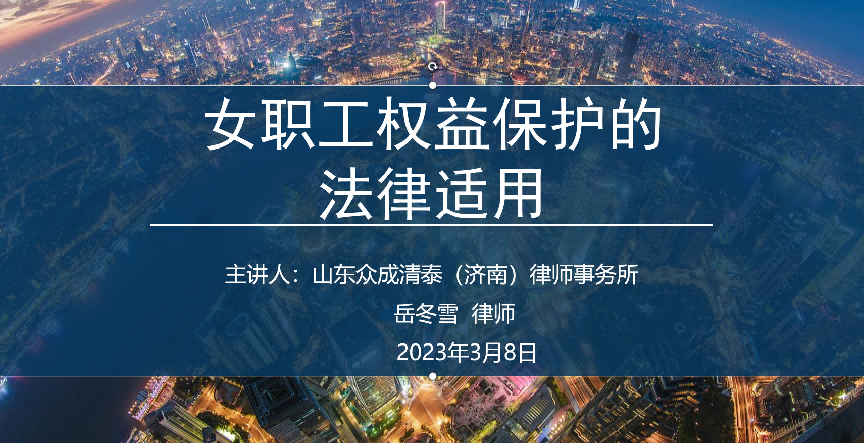
In order to thoroughly study and implement the spirit of the 20th CPC National Congress, further study and publicize the newly revised Law on the Protection of Women's Rights and interests, raise women's awareness of safeguarding their rights, and enhance women's concept of the rule of law. On March 8, 2023, lawyer Yue Dongxue, Department of Urban Construction Real Estate, Zhongcheng Qingtai (Jinan) Law Firm, was invited to give a special lecture on the protection of the rights and interests of female employees for Shandong Yiyang Health Group Marketing Planning Co., Ltd. Based on his rich experience, lawyer Yue explained in detail the legal knowledge of women's rights and interests protection through a large number of vivid cases and vivid language. He explained in detail the actual and frequent occurrences in life, such as marriage relationship, personal rights, property distribution, workers' rights and interests, and explained the law in combination with typical cases, On the risk points of women's legitimate rights and interests vulnerable to infringement, targeted analysis and explanation, guide female compatriots to learn to use legal weapons to protect their legitimate rights and interests, and patiently answer the legal questions raised by female employees. This lecture, which is simple and easy to understand, further popularizes the relevant laws and regulations on the protection of women's rights and interests, enhances the ability of women to protect their own rights and interests in accordance with the law, and has the effect of guiding women workers to respect the law, learn the law and abide by the law, and win the unanimous praise of female workers.
2023-03-17
13
2023-03
To the past to the future, Zhongcheng Qingtai 2023 Partner Conference was successfully held.
With the theme of "To the Past and to the Future", the 2023 Partner Conference of Zhongcheng Qingtai Law Firm was successfully held in Sanya, Hainan on March 11. Nearly 300 people from all partners and some specially invited personnel attended the conference. Under the full supervision of the board of supervisors, the meeting successfully completed the established agenda, summed up the past and planned for the future, laying a solid foundation for the Institute to go ahead and strive for the first. The meeting was presided over by Chairman Duan Chao. The meeting deliberated and voted on the agenda of the meeting in turn, approved the 2023 partner joining, promotion and withdrawal personnel, deliberated and approved the 2022 financial final accounts report, elected the new members of the management organization of the Exchange, approved the appointment of directors of each branch, deliberated and approved the establishment of Tibet Renbu Branch, deliberated and approved the "lawyer service fee standard" and the 2022 work report and work report of the board of supervisors, it also reviewed and approved the 2023 financial budget report, and passed the 2023 work action plan. Finally, the board of supervisors made a supervision report on this meeting. Yu Wei, deputy director of the General Office and member of the Administrative Committee, made the 2022 financial report. Zhou Jiyong, vice chairman of the partners' meeting, made a report on the establishment of the Tibet Renbu Branch. Deputy Director of the Administrative Committee Zhou Lisheng made a report on the charging standards for lawyer services. Director Han Honggang reviewed and summarized Zhongcheng Qingtai's work throughout 2022. Director Han said that in the face of severe challenges, Zhongcheng Qingtai has shown its precious potential to become the mainstream of the country. It has forged ahead in difficulties, not discouraged in the mud, and has made a series of impressive achievements and honors. In terms of party building work, under the guidance of Xi Jinping's thinking on the rule of law, under the overall planning of the party building joint meeting, various party building work has been put in place, and a total of 43 innovative achievements and 16 advanced experiences have been introduced, exceeding the plan for the beginning of the year. In terms of business development, the Strategic Development Committee provides decision-making guarantee at the first time. With the efforts of all colleagues in the institute, in 2022, it will successfully overcome difficulties with a stable development attitude and achieve the goal of stable development in the special period. While summarizing the achievements, Director Han also objectively pointed out and analyzed the existing problems of the Institute and put forward targeted solutions. Finally, Director Han proposed that the "Guangren Spirit" is the treasure of the institute. Under its guidance, we must continue to consolidate the will of the "craftsman", build the quality of the "craftsman", enhance the feelings of the family and the country, and strive to be the construction of the socialist rule of law in the new era. Practitioners, disseminators of the spirit of the rule of law, and devotees who give back to the society. Yao Huming, Chairman of the Board of Supervisors, made a report on the work of the Board of Supervisors for 2022. He said that the board of supervisors fully cooperated with the law firm in carrying out various work, supported and supervised a number of measures carried out by the headquarters and various offices, and effectively implemented the responsibilities of the board of supervisors entrusted by the articles of association. At the same time, six suggestions are put forward for the next step of the development of the law firm, involving the overall integrated development of the law firm, the level of specialization, the standardization of legal products, social influence, the introduction of talents and the creation of star lawyers. Finally, the work ideas of the Board of Supervisors in 2023 are clarified from five aspects. Li Ruzhi, deputy director of the General Office and member of the Administrative Committee, made the 2023 financial budget report. Based on the Law Firm's 2021-2025 Development Outline, Director Gong Lixin, on behalf of the Management Committee, proposed the Firm's 2023 Work Action Plan. The action plan establishes the overall goal of "11117" work, namely: "1" theme-establishing the theme of leading high-quality development with high-quality party building; "1" goal-building the province's first, national first-class, internationally renowned law firm brand; "1" platform-building an industry-leading digital empowerment platform (smart party building center and Taiwan operation digital service); "1" thousand lawyers-to achieve a thousand practicing lawyers, the province's largest scale; "700 million" fees-to complete the business fee 0.7 billion. Make arrangements in six major areas: first, solidly promote the leading role of party building-overall, effective and echelon; The second is to solidly promote the enabling role of the platform-strong central office, strict wind control and high quality. The third is to solidly promote self-construction capabilities-unity, compliance and supervision; The fourth is to solidly promote the promotion of core competitiveness-to set the first place, dare to innovate and strengthen links; the fifth is to solidly promote the effectiveness of integration construction-focus, butterfly change, and breakthrough; the sixth is to solidly promote the national and international development layout-broaden the market, practical cooperation, and promote linkage. Gao Jinjun, vice chairman of the board of supervisors, made a supervision report on the meeting. The tide is flat and the broad sail is strong, taking advantage of the momentum to open up a new chapter. After three years of epidemic, this year is a crucial year for the implementation of the five-year development program of the Institute. The Institute will continue to work together, in the same direction and in the same direction. Guided by the 2023 work action plan, it will bathe in the warm spring breeze, adhere to the original intention and start again, and let the brand of "Zhongcheng Qingtai" shine again with actual achievements!
2023-03-13

12
2023-03
Introduction Penalty interest and compound interest are two professional terms with different meanings in the financial industry. They cannot be included in each other, let alone confused. As to whether financial institutions can claim compound interest on penalty interest, looking at the current relevant laws and regulations, there is no clear stipulation that "compound interest should be calculated for overdue penalty interest", but in judicial precedents, we find that in some cases, it can be supported by the court to claim compound interest for overdue penalty interest. Therefore, this paper will combine the relevant jurisprudence of the Supreme Court to sort out the decision on whether the overdue penalty interest can be calculated and compound interest, with a view to providing some ideas and guidance for the handling of similar situations in the future. The concept of 1. penalty interest and compound interest. The concept of (I) penalty interest. According to Article 25 of the "Regulations on the Administration of RMB Interest Rates" (Yinfa [1999] No. 77) issued by the People's Bank of China (hereinafter referred to as the "Regulations on the Administration of RMB Interest Rates"), overdue loans or misappropriation of loans shall be overdue or From the date of misappropriation, penalty interest shall be charged at the penalty interest rate until the principal and interest are paid off, and the penalty interest rate shall be adjusted in sections. Thus, the penalty interest is due to the borrower overdue repayment or misappropriation of the principal of the loan, by the lender to the borrower to collect punitive interest, penalty interest is mainly divided into the loan overdue penalty interest and loan misappropriation after the penalty interest two categories, this paper mainly discusses the type of penalty interest is overdue penalty interest. The calculation basis of the penalty interest comes from the agreement of the loan contract. With reference to Article 3 of the Notice of the People's Bank of China on Issues Related to RMB Loan Interest Rate (hereinafter referred to as the "Notice of Loan Interest Rate"), the penalty interest rate for overdue loans (loans that the borrower fails to repay on the date agreed in the contract) is changed from the current interest rate of 2.1 per 10,000 per day to an additional 30%-50% on the loan interest rate stated in the loan interest rate level; the penalty interest rate at which the borrower fails to use the loan for the purpose agreed in the contract has been changed from the current five-tenths-of-a-day interest rate to an additional 50-100 per cent on the level of the loan interest rate stated in the loan contract. For loans that are overdue or not used for the purpose agreed upon in the contract, interest shall be charged at the penalty interest rate from the date on which the loan is overdue or not used for the purpose agreed upon in the contract until the principal and interest are paid off. Interest that cannot be paid on time is compounded at the penalty rate. Concepts related to (II) compound interest According to Articles 20 and 21 of the "Regulations on the Administration of RMB Interest Rates", the compound interest involved in financial claims refers to "interest on interest". Specifically, the compound interest on loans refers to the interest generated by the unpaid interest on loans. It is a method of interest calculation. In addition to the interest generated by the principal, the interest generated by the principal is also calculated as interest, which is liquidated damages in nature. The basis for the calculation of compound interest is also derived from the agreement of the loan contract, and according to Article 3 of the Loan Interest Rate Notice: "For interest that cannot be paid on time, compound interest shall be charged at the penalty interest rate.", Thus, if it is during the term of the loan, compound interest is charged at the normal loan rate, and if it is after the expiration of the loan, compound interest is charged at the penalty rate. 2. Disputes over Whether Overdue Penalty Interest Can Be Compensated As mentioned earlier, compound interest is interest on the unpaid interest payable, so can compound interest still be charged for overdue penalty interest? One view is that compound interest is a punitive measure for the borrower's default interest and penalty interest, and its calculation base can include the default interest and penalty interest. However, another view is that the penalty interest already reflects the penalty for default interest, compound interest can only be calculated on the basis of interest, can not be added to the overdue penalty interest. (I) affirms that late penalties can be compounded. 1. [Case 1] (2020) Civil Judgment No. 374 of the Supreme Court The Supreme Court held that both the Liquidity Loan Contract and the Fixed Assets Loan Contract involved in the case stipulate that "the lender has the right to charge the overdue penalty interest according to the actual overdue days from the overdue date of the overdue date until the borrower pays off the principal of the loan due at maturity (the term" maturity "in this contract includes the situation where the lender announces the premature maturity of the loan)", "The interest (including normal interest, overdue penalty interest and misappropriation penalty interest) that the lender fails to pay on time shall, from the date of expiration, be compounded according to the actual number of days overdue at the overdue penalty interest rate agreed in this contract". The Regulations on the Administration of RMB Interest Rates and the Notice of the People's Bank of China on Issues Related to RMB Loan Interest Rates do not restrict banks and other financial institutions from calculating compound interest on penalties. The above agreements do not violate the mandatory provisions of laws and administrative regulations. It should be determined that Zhenghua Company and Shanghai Pudong Development Bank Guiyang Branch and Shanghai Pudong Development Bank Bijie Branch have reached an agreement on the liability for breach of contract when the loan is overdue, that is, a penalty interest is charged on the outstanding principal payable, and a compound interest is charged on the interest, including the penalty interest. 2. [Case 2] (2019) Supreme Court Civil Judgment No. 840 The Supreme Court held that the agreement in the Liquidity Loan Contract on the interest that cannot be paid on time and the penalty interest in accordance with the penalty interest rate standard to collect compound interest is the agreement of the parties and the agreement is the true intention of the parties and does not violate the law. At the same time, the debtor has not proved that the total amount of interest calculated according to the contractual method of calculating interest, penalty interest and compound interest exceeds the amount calculated according to the standard of 24% annual interest rate based on the principal amount owed, so there is no problem of excessive. Compound interest shall be calculated on the basis of unpaid interest payable and the aforementioned unpaid penalty interest payable from March 21, 2015 in accordance with the penalty interest rate standard agreed in Article 4 of the Liquidity Loan Contract until the date of full settlement of the principal and interest of this loan. (II) negative said: overdue penalty interest can not be calculated compound interest 1. [Case 1] (2019) Civil Judgment No. 1990 of the Supreme Court The Supreme Court believes that, in accordance with the relevant provisions of the People's Bank of China's Regulations on the Administration of RMB Interest Rates and the Notice on Issues Related to RMB Loan Interest Rates, the calculation base of compound interest should only be normal interest, that is, interest payable during the contract period, excluding overdue penalty interest. The Loan Contract does not explicitly agree on the calculation of compound interest on penalties and the quarterly settlement of penalties and compound interest outside the performance of the contract, so the Court does not support the above proposition. 2. [Case 2], (2020) Civil Judgment No. 145 of the Supreme Court The Supreme Court held that Article 4.4 of the "Trust Loan Contract" signed by the Foreign Economic and Trade Trust Company (Party A) and Hengfeng Silk and Satin Company (Party B) stipulates: "Party B fails to use the loan as agreed in the contract, and for the part that is not used as agreed in the contract, the interest shall be calculated at 100 on the basis of the original interest rate from the date of change of use. If Party B fails to repay the loan on time, the outstanding part of the loan shall be charged at 50% interest on the basis of the original interest rate from the date of overdue. Interest that is not paid on time is compounded at the aforementioned penalty rate. The original interest rate is the interest rate applicable before the maturity date of the loan (including the early maturity date). If the loan is both overdue and not used for the purpose agreed upon in the contract, interest is charged at the higher of the above provisions." As Hengfeng Silk Company failed to repay the loan and pay the interest on schedule, the Foreign Economic and Trade Trust Company requested to collect the penalty interest from July 3, 2017 (based on the principal of the loan in arrears of 90 million yuan, calculated at the annual interest rate of 11.325 to the date of payment) and compound interest from July 21, 2016 (based on the interest in arrears, calculated at the annual interest rate of 11.325 to the date of payment) according to the above-mentioned contract, it has been supported by the court of first instance, and its current claim that the penalty interest on the loan involved in the case should also be compounded. There is no clear contract basis. The first instance judgment is not supported and it is not improper, and the court maintains it. " 3. of Judges Meeting Opinion on Whether Late Penalty Interest Can Be Compound On both of these views, the judge's opinion in the minutes of the 20th judges' meeting of the Second Circuit Court of the Supreme People's Court in 2021 adopted the affirmative statement that penalty interest and compound interest are usually only applicable to financial lending. In financial lending, the interest during the loan period can be calculated as compound interest when there is no doubt that compound interest is calculated on the basis of the interest owed on the settlement date multiplied by the corresponding interest rate, so the calculation of compound interest is closely related to the settlement date. Penalty interest charged after the loan is overdue, because there is no interest settlement date problem, so in general there is no penalty interest calculation compound interest problem. Of course, if the loan contract has a clear agreement on the overdue interest settlement date and the collection of overdue penalty interest, there may also be the problem of penalty interest collection compound interest. In view of the fact that the current law does not prohibit the collection of compound interest on penalties, in accordance with the principle of autonomy, the parties should be allowed to make such transaction arrangements, but not exceed the statutory interest rate ceiling. Considering that a financial lending contract is usually a form contract drawn up in advance by one of the financial institutions, it is up to the financial institution to prove that it has fulfilled its obligation to prompt and explain the existence of a clause on whether the penalty interest should be and how to calculate compound interest. Advice from 4. lawyers Financial institutions need to make clear agreements on the terms of the loan contract, and cannot violate the mandatory provisions of relevant laws and administrative regulations. In particular, loan interest, late penalty interest, misappropriation penalty interest and compound interest in the loan contract need to be clearly stated to ensure that the terms can be clearly distinguished and clearly prompted. The agreement of the loan contract for the calculation of compound interest on penalties and interest cannot be claimed as the content of overdue interest, such as "interest that cannot be paid on time", "interest payable for unpaid interest" and other interest expressions with different understandings, otherwise it will bear the adverse consequences of being the provider of the format clause.
2023-03-12

Zhongcheng Qingtai Jinan Region
Address: Floor 55-57, Jinan China Resources Center, 11111 Jingshi Road, Lixia District, Jinan City, Shandong Province
