


13
2023-04
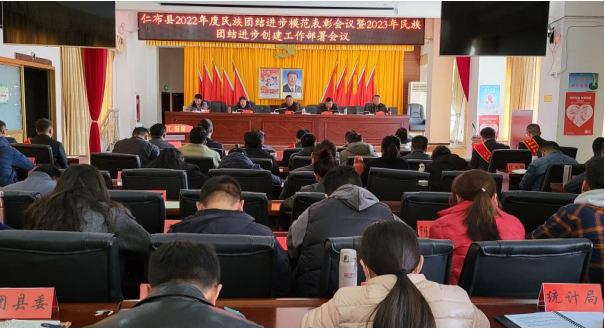
On April 11, Renbu County, Xigaze City, Tibet held the 2022 National Unity and Progress Model Commendation Conference and the 2023 National Unity and Progress Creation Work Deployment Conference. Tudeng, secretary of the county party committee, attended the meeting and delivered a speech. Leaders of the county party committee, chairman of the county CPPCC, executive deputy head of the county government, and head of the county united front work, principal responsible persons of various township and county units, directors of temple management committees, responsible persons of state-owned enterprises, representatives of the Executive Committee of the Federation of Industry and Commerce, as well as commended model collectives and individuals for national unity and progress attended the meeting. At the meeting, the 2022 Renbu County National Unity and Progress Model Collective and Model Individual were commended. Lawyer Zhang Wei of Zhongcheng Qingtai (Renbu) Law Firm won the honorary title of "2022 Renbu County National Unity Advanced Individual" and came to the stage as the award-winning representative to receive the award. General Secretary Xi Jinping's important thinking on strengthening and improving ethnic work is the crystallization of the party's ethnic work theory and practical wisdom, and the fundamental follow of the party's ethnic work in the new era. Under the leadership of the county party committee and county government, the Zhongcheng Tairenbu Branch will continue to be guided by ideology and politics, forge a sense of community of the Chinese nation, constantly enrich ways and methods, and focus on adhering to the overall national security concept, safeguarding the unity of the motherland, social stability, to make new contributions to creating a model county for ethnic unity and progress at the autonomous region level in Renbu County this year.
2023-04-13
13
2023-04
On April 11, 2023, the first special class meeting of Zhongcheng Qingtai Party Building Work was held in Zhongcheng Qingtai (Jinan) Law Firm. The meeting was held in a combination of online and offline. It was presided over by Geng Guoyu, the leader of the special team and Secretary of the Party committee of Zhongcheng Qingtai (Jinan) law firm of the Communist Party of China. All members of the special class attended the meeting. Han Honggang, director of Zhongcheng Qingtai General Office, led everyone to learn the guiding spirit of "Opinions on Party Building Leading the High-quality Development of Lawyers in the Province (Trial)", and said that it is necessary to play a leading role in party building in six aspects: politics, organization, talents, style, service and responsibility, integrate the spirit of "six leading" into all work of law firms, and enrich the connotation of party building in law firms. Yuan Jian, deputy leader of the party building special class, read out the 2023 action plan of the party building special class. The members of the special class actively made suggestions on the action plan, detailed the work of the special class, and conducted in-depth discussions on the specific implementation rules. During the exchange, Geng Guoyu introduced the party building work in Jinan region, showed the law firm's party building propaganda film, demonstrated the party building wisdom platform and the brand building of Luzheng Zhongcheng Qingtai party building, and led everyone to visit the content of the party building position construction. Tang Zongteam, deputy leader of the special team and secretary of the Qingdao Party Working Committee, introduced the construction of the "1116" party building system in Qingdao, and briefly described the work of the "Xi Jinping Rule of Law Thought Research and Practice Center" and the future overall plan. The committee members gave an overview of the party building situation of the firm, and conducted in-depth exchanges and discussions on issues related to the integration of the party building work of the law firm.
2023-04-13

11
2023-04
Among the ten typical cases of bankruptcy trial in Shandong court in 2022 and the ten typical cases of bankruptcy trial in Binzhou court from 2018 to 2022 recently announced, a total of three bankruptcy cases undertaken by Zhongcheng Qingtai were selected. Among them, the bankruptcy liquidation case of Shandong Yongan Cotton Products Co., Ltd. was selected as the top ten typical bankruptcy trials of Shandong courts in 2022, the merger and reorganization case of 27 companies such as Qixing Group Co., Ltd. and the bankruptcy reorganization case of Shandong Ocean Plastic Industry Co., Ltd. were selected as the top ten typical bankruptcy trials of Binzhou courts from 2018 to 2022. Ten Typical Cases of Bankruptcy Trial in Shandong Court in 2022-Simple Case Quick Trial Runs out of New Speed of Bankruptcy Handling-Bankruptcy Liquidation Case of Shandong Yongan Cotton Products Co., Ltd. Yong'an has a high asset-liability ratio and is a "zombie enterprise" that needs to be cleared ". In December 2021, Yong'an applied to the Jinan Zhangqiu District Court for bankruptcy liquidation. Due to the clear property status of Yongan Company and the small number of creditors, the court decided to simplify the trial procedure and let the judge alone hear the case. In January 2021, the first creditors' meeting of Yongan Company completed all voting matters in one lump sum, using the in-kind distribution method of first order, flexible disposal of the bankruptcy estate and implementation of distribution. typical meaning This case is a typical case of the implementation of the bankruptcy trial "complex and simple diversion" and the quick trial of the simple case. The case was fully studied at the bankruptcy review stage and a trial plan was developed. The selection of the insolvency representative shall be completed before the decision is accepted, and the method of trial by the judge alone and the method of variable price distribution in kind shall be applied. The case took only 33 days from the acceptance of the case to the end of the bankruptcy proceedings, which has accumulated valuable experience for the rapid liquidation of "zombie enterprises", and is currently the case with the shortest trial cycle of bankruptcy cases. Binzhou Court's Top Ten Bankruptcy Trial Typical Cases-Qixing Group Co., Ltd. and Other 27 Companies Merger and Reorganization Case basic case] Affected by comprehensive factors such as the economic situation and business management, Qixing Group Co., Ltd.'s capital chain was broken and unable to pay off its due debts. The Zouping City Court ruled to accept the bankruptcy reorganization applications of 27 affiliated companies including Qixing Group. Because the 27 companies have a high degree of mixed legal personality and the cost of distinguishing the property of the members is too high, in order to pay off the creditors fairly, according to the administrator's application, on October 20, 2017, the Zouping City Court ruled that Qixing Group and other 27 companies were merged and reorganized. referee results] On July 16, 2018, the Zouping City Court ruled to approve the merger and reorganization plan of 27 companies including Qixing Group, and terminate the reorganization procedures of 27 companies including Qixing Group Co., Ltd. typical meaning] The Zouping City Court respectively ruled to accept the bankruptcy reorganization applications of 27 companies including Qixing Group Co., Ltd., guide the administrator to conduct a comprehensive investigation and demonstration, organize hearings to fully listen to the opinions of interested parties, and innovate the application of the substantive merger and reorganization system of related enterprises, and When formulating the reorganization plan, choose to retain the main qualifications of 27 companies and formulate business plans by sector. Because the reorganization enterprise involves a large amount of financial claims, the mutual insurance and external guarantee of related enterprises involve a wide range of economic subjects, the unified consultation through the reduction of the proportion of secured claims payment, third-party claims acquisition and other ways, from the legal level to melt the associated guarantee chain, effectively prevent and control the unlimited spread of the guarantee circle. This case is a prudent application of the judicial practice of merger and reorganization of related enterprises, which reduces the cost of bankruptcy, equally protects the legitimate interests of all interested parties, and makes an effective exploration for the lifting of the guarantee circle in the reorganization of large enterprises and the resolution of regional financial risks in accordance with the law. Binzhou court ten typical cases of bankruptcy trial-Shandong Ocean Plastic Industry Co., Ltd. bankruptcy reorganization case. basic case] Shandong Ocean Plastic Industry Co., Ltd. fell into a debt crisis due to poor management and a broken capital chain, and filed an application for bankruptcy reorganization with the development zone court. Because Ocean Plastic Company has production capacity and investment conditions, the development zone court ruled to accept the reorganization of Ocean Plastic Company. application. referee results] On January 22, 2021, the Development Zone Court ruled to approve the bankruptcy reorganization plan of Ocean Plastics Company. typical meaning] Shandong Ocean Plastic Industry Co., Ltd. has production conditions and reorganization value, the development zone court actively implemented bankruptcy rescue, determined that Ocean Plastic Company to adopt the debtor's independent operation, the administrator's comprehensive supervision of the mode of bankruptcy reorganization. Continuous operation ensures the vitality of the enterprise, is conducive to the reorganization of investor recruitment, is conducive to stabilizing the mood of employees and creditors. At the same time, the legitimate rights and interests of small creditors are protected to the maximum extent by giving priority to the protection of small creditors and increasing the number of small creditors to pay off in full. This case is a typical case of judicial rescue of troubled enterprises, judicial wisdom to help enterprises to regenerate, to achieve the optimal allocation of market resources and the stable cash of claims. Over the years, Zhongcheng Qingtai has continued to make efforts in the field of bankruptcy business, formed a professional and efficient business system and a mature and stable business team, has a strong ability to handle major and complex bankruptcy cases, and enjoys a high reputation and influence in the industry. In the bankruptcy business sector of Zhongcheng Qingtai, Jinan, Qingdao, Zibo and Dezhou have the qualifications of first-class managers, Chengyang, Binzhou, West Coast and Yantai have the qualifications of second-class managers, and six lawyers, including Geng Guoyu, Li Ruzhi, Jia Maoyuan, Tang Zong, Ma Shibin and Li Xuehua, have the qualifications of personal managers. Zhongcheng Qingtai will continue to deepen its bankruptcy business, attach great importance to project quality control and talent cultivation, continue to explore and innovate, integrate resources, improve the quality and efficiency of case handling, and contribute to saving troubled enterprises and optimizing the business environment.
2023-04-11
11
2023-04
Foreword Since the concept of "smart court" was put forward in January 2016, digital reform has been gradually promoted in the field of bankruptcy trial. The National Enterprise Bankruptcy Reorganization Case Information Network (hereinafter referred to as the "Reorganization Information Network") established by the Supreme People's Court has realized the timely disclosure of bankruptcy case trial process information and announcements, legal documents, debtor information and other information related to bankruptcy procedures., So that the work of the trial court and the administrator can be supervised by creditors and debtors in a timely manner. The purpose of the establishment of the reorganization information network is to "improve the transparency and credibility of the trial", which is mainly to enable the trial court and the administrator to publish information in a timely manner, accept supervision, and have the characteristics of "externality. In addition to the reorganization information network, there are also some other bankruptcy case handling digital platforms in the market, such as "bankruptcy cloud" and "breaking easy cloud". These bankruptcy case handling digital platforms are mainly set up with management labor as the main body. At present, the main function is to receive creditor's rights declaration. However, in the process of bankruptcy case trial, besides the court and administrator, it is also inseparable from the participation and support of other social subjects such as debtors, creditors and investors, there is a great deal of communication between these subjects, such as between the administrator and the court, between the administrator and the debtor, between the administrator and the investor, between the court and the debtor, between the court and the creditors, and the interaction between these subjects is "internal". The current reorganization information network and the market bankruptcy case digital platform can not achieve effective communication between these subjects, the communication between the main body is still mainly offline, which undoubtedly increases the cost of communication between the administrator, the court and other parties, reduce the efficiency of bankruptcy case work. The purpose of this paper is to combine the daily practical work needs of the manager, to the manager's perspective for the bankruptcy case digital platform construction to put forward the idea, to build a multi-functional bankruptcy case digital platform. 1. increase the setting of the debtor sector Take the reorganization information network as an example, the current reorganization information network set up the main body of the bankruptcy case for the court, creditors, managers, investors, the lack of the debtor plate set up. The debtor is very important in the trial proceedings of bankruptcy cases. Its main obligation is to "cooperate", which is manifested in the main cooperation with the administrator, the completion of the handover of the financial and business affairs of the bankrupt enterprise, and the investigation and verification of the administrator in the course of performing his duties. Work and so on. Although the debtor is in a "relatively passive" position throughout the insolvency proceedings, the degree of cooperation and participation of the debtor sometimes directly determines the course of the insolvency case. In addition, when the court and the administrator send relevant documents and notices to the debtor enterprise in the bankruptcy proceedings, they can also be sent through the case-handling platform with one click. Therefore, it is reasonable to set up a "debtor" section to increase the transparency of the debtor's participation in the entire bankruptcy case and promote the sound development of the bankruptcy procedure. 2. improve the bankruptcy filing system settings Most of the applications in current bankruptcy cases are made by creditors or debtors submitting written materials to the court offline. When a creditor files a bankruptcy petition, the court needs to notify the debtor whether it objects. If the court accepts the application, it is necessary to serve a ruling on the debtor and require the debtor to submit to the court a statement of property status, a list of debts, a list of claims and other enterprise information materials in the possession of the debtor's enterprise. And these bankruptcy filing materials are also the first-hand information for the later administrator to understand the debtor's business information. In practice, the court issues a decision on the appointment of the administrator, and after the administrator enters the market, he will often copy the relevant bankruptcy application materials to the court at the first time. In the process of digital development of bankruptcy cases, on the premise of increasing the setting of debtor sections, an online filing system for bankruptcy cases is added, so that debtors and creditors can upload filing materials and supplementary materials, the court can send one-click notice to creditors and debtors, and the court can also send bankruptcy application materials to administrators, thus realizing digital operation in each work link, greatly saving working time and providing work efficiency. 3. set up a separate creditor system in the manager's work platform to realize one-click sending of notification information. Sending all kinds of notices to creditors in a timely manner to protect the creditors' right to know, participate and supervise is an important work of the administrator. In the whole process of bankruptcy cases, the general notice to creditors are: notice of claims declaration, notice of creditors' meeting, communication letter of verification of claims, notice of reminder to attend the meeting, etc. In current practice, most managers still send notices to creditors by traditional mail, sometimes due to local technical limitations, and the mailing slips sent to creditors are also handwritten rather than typed. And in order to ensure that creditors receive the relevant notice, the administrator will generally take the mailing bureau to ask for a receipt, their own manual query courier information in order to prove that creditors received the relevant materials. Handwritten mailing, inquiry of express delivery information, and matching of request receipt with mailing information are all aimed at ensuring that the relevant notices sent to creditors can be delivered to creditors in a timely manner and to protect the rights of creditors. If the number of creditors of the debtor's business is in the hundreds, each time the relevant notice is sent to the creditors, these repetitive tasks cost the administrator a lot of human, material and financial resources. If the creditor system can be set up separately and the manager can freely enter creditor information, no matter how many notices are sent, the relevant work can be completed by selecting the creditor and sending it with one click. Whether it is successfully sent and whether creditors receive relevant notices can also rely on technical statistics to fully realize digital development, greatly saving manpower, material resources and financial resources. In current practice, there are also some digital systems, which rely on the relevant information filled in by creditors in the creditor's rights declaration system to realize one-click notification to creditors. This operation can also improve efficiency and save time, but there are still some disadvantages: First, when the court or the administrator (in practice, the court generally entrusts the administrator to send the creditor's rights declaration notice) sends the creditor's rights declaration notice to creditors, creditors do not fill in the creditor's rights declaration system, when the first notice of claim declaration is sent to creditors, the list of creditors is often based on the list of claims provided by the enterprise, coupled with the list of creditors finalized by the administrator after taking over the enterprise through due diligence and other means. When sending the creditor's rights declaration notice for the first time, it cannot be sent by the creditor's rights declaration system. Second, in order to ensure the success of creditor's rights declaration, some creditors often fill in multiple creditor's rights in the system and use the creditor's rights declaration system to send them with one key, which will lead to the problem of repeated sending. Third, due to the limitation of technical level, some creditors often use the traditional on-site declaration or paper mail method to declare claims, at this point, using the claim filing system to send a notice to creditors would omit that part of the creditor. Therefore, the confirmation of the list of creditors should be based on the list of creditors information held and determined by the administrator itself, rather than the information of creditors in the claims declaration system. The notice to creditors should also be based on the creditor information in the administrator's own possession. 4. set up a separate employee system on the manager's work platform to publicize employee claims. Article 48 of the Enterprise Bankruptcy Law stipulates that employee claims are not required to be declared, and a list is made and publicized by the administrator after investigation. If the employee has any objection to the list, he may request the administrator to correct it; if the administrator refuses to correct it, the employee may bring a lawsuit to the people's court. According to this law, although the employee's creditor's rights are not required to be declared, the manager still needs to make public to the employee after investigation, especially if the employee has any objection to the creditor's rights, he can raise an objection, so as to protect the rights and interests of the employee. In practice, after the administrator has completed the investigation of the employee's claim, it will generally notify the employee to post the employee's claim at the domicile of the debtor's enterprise, and if the employee has any objection to the claim, it will be proposed to the administrator that if the employee has no objection to the claim, he will sign a no-objection confirmation form (or not). In bankrupt enterprises, there are often many years of unpaid wages, some employees have long been in a state of resignation, in the new unit, and then let this part of the staff back and forth to confirm the claims for employees there is a certain degree of difficulty. Therefore, the notification and confirmation of employee claims can be realized through the digital platform. Managers send their claims to employees through the platform, and employees also confirm their claims through the digital platform to achieve digital green office. 5. setting up a correlation system between the court and the administrator to realize the submission and approval of documents. In the process of performing the duties of the administrator, based on the needs of the work, some documents need to be approved by the court before they can be effectively implemented, such: on the "Request for Approval of XX Co., Ltd. Reorganization Working Mechanism Plan and Other Systems", "Request for Approval of XX Company's Public Selection of Audit and Evaluation Institutions", "Report on Request for People's Court to Ruling Confirmation of Unchallenged Creditor's Rights", "Request for Request for Extension of Approval to Submit XX Company's Reorganization Plan Draft", etc. In addition, the manager also needs to report to the court on a regular basis, such as: the manager takes over the company's work report, about XX company work briefing. In practice, when the administrator submits documents to the court, he generally makes an appointment with the host judge in advance to submit relevant materials to the court, but sometimes changes the time to submit documents to the court due to temporary matters. After the court approves, the administrator will go to the court to retrieve the relevant documents and repeat them back and forth before completing a job. However, if a correlation system is set up between the administrator and the court, the administrator can directly submit relevant documents to the court through the case handling platform, and the court will review the approval documents and then transmit them to the administrator, which can facilitate the communication between the administrator and the court and improve work efficiency. Conclusion The handling of bankruptcy cases requires the participation of multiple parties, and the construction of the digital platform for bankruptcy cases also requires the participation of multiple parties to gradually improve. The author's idea of a multi-functional bankruptcy case digital platform is only from the perspective of the manager, and puts forward the above ideas from the perspective of the most practical and efficient work. Courts, debtors, investors, and creditors should not be absent from the participation in the construction of the digital platform for bankruptcy case handling, so that the construction of the digital platform tends to be complete, so that the construction of the digital platform is not reduced to "decoration" because of its practicality ".
2023-04-11
10
2023-04
From April 6 to 7, the 2023 provincial industrial and information system city tour law popularization activity (the second session) was held in Zaozhuang City. The main purpose of this activity is to help enterprises solve the legal risks of production capacity indicators, eliminate hidden dangers of enterprise development, guide the majority of small and medium-sized enterprises to establish a sense of compliance, and provide a more solid legal guarantee for speeding up the high-quality development of industrial economy. Relevant persons in charge of the Policy and Regulations Department of the Provincial Department of Industry and Information Technology, the Raw Material Industry Department, Zaozhuang and Jining Industry and Information Technology Departments, and more than 30 cement, grinding, and flat glass companies in Zaozhuang and Jining participated in the event. Yin Huili, Zhang Qinbo, senior partners of Zhongcheng Qingtai (Jinan) Law Firm, and lawyer Li Shuang were invited to participate in this activity as members of the touring legal publicity team. The lecture was presided over by Zhang Zhibo, deputy director of the laws and regulations Department of the Provincial Department of Industry and Information Technology, and Wang Gongyong, a second-level researcher of the Raw materials Industry Department of the Provincial Department of Industry and Information Technology, explained the relevant capacity replacement policies of the cement and flat glass industries. The meeting pointed out that capacity replacement is an effective means to promote supply-side structural reform and resolve excess capacity in the cement and glass industries by means of marketization and rule of law. In recent years, the Provincial Department of industry and information technology has fully implemented the requirements of the "three resolute" deployment of the provincial Party committee and the provincial government, deepened the transformation of kinetic energy, accelerated the structural optimization and adjustment in the direction of high-end, intelligent and green, actively, steadily and orderly promoted the production capacity integration of cement and flat glass industry, and achieved good results. The symposium was presided over by Wang Kehua, Director of the Regulations Department of the Provincial Department of Industry and Information Technology. Lawyers Yin Huili, Zhang Qinbo and Li Shuang of Zhongcheng Qingtai (Jinan) Law Firm gave lectures on the legal and policy issues involved in the replacement of production capacity indicators and judicial enforcement of production capacity indicators in cement, flat glass and other industries through case statements, and gave on-site answers to common issues such as corporate governance, labor management and contract disputes, it also puts forward corresponding legal suggestions on improving the construction of legal institutions, solving historical problems and foreign-related legal disputes. As the perennial legal adviser of Shandong Provincial Department of industry and information technology, Zhongcheng Qingtai law firm will actively help the transformation of new and old kinetic energy, optimize and adjust the industrial structure, make suggestions and suggestions for promoting the stable and healthy development of enterprises, and contribute legal professional strength to the high-quality development of industrial economy in Shandong Province.
2023-04-10

10
2023-04
Foreword Under the background of the marketization of the allocation of human resources, the flow of staff in public institutions is inevitable. Because public institutions have certain social welfare attributes, the state has made different provisions on the resignation right of staff in public institutions from the Labor contract Law. The "Regulations on Personnel Management of Public Institutions", which came into effect on July 1, 2014, has become the most important legal basis for adjusting the personnel relations of public institutions. Article 17 of the Regulations stipulates: "A staff member of a public institution may terminate the employment contract upon 30 days' written notice to the institution. However, unless the two parties agree otherwise on the termination of the employment contract." This provision has become one of the most controversial legal provisions in the case of the resignation of personnel employed by public institutions. From the perspective of the employing unit, this paper combs the controversial views in judicial practice, and provides ideas for the employing unit in the face of similar situations. Text The employment contract is an agreement between the institution and the employee in accordance with the requirements of relevant national laws and regulations and related policies, on the basis of equality, voluntariness and consensus, to clarify the rights and obligations of the employer and the employed person related to the work. In practice, in order to retain talents and ensure the normal development of work, public institutions often agree with employees on the service period and the corresponding liability for breach of contract in the employment contract. When an employee unilaterally terminates the employment contract in advance in violation of the service period agreement and causes disputes, the employing unit will often require the employee to bear the liability for breach of contract in accordance with the provisions of Article 17 of the Regulations on Personnel Management of Public Institutions and the provisions of the employment contract, but the employee will usually defend against the provisions of Article 25 of the Labor Contract Law in violation of such provisions. However, there are disputes in the judicial practice on the validity of this kind of breach of contract clause, and the standard of judgment varies from place to place. One view is that, according to Article 17 of the "Regulations on Personnel Management of Public Institutions", "However, unless the parties agree otherwise on the termination of the employment contract", the public institution may make a reasonable restriction agreement on the unilateral early termination of the employment contract by the employee. Therefore, the liability for breach of contract can be agreed in the employment contract. For example, in the 2022 typical case of labor and personnel dispute arbitration issued by the Beijing Municipal Bureau of Human Resources and Social Security, in the case of a personnel dispute between a university affiliated middle school and Yao, the Arbitration Commission held that the relevant agreement between a university affiliated middle school and Yao on the termination of the employment contract and the payment of liquidated damages does not violate the mandatory provisions of laws and regulations, and is the true intention of both parties. It is binding on both parties. Therefore, Yao was ruled to pay liquidated damages to a university affiliated high school. Another example is: in the case of a personnel dispute between a university in Shijingshan and a certain person, the court held that: from the content stipulated in Article 17 of the Regulations on Personnel Management of Public Institutions, public institutions can negotiate with their staff on the specific circumstances of the termination of the employment contract and whether to assume corresponding responsibilities. According to the employment contract signed by both parties, if a party terminates the agreement in advance, it shall pay liquidated damages in accordance with the contract. The agreement does not violate the mandatory provisions of laws and regulations and shall be valid. Another example: in the case of a personnel dispute between a university in Huainan and Cheng, the court held that Cheng was a person with full capacity for civil conduct and had a high level of education. He should know the legal consequences caused by signing the contract. The contract was Cheng's choice after weighing the rights and interests of resignation and liability for breach of contract, which was his true intention. Therefore, the contract is the true intention of both parties, does not violate the mandatory provisions of laws and regulations, should be legal and effective, and has legal binding force on both parties. Therefore, Cheng's argument that the breach of contract clause is invalid cannot be established. Another view is that the "Regulations on Personnel Management of Public Institutions" does not provide for liquidated damages, so the provisions of the "Labor Contract Law" should be applied to determine that the relevant employee's unilateral early termination of the employment contract is invalid. For example, in the personnel dispute between Huaiyin Normal University and Wang, the court held that although the two parties agreed on the service period and liquidated damages in the Agreement on the Establishment, Employment and Performance of Senior Professional and Technical Posts, the agreement violated Article 25 of the Labor Contract Law, and the agreement should be invalid, so the court did not support the request according to law. Another example: In a personnel dispute between a college in Hubei and He, the court held that: Regarding the liquidated damages for the service period, although the minimum service period is stipulated in the documents of a college in Hubei and the Agreement on Entrusted Training and Studying for a Doctoral Degree, the service period The liability for breach of contract is not clearly stipulated in laws, administrative regulations or the State Council, so the court does not support the request in accordance with the law. The above two views, the author tends to the first view, that is, institutions can agree with employees in the employment contract to unilaterally terminate the contract of breach of contract, and the agreement has legal effect. The main reasons are as follows: According to Article 96 of the Labor Contract Law and Article 1 of the Reply of the Supreme People's Court on the Application of Laws to Personnel Dispute Cases in Public Institutions (Fa Han [2004] No. 30), the substantive handling of personnel dispute cases shall give priority to the application of personnel laws, administrative regulations or relevant provisions of the State Council. The Regulations on Personnel Management of Public Institutions are administrative regulations and are an important basis for handling personnel dispute cases. They should be applied preferentially. The proviso in Article 17 of the Regulations stipulates that both parties can unilaterally terminate the employment contract in advance. The circumstances and whether to bear the corresponding responsibilities and other issues are negotiated and agreed. At the same time, according to Article 4 of the "Opinions of the General Office of the State Council on Forwarding the Ministry of Personnel on the Trial Implementation of the Personnel Employment System in Public Institutions" (Guo Ban Fa [2002] No. 35), the responsibility for violating the employment contract is one of the provisions that must be included in the employment contract. This opinion belongs to the provisions of the State Council and is also the basis for the handling of personnel dispute cases, and shall be applied on a priority basis. Article 25 of the Labor Contract Law does not apply to employment contracts based on personnel relations. In summary, the employment contract can be agreed on the employee's unilateral early termination of the employment contract breach of contract clause, and the clause should be recognized as a valid clause. Suggestion: in order to avoid disputes and the risk of losing the lawsuit, it is suggested that the public institution should agree on the liability clause for breach of contract when signing the employment contract, and fully negotiate with the employees on the specific liability for breach of contract. The liability clause for breach of contract should be determined after comprehensive consideration of various factors such as the employment cost of the public institution, the service life of the employees, the working position and the economic losses that may be caused by the breach of contract, avoid the legal risk of losing a lawsuit due to failure to agree on liability for breach of contract or being adjusted because the amount of liquidated damages is too high. At the same time, while retaining talents, institutions should look at the rational flow of talents objectively and rationally. In the event of a dispute over liquidated damages due to the resignation of an employee, if it cannot be resolved through independent negotiation, it shall be resolved through arbitration and litigation in a timely manner in accordance with the law. Relevant legal provisions 1. Regulations on Personnel Management of Public Institutions Article 17 A staff member of a public institution may terminate an employment contract by notifying the institution in writing 30 days in advance. However, unless the parties agree otherwise on the termination of the employment contract. 2. Labor Contract Law Article 25 Except for the circumstances specified in Articles 22 and 23 of this Law, the employing unit shall not agree with the laborer that the laborer shall bear the liquidated damages. Article 96 Where laws, administrative regulations or the State Council provide otherwise for the conclusion, performance, modification, dissolution or termination of labor contracts between public institutions and staff members under the employment system, such provisions shall prevail; if no such provisions are made, the relevant provisions of this Law shall prevail. 3. Reply of the Supreme People's Court on the Application of Law and Other Issues in Personnel Dispute Cases of Public Institutions (Fa Han [2004] No. 30) Article 1 of the 1. "Provisions of the Supreme People's Court on Several Issues Concerning the Trial of Personnel Dispute Cases by Public Institutions by the People's Courts" (Fa Shi [2003] No. 13) stipulates that "disputes arising from resignation, dismissal and performance of employment contracts between public institutions and their staff shall be handled in accordance with the provisions of the the People's Republic of China Labor Law." Here, "applying the provisions of the the People's Republic of China Labor Law" means that the procedures of the people's court in hearing personnel dispute cases of public institutions apply the relevant provisions of the the People's Republic of China Labor Law. The people's court shall apply the legal provisions on personnel matters to the substantive handling of personnel dispute cases in public institutions, but if the content involving the labor rights of the staff of public institutions is not stipulated in the personnel law, the relevant provisions of the the People's Republic of China Labor Law shall apply. 4. "The General Office of the State Council Forwarding the Opinions of the Ministry of Personnel on the Trial Implementation of the Personnel Employment System in Public Institutions" (Guo Ban Fa [2002] No. 35) Standardize the contents of the employment contract The employment contract shall be concluded in writing by the legal representative of the employing unit or the person entrusted by it and the employed person. The employment contract must have the following clauses: (I) the term of the employment contract; (II) positions and their responsibilities; (III) post discipline; (IV) the working conditions of the post; (V) wages; (VI) the conditions for modification and termination of the employment contract; (VII) liability for breach of employment contract.
2023-04-10
10
2023-04
Viewpoint | Knowledge Management-Avoid Loss of Novelty Disclosure
Foreword The technology or design achievement before the patent application right is essentially a commercial secret, so it should meet the confidentiality requirements, that is, the relevant subjects should take appropriate confidentiality measures for the corresponding commercial secrets, and with the help of these confidentiality measures, the willingness of the relevant subjects to keep secrets, the nature of the carrier of the commercial secrets, the recognizability of the confidentiality measures and the matching degree of the confidentiality measures with the commercial secrets can be identified relatively accurately, and how easy it is for others to obtain trade secrets through proper means. The appropriateness of the secrecy measures is important both for the trade secret itself and for the patent application/patent rights that may be formed in the future. Origin of 1. In the past less than a year, many of the cases that I have contacted or directly participated in have involved patent infringement/confirmation disputes that were disclosed before the application date. Therefore, I think it is necessary to discuss the behavior disclosed before the patent application date on patent infringement. Or the impact of confirmation. The following is a description of the basic situation of several cases. Case one: Enterprise A has developed a product with certain innovative value, which is put on the market after small batch production. While the product sales have a certain effect, competing products that are basically consistent with the product innovation point also appear on the market. At this time, Enterprise A decides to apply for a patent for the corresponding invention to protect its technological achievements. Case two: A certain place formed a production base for a product with strong demand in the destination country, and gathered many enterprises. Among them, enterprise B applied for a product with a certain shape and pattern, as well as the mold for producing the product, and obtained a design patent, and then filed a customs record on the design patent, and filed an application for protection measures with the customs in due course, and seized a batch of products that a company was going to send to the destination country. Case three: Enterprise C tried to initiate infringement charges against Enterprise D. Enterprise D responded that there was sufficient evidence to prove that a patent used by Enterprise C as the basis of rights was not novel due to the disclosure of the relevant product before the application date. Enterprise D attached complete evidence that Enterprise C had been put on sale on a certain platform on a certain day of a certain year before the application date of the patent in question. Case four: Enterprise E holds a patent for a creative product, and uses this patent as the basis of rights to sue the enterprise for infringement. The enterprise has initiated the invalidation procedure for the patent. The core evidence is the publicity photo of the corresponding creative product published by enterprise E on its WeChat public number. Case five: Enterprise Geng participated in an exhibition to publicize its products. The technical personnel applied by the enterprise saw that the product was innovative and inquired about the relevant products. After confirming that the relevant technology and design contained in the product had not applied for a patent, they notarized and preserved the public behavior of the product at the exhibition and put it on the market after imitation. Although the enterprise applied for and obtained the patent right for the relevant products afterwards, the relevant patents were all invalidated during the rights protection stage because they were disclosed before the application date. The above five cases all involve the failure of the enterprise holding the technology or design to improperly disclose the relevant technology or design before the formation of the patent application right, resulting in the relevant technology or design constituting the existing technology or design, and the problems involved in the above five cases will be explained one by one below. 2. publicity without loss of novelty (I) legal basis Article 24 (A24) of the Patent Law (2022) An invention-creation for which a patent is applied for shall not lose its novelty if, within six months before the filing date, one of the following circumstances occurs: (I) made public for the first time for the purpose of public interest in the event of a state of emergency or extraordinary circumstances; (II) exhibited for the first time at an international exhibition sponsored or recognized by the Chinese Government; (III) first published at a prescribed academic or technical conference; (IV) others to divulge its contents without the consent of the applicant. Description of (II) cases 1. In case 5, the enterprise g participated in an exhibition to publicize its products. during the confirmation stage, it claimed that the nature of the exhibition was an exhibition sponsored by the Chinese government. however, the state intellectual property office finally supported the applicant, that is, the enterprise's application, and declared all the patents involved invalid. There are two reasons. First, the enterprise G should submit the relevant patent application within the grace period (this is in line with the regulations), and at the same time, it should submit a declaration of novelty grace period within two months from the application date of the patent application in question. Obviously, it has lost the relevant rights to make the relevant declaration at the invalid stage. Second, the level of the exhibition is not enough. The exhibition should be an international exhibition, and it should be sponsored or recognized by the Chinese government. The most widely recognized example in the early years is that the level of the Canton Fair is not enough. Although it is already an international exhibition, it is not sponsored by the Chinese government, nor is it recognized by the Chinese government. 2. At present, the most widely used item is item (IV), paragraph 1, Article 20 of the Patent Law (2022), that is, others disclose its contents without the consent of the applicant. Specifically, it includes: others disclosing the contents of the applicant's invention and creation without complying with the express or implied obligation of confidentiality; Others use threats, fraud, theft, espionage and other improper means to learn the contents of the invention and creation from the inventor or any other person who has been told by him to learn the contents of the invention and creation and then disclose it. The aforementioned case 4 involves this situation. The reason for the enterprise E's defense is that the disclosure on the WeChat public number is the personal behavior of one of its employees, and the personal behavior violates the confidentiality agreement between it and the employee. Then, the relevant confidentiality agreement is only a general agreement that does not have a clear direction, and only reflects the enterprise's willingness to keep secrets. For the carrier of the relevant business secrets, there is neither a confidentiality identification nor a restriction on the scope of personnel contacted by the confidential carrier. In particular, the publication behavior on the WeChat public number of the enterprise should belong to the enterprise behavior, there is a stronger reason to believe that the publication of articles on the WeChat public number operated by enterprises has undergone strict examination. 3. The other three cases do not involve the disclosure without loss of novelty as stipulated in the first paragraph of Article 24 of the Patent Law (2022), but they all belong to the improper management of trade secrets by the "right holder". When the management falls into a state of disorder, omissions will be unavoidable. What can get inspiration from it is the opposite party in case 3 and case 5. Both enterprises have relatively complete intellectual property management systems, so that even ordinary employees can identify the information that is beneficial or harmful to the company, and fix the relevant behaviors in a standardized way, leaving credible evidence for future behaviors. 4. As legal persons, we all know that the evidence used to prove the existence of relevant facts cannot exist forever, and the same is true for public acts before the application date. The shape and pattern of the product in the patent applied for by enterprise B in case 2 have actually been used in such products for many years before the relevant patent application date, but there is no credible evidence to prove it. However, the problem is usually two sides of the same body. For those who apply for patents on related technologies or designs late due to weak awareness of intellectual property protection, it does not necessarily lead to the loss of rights. It is that over time, the traces of related behaviors will gradually The decrease, or even disappear completely. Relatively speaking, enterprises with strong awareness of intellectual property protection will, like the opposite parties in cases 3 and 5, consolidate their certificates in advance, so that the market control is always on their own side, thus being in an advantageous position in the market competition. Relationship between 3. Prior Art/Design Defense and Disclosure Without Loss of Novelty Article 62 (A62) of the Patent Law (2020) stipulates that in a patent infringement dispute, if the alleged infringer has evidence to prove that the technology or design implemented by him belongs to the existing technology or existing design, it does not constitute an infringement of the patent right. Article 22, paragraph 5, of the Patent Law (2020) provides that the prior art referred to in this Law means the technology known to the public at home and abroad before the filing date. Article 23, paragraph 4, of the Patent Law (2020) stipulates that the existing design referred to in this Law refers to the design known to the public at home and abroad before the date of filing. Then will there be any conflict between the provisions of A62 and A24. After all, the disclosure without loss of novelty stipulated in A24 involves the validity of rights, but in fact the relevant technology or design already constitutes the existing technology or existing design, but it may not be considered as not losing novelty; However, the existing technology and existing design defenses stipulated in A64 are infringement defenses. Obviously not, the disclosure without loss of novelty stipulated in A24 is obviously able to protect the technical scheme or design required by the relevant patent. If the existing technology or existing design stipulated in A62 is understood to cover the content that A62 nominally already constitutes the existing technology or existing design, then it is empty talk or meaningless provision to be protected. 4. typical cases 1. [Case No.] (2020) Supreme Law Zhihang Final No. 588 referee gist] The core of the provisions of the patent law on the "disclosure of the contents of others without the consent of the applicant" in the grace period of novelty lies in the disclosure of the contents of the invention against the wishes of the applicant. When making specific judgments, the applicant's subjective meaning and objective behavior can be comprehensively considered, that is, whether the applicant is subjectively willing to disclose or whether the public behavior is allowed to occur, and objectively whether certain confidentiality measures have been taken to make his invention and creation difficult to be known by the public. If another person violates the express obligation of confidentiality or violates the implied obligation of confidentiality based on social concepts and business habits, and discloses the content of inventions and creations without authorization, it constitutes a violation of the applicant's wishes and belongs to "others disclosing the content without the applicant's consent". referee excerpt] According to the provisions of Article 24, Item 3 of the Patent Law, an invention-creation for which a patent is applied for shall not lose its novelty if it is disclosed by others without the consent of the applicant within six months before the date of application. The core of disclosure caused by disclosure of the contents by others without the consent of the applicant lies in the disclosure of the contents of the invention and creation by others against the wishes of the applicant, and its specific manifestations include but are not limited to: the disclosure of the contents of the invention and creation by others who fail to abide by the express obligation of confidentiality or the implied obligation of confidentiality according to social concepts and business habits; disclosure by others of the contents of the invention from the inventor or applicant by illegal means such as threats, fraud or espionage, etc. When judging whether the disclosure is against the wishes of the applicant, the subjective expression of the applicant's intention and the objective behavior can be considered comprehensively, that is, whether the applicant is subjectively willing to disclose the contents of his invention and creation, or allow the public behavior to occur; objectively, whether certain confidentiality measures are taken to ensure that his invention and creation are not easily known by the public. The circumstances of the grace period for novelty stipulated in Article 24 of the Patent Law are aimed at the fact that the disclosed content belongs to the "invention-creation for patent application" itself, or the difference between the disclosed content and the "invention-creation for patent application" cannot at least exceed the scope of affecting novelty. This case involves a graphical user interface design patent. According to Article 2 of the Patent Law, a design patent is a combination of a product and a design. The product name of this patent is "computer with graphical user interface", that is, the product is a computer, and the graphical user interface shown in the design diagram and the change state diagram is displayed. Patentees Qihoo and Qizhi claim that the prior disclosure of the novelty grace period, although the graphical user interface presented in the "360 Security Guard 10.0Beta" software, did not appear on the computer. However, since the software is usually run on a computer, it must be carried by hardware such as a computer. Considering the particularity of the appearance design of the graphical user interface, the graphical user interface presented in the "360 Security Guard 10.0Beta" software can be regarded as The content disclosed first when judging whether it meets the novelty grace period. In this case, the existing evidence 1 can prove that the poster published the software with the graphical user interface design of this patent on the card meal forum before the patent application date, but its installation interface prompted "for trial only" and required to enter the experience code, and only some users who can obtain the experience qualification can try the software. Subsequently, the follower issues a 7-Zip software download prompt so that the public can download and use the software through the 7-Zip software. It should be pointed out that Qihu and Qizhi recognized that the software link on the Kaifan Forum on August 19, 2014 was an internal test, but advocated that the poster disclosed the software content without consent. In addition, according to the content of evidence 2, the user who obtained the priority experience qualification also further disclosed the software content. In this regard, the Supreme People's Court analysis is as follows: First, as far as the poster is concerned, first of all, it makes it clear that the software is "only for users who have obtained the priority experience qualification" and requires the input of the experience code. From the poster's meaning and the experience code restriction measures adopted, it can be seen that he is subjectively unwilling to disclose the content of the software, and there is no evidence to prove that he has the willingness to allow the software to be disclosed. Objectively, it has taken confidentiality measures requiring the input of experience codes to ensure that the content of the software is not easily known by the public. Therefore, the poster has fulfilled the obligation of non-disclosure in accordance with the requirements of the patent applicant and has not disclosed the software, which does not belong to "others" as stipulated in Item 3 of Article 24 of the Patent Law ". Secondly, through the above-mentioned behavior of the poster, according to the social concept and the business practice of the software internal test, the poster who makes the 7-Zip software download prompt should know or should know that the poster or the software right holder has the intention and behavior of confidentiality, and therefore has the implied obligation of confidentiality. However, the follower violated the implied confidentiality obligation based on social concepts and business practices, disclosed the abnormal opening method of the software and presented the graphical user interface in the software to the public, which violated the wishes of the patent applicant. It should belong to the situation that "others disclose its content without the consent of the applicant" as stipulated in Item 3 of Article 24 of the Patent Law. Second, as far as users who can obtain the priority experience qualification are concerned, since the experience center page requires the user who receives the experience code to have a confidentiality commitment, the experience user should abide by its confidentiality agreement. The real intention of the patent applicant is that the downloaded software is limited to trial and experience for qualified users, and the experience code is generally a restriction on the eligibility of the trial. Therefore, although the experience code is not a password, its function is basically the same as that of a password, and both limit the scope of people who come into contact with the software. Therefore, for users who can obtain the priority experience qualification, they certainly have the express obligation of confidentiality. In violation of the agreed obligation of confidentiality, the disclosure of the applicant's invention and creation belongs to the circumstances stipulated in Item 3 of Article 24 of the Patent Law. To sum up, Evidence 1 belongs to the existing design disclosed before the application date of this patent because the graphical user interface design presented by the downloaded software is in a state that can be known to the public due to the prompt behavior of the poster, and its time is earlier than the application time of this patent. However, because the court believes that the software disclosure behavior mentioned in Evidence 1 belongs to the situation of no loss of novelty grace period stipulated in Item 3 of Article 24 of the Patent Law, therefore, evidence 1 cannot be used as a comparison document of the previous design. The comparative design presented in Evidence 1 is the basis for the decision of the accused to find that the patent does not comply with Article 23, paragraph 2, of the Patent Law, and since the basis cannot be established, the decision of the accused shall be revoked. 2. [Case No.]]
2023-04-10
06
2023-04
Introduction The enforcement of housing is based on the principle of real estate registration, with the exception of the housing ownership agreement. Although the agreement in the divorce agreement on the ownership of the house registered in the name of the husband and wife is binding on the two parties to the divorce, but because our country adopts the real estate ownership to register as the effective element, the application of the principle of property law, the husband and wife's agreement on the ownership of the house does not directly have the effect of the change of property rights. Therefore, if the divorce agreement attributes the house under the name of both husband and wife to one of the husband and wife but has not changed the ownership registration, the party who has not obtained the ownership of the house from the perspective of "intended debt" only relies on the agreement of the divorce agreement to claim a breakthrough in the real estate registration effect in the execution case where the creditor claims from it, which usually cannot be established and cannot prevent enforcement. On the other hand, in the execution case where the creditor claims the creditor's right to the owner of the house under the name of both husband and wife, although the ownership of the house is still registered as owned by both husband and wife, if the divorce agreement stipulates that the house belongs to the executed party, and the intention of both parties is true, the division of the ownership of the house is clear, and the transfer registration cannot be handled for their own reasons, the execution objection raised by the party who has not been owned by the divorce agreement can be excluded. Basic case Zhao and Liu were once husband and wife. Both parties registered for divorce in 2007 and signed a divorce agreement (which has been filed with the civil affairs department), agreeing that the house involved in the case purchased by both parties shall be owned by the man Zhao, and the mortgage of the house shall be later repaid by Zhao alone. Zhao paid the woman Liu 100000 yuan in one lump sum. Both parties have no other disputes. After the divorce, the woman Liu moved out of the house and returned to live in her hometown in other provinces. The man Zhao did not pay 100000 yuan. In 2022, Li mou applied for the execution of the property under Zhao mou's name due to the effective judgment. during the execution, Liu mou (Zhao mou's ex-wife), an outsider, filed an execution objection with the court, claiming that Zhao mou did not pay 100000 yuan to him and provided the property ownership certificate involved in the case (the registered owners are still Zhao mou and Liu mou) to prove that the property is still the common property of Liu mou and Zhao mou, the court was requested to retain and return the house auction money corresponding to Liu's share, and then the enforcement court ruled that the outsider Liu's execution objection was established. The author filed a lawsuit against Li mou on behalf of Li mou. the court of first instance held that the 100000 yuan agreed in the divorce agreement should be regarded as Zhao mou's discount compensation for Liu mou's share of the house. because the agreement on discount compensation for the share of the house could not be fulfilled, Liu mou still enjoys the share of the house involved and has the right to the house involved. Therefore, the court of first instance rejected Li's claim for execution objection and supported the execution objection ruling. Li refused to accept the first instance judgment, according to the law to appeal. The court of second instance held that the divorce agreement had clearly recorded that the real estate and property involved in the case were given to Zhao, Zhao paid Liu 100000 yuan in one lump sum, and Zhao was responsible for the mortgage of the real estate involved in the case. It was also impossible to change the registration of the property right of the house because the mortgage was not clear. It can be seen that Liu has given up his share of the real estate involved in the case, and Zhao has obtained full ownership of it. After nearly 14 years, Liu has claimed a share of the real estate involved in the case. There is no factual and legal basis. Liu has no legal rights and interests in the real estate involved, so he does not enjoy the corresponding share of the auction money of the real estate involved. At this point, Li's appeal request was established and supported, the first-instance judgment was revoked, and the house auction money involved in the case continued to be fully executed, which fully safeguarded the legitimate rights and interests of the parties. Key points analysis The agreement on the ownership of the house in the divorce agreement is intended to determine the debt, and China's real estate to register as an effective element, "debt" binding force can break through the effect of property rights, whether it can block the implementation, from the point of view of this case, must be based on objective facts of rigorous judgment. 1. The meaning of the house ownership agreement is true, the division is clear, and the civil affairs department records, the target property is owned by one party alone. 2. The reason why the house ownership has not been registered for change is caused by other objective factors besides the parties involved in the case. If the change cannot be made due to the unsettled mortgage, the Chinese Communist Party has established two mortgage rights in this case. The first time was established during the marriage between Zhao and Liu, and the second time was established 8 days after Zhao and Liu registered for divorce, evidence of the fact that Liu knew that the establishment of the mortgage could not handle the registration of the change of property rights of the house. 3. The party who has not obtained the property (claiming the exclusion of execution) and the party who has obtained the property (being executed) have no contact for a long time and have not claimed any rights for a long time, and the relationship between the rights and obligations of the ownership of the house has been stable for many years. 4. If there is a mortgage, whether the loan is repaid independently by the executed party. In this case, after Zhao and Liu registered for divorce, the loan of the real estate involved in the case has been repaid by Zhao independently. Legal basis The first paragraph of Article 209 of the the People's Republic of China Civil Code stipulates that the establishment, alteration, transfer and elimination of real property rights shall be effective after registration in accordance with the law; without registration, it shall not be effective, unless otherwise provided by law. At the same time, article 1065 stipulates that both men and women may agree that the property acquired during the marriage and the pre-marital property shall be owned by each other, jointly owned or partly owned by each other or partly jointly owned. The agreement shall be in writing. If there is no agreement or the agreement is unclear, the provisions of Articles 1062 and 1063 of this Law shall apply. typical meaning The entry into force of real estate registration is not effective without registration, which is a clear stipulation of the Civil Code. Due to the absolute and dominant characteristics of real right, the entry into force and confrontation effect are obviously different from creditor's rights. Therefore, disputes involve real right. The entry into force requirement of registration is "Shangfang Baojian", which is conducive to judging the ownership of rights in mixed disputes between property and debt. According to the recent cases searched by the author, most courts have rigid understanding of real right, however, ignoring the prior expression of objective and true intention, in this case, even ignoring the examination of objective facts that cannot be changed, thus causing the judgment of the first instance of the execution objection and the execution objection to ignore important facts and be unfair. It is true that from the point of view of the person subject to execution, the identity of the co-owner of the subject matter involved in the case is used to block the execution, or it is the execution defense technology of the person subject to execution. However, as far as the agency work of the person applying for execution is concerned, the division of the scope of creditor's rights and the fixation of the payment of evidence should be further carried out, which undoubtedly increases the obligation of acting the person applying for execution or the plaintiff.
2023-04-06
06
2023-04
On the morning of April 6, lawyer Yu Cuilan, senior partner of Zhongcheng Qingtai Jinan Institute, lawyer Sun Guangming, partner, and lawyer Zhang Hao, partner, went to Beijing to sign the "Shandong Regional Investment and Financing Business Strategic Cooperation Framework Agreement" with Beijing Ma Liuji Catering Management Co., Ltd. Strategic cooperation framework agreement signed on site Beijing Ma Liuji Catering Management Co., Ltd. was established in 2020. The founder is Mr. Wang Xiaofei. Its Ma Liuji is a well-known catering brand in the country. Since its establishment, Ma Liuji has quickly spread across the country with its high-end quality, outstanding taste, and people-friendly prices. It has won the love of consumers and has huge industry influence and appeal. Shandong is a province with a large economy, a large population and a strong food province. In order to enrich the food culture of Shandong people, provide safe and high-quality catering services to customers in Shandong region, and further expand the influence of Ma Liuji in the whole country, Ma Liuji has been looking for investment and cooperation opportunities in Shandong Province in order to open up the catering market in Shandong region. Ms. Tian Jinlu, supervisor of Beijing Ma Liuji Catering Management Co., Ltd., took a photo with Zhongcheng Qingtai lawyer service team. As a large-scale institute radiating the whole country in Shandong Province, Zhongcheng Qingtai's service level and industry status have been fully affirmed by Ma Liuji. The signing of this framework cooperation agreement indicates that Ma Liuji will be under the escort of Zhongcheng Qingtai., Conduct a comprehensive investigation and demonstration of the Shandong market, and lay a solid foundation for the follow-up investment plan. Finally, Yu Cuilan had a private exchange with Ms. Zhang Lan, the founder of South Beauty. Lawyer Yu Cuilan, senior partner of Zhongcheng Qingtai Jinan Institute, communicated with Ms. Zhang Lan, founder of South Beauty, and accepted Ms. Zhang Lan's book "My Nine Lifetimes"
2023-04-06

04
2023-04
On the morning of April 1, the China legal Aid Foundation held a forum on "studying and implementing the spirit of the 20th CPC National Congress to promote the construction of the 'four projects'" in Beijing. Zhao Dacheng, chairman of the China legal Aid Foundation, delivered a speech. The secretary-general, some directors and supervisors of the China legal Aid Foundation, and volunteers of the legal aid project of the China legal Aid Foundation attended the meeting through a combination of online and offline. Comrade Zhao Dacheng pointed out that it is necessary to be guided by Xi Jinping's thoughts on socialism with Chinese characteristics in the new era and Xi Jinping's thoughts on the rule of law, to serve the people in need wholeheartedly as their own responsibility, and to improve their own service capabilities, and to implement the spirit of the 20th National Congress of the Party in a down-to-earth manner. Use practical actions to promote Chinese-style modernization. Strive to promote the construction of the "four projects" of service, fund-raising, publicity, and quality and efficiency, and implement the construction results of the "four projects" to the legal aid needs of the recipient groups, and reflect the people's sense of rule of law, in order to promote Comprehensively governing the country according to law and building a rule of law in China make new contributions. It is hoped that the vast number of volunteers will always adhere to the correct political direction, always adhere to the purpose of serving the people, strive to make extraordinary achievements in ordinary work, and strive to be practitioners of the construction of China under the rule of law in the new era. At the meeting, lawyer Zhang Wei of Zhongcheng Qingtai Renbu Branch made a keynote speech on behalf of the lawyer volunteers of the "Tibet Aid Lawyers Service Group" on "Fully Implementing the Party's 20th National Congress of the Communist Party of China and Striving to Build a Dream of Rejuvenation". He said that he would earnestly implement the important instructions of the General Secretary of the internship, "We should speed up the solution to the problem of lack of lawyers in some places and lack of resources of lawyers in underdeveloped areas, and never allow ordinary people to be unable to fight, take root at the grass-roots level in rural areas, create an effective position for law popularization and governance at the grass-roots level, lead rural construction with the thinking of the rule of law, serve the practical needs of the people in need, and strive to be propagandists, practitioners, and promoters of promoting the" four projects. "continue to make new contributions to the better and faster development of the snow-covered plateau.
2023-04-04


Zhongcheng Qingtai Jinan Region
Address: Floor 55-57, Jinan China Resources Center, 11111 Jingshi Road, Lixia District, Jinan City, Shandong Province
