


29
2021-09
Li Zhenzhong, deputy director of Zhongcheng Qingtai Law Firm, Zhang Jian, director of Jinan Fund Business Center, and Zhang Yuan, lawyers were invited to give special lectures on policy interpretation for gazelle enterprises, unicorn enterprises and listed reserve enterprises in Zibo High-tech Zone. Leaders from Zibo High-tech Zone Management Committee, Finance Bureau, Economic Development Bureau, Zhongtai Securities, Shandong Industry and Finance Park Operation Management Co., Ltd., and Zhonghui Certified Public Accountants attended the event. The establishment of the Beijing Stock Exchange is conducive to the formation of an organic whole of interconnection in the multi-level capital market, and establishes a smooth capital market growth path for more innovative small and medium-sized enterprises, helps the development of enterprises, and further expands the core competitiveness of small, medium and micro enterprises. Alleviate the core problems of financing difficulties and expensive financing for SMEs, and promote the high-quality development of the real economy. Lawyer Li Zhenzhong explained the background, significance, issuance conditions and listing procedures of the Beijing Stock Exchange. Lawyers Zhang Jian and Zhang Yuan answered relevant questions for participating enterprises, and the activity achieved good social results.
2021-09-29

28
2021-09
The raising of the problem Article 43 of the (I) of the Supreme People's Court on the Interpretation of Legal Issues Concerning the Trial of Construction Contract Disputes (hereinafter referred to as the "Construction Project Judicial Interpretation (I)"), which came into effect with the Civil Code on January 1, 2021, stipulates that If the actual builder sues as a subcontractor or an illegal subcontractor, the people's court shall accept it in accordance with the law. If the actual builder claims the rights of the contractor as the defendant, the people's court shall add the subcontractor or the illegal subcontractor as the third party in the case, and after finding out the amount of the construction project price owed by the contractor or the illegal subcontractor, the contractor shall be liable to the actual builder within the scope of the construction project price owed. The judicial interpretation basically continues the provisions of Article 26 of the 2004 Interpretation of the Supreme People's Court on the Application of Legal Issues in the Trial of Construction Contract Disputes and Article 24 of the 2018 Interpretation (II) of the Supreme People's Court on the Application of Legal Issues in the Trial of Construction Contract Disputes, with the word "actual builder" used at the beginning of the sentence, and in the latter sentence only provides that in the case of subcontracting and illegal subcontracting, the actual builder can claim the project price to the contractor, then the same as the actual builder's affiliate, similar to subcontracting and illegal subcontracting, in the case of invalid contract can claim the project price to the contractor? There are different viewpoints in theory and judicial practice. judicial practice viewpoint There are two different views in the administration of justice. One is that the affiliated person is no different from the actual construction person in the case of subcontracting or illegal subcontracting. Article 43 of the (I) for Judicial Interpretation of Construction Projects should be applied by analogy. The affiliated person can claim the project price from the employer; the other is that the scope of application of the judicial interpretation should be strictly limited, the affiliated person shall not claim the project price from the contractor on this basis. Several cases are cited below to illustrate: (I) support the case of the affiliated person claiming the project payment from the contractor. 1. Supreme People's Court (2019) Supreme Law Minzong No. 329 Civil Judgment Referee's Point of View: Zhu Tianjun borrowed the qualification of Zhongding Company to sign a construction contract with Wulan County Land and Resources Bureau. As the borrowed qualification party, Zhongding Company lacks the true meaning of signing a construction contract with Wulan County Land and Resources Bureau. Zhongding Company does not have a substantive legal relationship with Wulan County Land and Resources Bureau. In this case, Zhu Tianjun, as the actual builder of the project involved in the case, formed a de facto legal relationship with the Wulan County Land and Resources Bureau in the process of concluding and performing the construction contract, and Zhu Tianjun had the right to claim the project payment from the Wulan County Land and Resources Bureau. 2. Supreme People's Court Supreme Law Minzong No. 353 Civil Judgment Referee's Point of View: The "Affiliation Agreement" signed by Zheng Guoping and Zhongqin Qinghai Branch clearly stipulates that Zheng Guoping is affiliated with Zhongqin Qinghai Branch to contract the project involved in the construction case. Although Yuntian Company does not approve the agreement, the "Statement" issued by the company on July 23, 2017 clearly states that the construction party is Zheng Guoping. The existing evidence in this case is sufficient to prove that Zhongqin Qinghai Branch has not fulfilled its construction obligations, but is only the nominal subject of the contract. Yuntian Company knows the fact that Zheng Guoping is affiliated with Zhongqin Qinghai Branch for actual construction. The construction contract of the construction project in this case was actually performed by Yuntian Company and Zheng Guoping, so the two parties formed a de facto relationship of rights and obligations. A series of contracts signed by Zheng Guoping in the name of Zhongqin Qinghai Branch shall be deemed invalid in accordance with the provisions of Article 1 of the judicial interpretation of the construction contract. Article 58 of the the People's Republic of China Contract Law stipulates the legal consequences of the invalidity of the contract, that is, the parties to the contract have the obligation to return the property, compensate for the discount, compensate for the loss, etc. In this case, Zheng Guoping, as the affiliated construction party, the materials and services it invested have been materialized into the project involved in the case, and its value has been determined through appraisal. Yuntian Company shall complete the obligation to return the property after the contract is invalid by paying the project funds to Zheng Guoping. Zheng Guoping has the right to claim claims against Yuntian and has the right to directly request Yuntian to pay for the project. 3. Jiangsu Provincial Higher People's Court (2016) Su Min Zhong Zi No. 46 Civil Judgment Referee's point of view: The affiliated person claims the project payment to the contractor, which is due to the contractor's acceptance of the work results of the affiliated person, resulting in the obligation to pay to him. However, there is no factual and legal basis for the affiliated person to require the affiliated person to bear joint and several liability for the contractor's non-payment of the project funds. 4. Supreme People's Court (2019) Supreme Law No. 1350 Chen Yajun and Jiangxi four built between the formation of affiliated relations. When dealing with unqualified enterprises or individuals affiliated with qualified construction enterprises to undertake projects, they should further examine whether the contract counterpart is in good faith and whether they know the affiliated facts at the time of signing the agreement to make corresponding determinations. If the relative does not know the affiliated facts and has reason to believe that the contractor is the affiliated person, priority should be given to protecting the bona fide counterpart. The agreement signed by both parties directly binds the bona fide counterpart and the affiliated person. At this time, an illegal subcontracting relationship may be formed between the affiliated person and the affiliated person. The actual builder can request the contractor and the employer to bear corresponding civil liabilities for the project price involved in the case. If the counterpart knows the affiliation when signing of the agreement, that is, the relative and the affiliated person, the affiliated person conspires to make a false intention, then the affiliated person and the contractor may directly form a de facto contractual rights and obligations relationship, the affiliated person can directly claim rights to the contractor. That is, no matter what kind of situation it belongs to, it is not possible to simply deny the right of claim for the price of the project enjoyed by the attached person only by the existence of an attached relationship. Therefore, the court of first instance held that the affiliated relationship could not apply the provisions of Article 26 of the interpretation of the Supreme People's Court on the application of legal issues in the trial of construction contract disputes, and further determined that Chen Yajun was not the qualified plaintiff in this case and rejected his lawsuit, which was an error of applicable law. The (II) does not support the case of the affiliated person claiming the project payment from the contractor. 1. Civil Ruling No. 3613 of the Supreme People's Court (2017) Referee's point of view: In the case of affiliated construction, there are two legal relationships of different nature and content, one is the legal relationship of construction projects, the other is the legal relationship of the affiliated legal relationship, according to the principle of contract relativity, the rights and obligations of the parties should be dealt with separately according to the relevant contract. Jianbang Foundation Company has not provided evidence to prove that it has formed a de facto construction contract relationship with China Metallurgical Group Company. Therefore, even if Jianbang Foundation Company is identified as the actual constructor of the project involved in the case, it has no right to break through the relativity of the contract and directly claim the contract right of the construction project to China Metallurgical Group Company, which is not the counterparty to the contract. Article 26 of the Interpretation of the Supreme People's Court on the Application of Law in the Trial of Disputes over Construction Contracts for Construction Projects applies to illegal subcontracting and illegal subcontracting of construction projects, and does not apply to affiliated situations. Article 2 of the interpretation gives the subject of the right to claim the project payment as the contractor rather than the actual construction person, and the actual construction person under the condition that Jianbang Foundation Company claims to be attached can directly claim the project payment to the counterparty of the contract over the attached unit, which is not based on enough. 2. Supreme People's Court (2018) Supreme Law Civil Judgment No. 391 Referee's point of view: Even if Shen Guangfu, the subject of the case, is the actual construction person attached, the judicial interpretation does not clearly stipulate that the actual construction person attached has the right to claim rights against the contractor, and in this case the contractor has claimed rights against the contractor, its claim should not be supported. legal analysis According to the current legal system and its interpretation methods, whether or not based on Article 43 of the (I) for Judicial Interpretation of Construction Projects, there are different angles and bases for each person to claim the project price from the contractor, which can be analyzed from the following aspects: The legal analysis of the application of Article 43 of the (I) on the judicial interpretation of construction projects by the (I) affiliated persons Whether the affiliated person can refer to the provisions on subcontracting and illegal subcontracting, the analogy applies the provisions of Article 43 of the judicial interpretation, directly to the contractor to claim the price of the project, can be based on the legislative purpose from the perspective of the relationship between the interests of the affiliated person and the contractor to make a value judgment: 1. Analysis from the perspective of the affiliated person Whether it is subcontracting, illegal subcontracting or affiliation, although the contract is invalid, but without the confirmation of the court or arbitration institution, there is no contractual relationship between the contractor and the actual builder in the legal form, let alone the claim of contractual rights, otherwise there is a violation of the relativity of the contract. Even after the contract is confirmed to be invalid, according to the provisions of Article 793 of the Civil Code, if the construction project has passed the completion and acceptance, the contractor shall be compensated at a discount with reference to the contract on the price of the project. However, Article 43 of the (I) on Judicial Interpretation of Construction Projects allows breaking through the relativity of the contract under the circumstances of subcontracting and illegal subcontracting, which should be regarded as an exception to the relativity of the contract. The reason is to protect the vulnerable groups (especially the interests of migrant workers) who have performed the contract although they have not performed the contract. The Supreme People's Court also pointed out that breaking through the relativity of the contract is mainly applicable to the failure to pay of migrant workers, therefore, from the purpose of interpretation, the affiliated person and the other two types of actual construction is no different, the same need to protect, although the judicial interpretation is not clearly defined, but has the basis of the legislative purpose of analogy application. 2. Analysis from the Employer's Point of View In the case of affiliation, it is necessary to distinguish whether the contractor is aware of the facts of the affiliation, and then to determine whether the affiliation is contrary to the principle of protecting good faith if the affiliation claims to it. (1) The Employer does not know the facts of the affiliation. If the employer does not know the qualification of the affiliated party, from the perspective of bona fide protection of the employer, according to the principle of contract relativity and trust protection, it may come to the conclusion that the legal relationship between the affiliated party and the employer has formed a construction contract, and then it is concluded that there is no de facto construction contract relationship between the affiliated party and the employer, and the affiliated party directly requests the employer to claim the project price without a claim basis. However, from another perspective, both the affiliated person and the affiliated person enjoy monetary creditor's rights. According to the second paragraph of Article 545 of the Civil Code on the transfer of monetary creditor's rights, even if it is admitted that only the affiliated person can request the project price from the employer and both parties agree that the project payment creditor's rights cannot be transferred, the affiliated person can also transfer the project payment creditor's rights to the affiliated person, and the employer cannot use this as an excuse against the third person, therefore, even if the contractor is in good faith and does not know the facts of the affiliation, it is not impossible for the affiliation to directly claim the project payment from him. In addition, from a result-oriented point of view, the contractor pays the affiliated person within the scope of the project payment owed to the nominal contractor, and the project payment owed to the nominal contractor is eliminated at the same time, which can simplify the rights and obligations between the three parties. (2) The Employer knows the facts of affiliation If the contractor is aware of the fact of the affiliation, the contract signed by the contractor in name with the affiliated person shall be invalid for the false meaning of the accomplice of both parties, and the actual construction contract relationship between the affiliated person and the contractor hidden by the false meaning shall also be invalid because the affiliated person does not have the corresponding qualifications. In the case that both contract relationships are invalid, according to the general theory of judicial practice, the actual performance of the contract should be respected. The affiliated person, as the actual builder, has a de facto legal relationship between the construction contract and the employer. If the quality of the project involved is qualified, the affiliated person has the right to request the owner to pay the project fund according to the agreement of the construction contract. To sum up, from the balance of interests between the affiliated person and the employer, Article 43 of the (I) for Judicial Interpretation of Construction Projects is not without applicable space for the affiliated person, and can be applied by analogy based on the above reasons. (II) other paths for the affiliated person to claim the price of the project from the contractor. In addition to the application of the above-mentioned judicial interpretation to the contractor by analogy, there is also the possibility of realization through other paths, such as the right of subrogation and the right of claim for the return of unjust enrichment. 1. The attached person may claim the project payment from the contractor on the basis of the right of subrogation. Article 44 of the (I) for Judicial Interpretation of Construction Projects stipulates that if the subcontractor or the illegal subcontractor is lazy in claiming the due claims from the contractor, the actual contractor may claim the subrogation litigation for the defendant. Although the judicial interpretation does not make it clear that the affiliated person can exercise the right of subrogation, according to the general provisions of the General Principles of the Civil Code of Contracts on the right of subrogation, the right of subrogation is not limited by the subject. As long as the affiliated person is idle in claiming the project claim to the contractor, affecting the realization of the project payment claim enjoyed by the affiliated person, the affiliated person can exercise the right of subrogation to claim the project payment to the contractor. 2. The affiliated person may claim the project payment from the contractor on the basis of the right to claim the return of unjust enrichment. Whether it is the provisions of Article 793 of the Civil Code on invalid discount compensation for construction contracts, or Article 157 of the Civil Code on the invalidity of general legal acts and the return of property or discount compensation after revocation, in the case of invalid contracts, their essence is the return of unjust enrichment. Similarly, the affiliated person as the actual construction person, its labor materialization in a specific construction project, the contract is invalid, the abstract labor results can not be returned, can only be discounted compensation, which is also the legislative basis of the above-mentioned legal provisions. The construction project is constructed and completed by the affiliated person, and the contractor benefits as a result, so the affiliated person can get out of the dilemma of contract relativity and claim the project payment to the contractor through the right of return of improper profits. Summary Whether the affiliated party can directly claim the project price from the employer can be analyzed from two angles. One is to weigh the interests of the affiliated party and the employer on the basis of legislative purpose, and to analyze whether the provisions of Article 43 of the (I) for Judicial Interpretation of Construction Projects can be applied by analogy through legal interpretation and value judgment. The second is to jump out of the dilemma of applying the above judicial interpretation and contract relativity by analogy, attempt to claim the project payment from the contractor by exercising the right of subrogation or the right of return of unjust enrichment.
2021-09-28
28
2021-09
On September 28, 2021, under the auspices of the Juye County People's Court, the first creditors' meeting of the Juye Coalfield Central Hospital bankruptcy reorganization case was successfully held. The meeting was held in the form of live webcast through the national enterprise bankruptcy reorganization case information network, and 368 creditors attended the meeting through the network to vote on relevant matters. The voting matters were passed with a high vote in favor, and the agenda of the meeting was successfully completed. Juye Coalfield Central Hospital was unable to pay off its due debts and obviously lacked solvency. The Juye County People's Court accepted Jinan Daiyan Medical Equipment Co., Ltd.'s application for reorganization of Juye Coalfield Central Hospital on August 9, 2021. The liquidation team of Juye Coalfield Central Hospital is the manager of Juye Coalfield Central Hospital, and Zhongcheng Qingtai (Jinan) Law Firm is a member of the liquidation team. After accepting the appointment, the Institute formulated a detailed work plan and plan in accordance with the Enterprise Bankruptcy Law and relevant laws and regulations, carried out the bankruptcy administration of the debtor in a timely manner, and performed its duties diligently and faithfully. In order to prevent and control the new crown epidemic and improve the efficiency of the meeting, the Juye County People's Court decided to hold the first creditors' meeting by means of an online meeting upon the application of the administrator. At the meeting, the administrator made the "Phased Work Report on Performing Duties", "Report on Submission to the Creditors' Meeting to Verify Creditors", and read out the "Creditors' Meeting Voting Rules", "Administrator's Remuneration Plan", and "Property Management Plan". After all the creditors with voting rights voted, the voting proposal was passed with a high vote of 90.02, and the agenda was successfully completed, and the bankruptcy reorganization work proceeded in an orderly. Zhongcheng Qingtai (Jinan) Law firm has always adhered to the working principle of "according to law, standardization, efficiency and fairness", completed the work of the administrator diligently and dutifully, and won the unanimous praise of the people's court and creditors.
2021-09-28

28
2021-09
On the morning of September 27, Zhang Hua, deputy director of the Organization Department of the Chiping District Committee of Liaocheng City, Dou Qiang, deputy director of the District Justice Bureau, Zhang Bin, director of Shandong Minxing Law Firm, and Liu Jian and his party went to Zhongcheng Qingtai (Jinan) Law Firm to carry out party building exchange activities. Han Honggang, director of Zhongcheng Qingtai Law Firm, and Li Heng, deputy director of Jinan Institute, senior partner and president of Zhongcheng Qingtai Law Institute, attended the forum. The exchange group and his party visited Jinan's office area, reception area, honor room, party building studio and other places, and held a forum on party building work in the party building studio. Director Han Honggang introduced Zhongcheng Qingtai's party organization building, party building system, party building activities, "party building" and "lawyer" models, and party building-driven construction. Director Li Heng introduced the party building work of Zhongcheng Qingtai Jinan Institute from the aspects of perfecting and perfecting the party organization construction mechanism, rules and regulations mechanism, work integration mechanism, learning and education mechanism, etc. The exchange group and his party expressed their appreciation for the party building work of our firm, and said that our party building work experience provided new ideas for promoting the development of party building in Chiping District Law Firm, and added confidence to further do a good job in the party building work of law firms. The next step will be to further strengthen exchanges and cooperation in the party building and related work of law firms.
2021-09-28

26
2021-09
Author: XU Wen (Hubei Provincial Department of Ecological Environment) Published in China Environmental Journal on January 29, 2021 In order to coordinate the promotion of epidemic prevention and control and economic and social development of ecological and environmental protection work, actively serve the implementation of the "six stability" and "six protection" work, optimize the business environment, the ecological environment department to further explore inclusive and prudent supervision, a number of provinces and cities across the country have established a "ecological environment minor violations of the list of matters not penalized." After the promulgation of the newly revised "Administrative Punishment Law", to correctly implement this system in environmental law enforcement and supervision, there are four issues that need to be focused on. Question 1: Under what circumstances does non-punishment apply? On January 22, 2021, the twenty-fifth meeting of the Standing Committee of the 13th National People's Congress voted and passed the newly revised "Administrative Punishment Law", which will be implemented on July 15, 2021. There are new changes in the provisions of the newly revised Administrative Punishment Law on "no punishment. Article 30 of the law stipulates: "Minors under the age of 14 who commit illegal acts shall not be subject to administrative punishment"; Article 31: "Mental patients and mentally disabled persons cannot recognize or control their own behaviors. If there is an illegal act, no administrative penalty shall be imposed"; Article 33: "If the illegal act is minor and corrected in time, and no harmful consequences are caused, no administrative penalty shall be imposed. Those who violate the law for the first time and have minor harmful consequences and correct them in time may not be given administrative punishment. If the party has evidence sufficient to prove that there is no subjective fault, no administrative penalty shall be imposed. Where laws and administrative regulations provide otherwise, such provisions shall prevail". Paragraph 3 of Article 57: "Upon the conclusion of an investigation, the person in charge of the administrative organ shall examine the results of the investigation and make the following decisions according to different circumstances: ...... If the facts of the (III) violation cannot be established, no administrative penalty shall be imposed". Judging from the relevant provisions of the newly revised "Administrative Punishment Law", the application of "no punishment" has been expanded, especially the addition of "first violation of the law and minor harmful consequences and timely correction, no administrative punishment may be imposed" and "If the parties have evidence sufficient to prove that there is no subjective fault, no administrative punishment shall be imposed. In view of the fact that the newly revised Administrative punishment Law has expanded the application of "no punishment", it is necessary to further revise and improve the list of items not to be punished for minor violations of ecological environment according to the newly revised Administrative punishment Law. Question 2: Does non-punishment need to be made after the case is filed? As many provinces and cities across the country have successively issued a list of items that will not be punished for minor violations of the ecological environment, it can be expected that there will be a number of clues to cases that will not be punished. What kind of investigation procedure should be applied to such case clues will become a realistic but must be solved problem in front of the investigators. The first is whether the case trail of non-punishment needs to be filed. In this regard, neither the pre-revised Administrative Penalty Law nor the newly revised Administrative Penalty Law provides for it. Article 22 of the "Environmental Administrative Punishment Measures" stipulates: "The environmental protection department shall conduct a preliminary review of suspected violations of environmental protection laws, regulations and rules, and decide whether to file a case within 7 working days. After review, if the following four conditions are met, the case shall be filed: (1) There is a suspected violation of environmental protection laws, regulations and rules; the (II) should or can impose administrative penalties in accordance with the law; the (III) is under the jurisdiction of the agency; (IV) violations occur No more than 2 years from the date of discovery, unless otherwise provided by law. If the illegal act is in a continuous or continuing state, it shall be counted from the date of the end of the act." The four conditions for filing a case stipulated in the Environmental Administrative Punishment Measures need to be met at the same time. According to this article, if the clues of the case are found to be unpunished after investigation before filing the case, they may no longer meet the conditions for filing the case. Therefore, the decision not to impose a penalty does not have to be made after the case has been filed. In law enforcement practice, if the case is investigated and found to be in line with the situation of no penalty, how to deal with it? The author suggests that if the case is found to be in line with the situation of no penalty after the case is filed, the case should be revoked. Question 3: Does it need to make a decision not to punish? The applicable situations of no punishment are divided into two categories: one is that the administrative counterpart has illegal acts, but because of the existence of legal reasons, the offender who should be punished is exempted from the application of administrative punishment. Second, the fact that the administrative counterpart violates the law cannot be established and will not be punished. In both cases, although the administrative counterpart does not have to apply administrative penalties, it may still have its creditworthiness affected or be at a disadvantage in the relevant civil and commercial rights and obligations. For example, some listed companies suspected of violating the law must be announced by law enforcement agencies, which may have adverse effects on them. The "No Punishment Decision" can eliminate the adverse effects to a certain extent. Therefore, from the point of view of standardizing the handling of cases and safeguarding the legitimate rights and interests of the administrative counterpart, the author suggests to make and serve the "decision of no punishment" to the administrative counterpart. In view of the fact that non-punishment itself is also a specific administrative act, which will have an impact on the rights and obligations of the administrative counterpart, the administrative counterpart should also be given the right to initiate reconsideration or litigation in the "No Punishment Decision. Question 4: How to standardize the implementation of non-punishment? Non-punishment involves not only the administration of the ecological environment department according to law, but also the protection of the legitimate rights and interests of the administrative counterpart. Although neither the Administrative punishment Law nor the measures for Environmental Administrative punishment specify the implementation process of non-punishment, the author believes that the implementation of non-punishment must be standardized, and if it is implemented at will, it will bring certain risks to the personnel handling the case. How can we achieve standardized implementation? The investigation of the acts targeted by "no punishment" should be treated equally with the investigation of the acts targeted by "to be punished. This equal treatment means that the normative requirements of case investigation also apply to the implementation of "no punishment. First, no punishment needs to be supported by evidence. The ecological environment department must have conclusive evidence to prove that an act is not punishable. There must be evidence of punishment and evidence of non-punishment. In particular, where the "List of Matters Not to be Punished for Minor Violations of Ecological Environment" has been promulgated, solid evidence materials should be used to support the clues of the case as not to be punished according to the detailed identification conditions. Second, non-punishment requires the establishment of relevant implementation rules. The ecological environment department shall establish the implementation process of no penalty. Clarify which department will initiate the non-punishment, the internal approval process, how the non-punishment decision will be made and whether it will be publicized. Third, no punishment needs to be filed. Non-punishment is also a handling decision formed during the investigation of the case. Therefore, the evidence collected during the investigation and the documents formed during the investigation also need to be filed. This is not only a requirement for standardizing law enforcement, but also a necessary step to reduce the risk of case-handling personnel performing their duties.
2021-09-26
24
2021-09
Source: Zhonglu Energy Legal Service Circle Original link: Preliminary Study on Legal Risk Control of Wind Power Photovoltaic New Energy Enterprises New energy refers to renewable energy developed and utilized on the basis of new technologies, including solar energy, biomass energy, wind energy, geothermal energy, etc. The new energy that can form an industry in China mainly includes hydropower, wind energy, biomass energy, solar energy, geothermal energy, etc. China's new energy industry started late, but it has developed rapidly, especially in the field of wind power and photovoltaic, and has achieved world-renowned results. According to relevant statistics, in 2019, the cumulative installed capacity of wind power nationwide was 0.21 billion kilowatts, with wind power installations accounting for 10.4 percent of all power generation installations, and the cumulative installed capacity of photovoltaics in 2019 has also reached 205.7 gigawatts. Wind power and photovoltaic new energy have their own characteristics in the development, construction, and operation. At the same time, due to the greater impact of policies, the risks they face, especially legal risks, are more prominent. Take the policy of full-capacity grid-connected power generation of wind turbines at the end of 2020 as an example, otherwise they cannot enjoy the approved electricity price. Due to the epidemic situation and the influence of wind turbine supply factors in 2020, it is expected that a large number of wind power projects will not be able to complete the full-capacity grid-connected on time in 2021. At that time, these projects may not enjoy the approved electricity price, causing huge losses and a large number of legal disputes to relevant new energy enterprises. The purpose of this paper is to sort out the legal risks and countermeasures of new energy enterprises in the development, construction and operation of wind power and photovoltaic, so as to provide some reference for new energy enterprises in the prevention and control of legal risks. At the same time, all my special legal risk prevention and control service teams and products can carry out professional legal service work for wind power and photovoltaic new energy projects. Overview of Legal Risks of Wind Power Photovoltaic New Energy Enterprises Compared with traditional power generation projects, wind power and photovoltaic new energy power generation projects have great advantages in environmental protection, energy saving, emission reduction and sustainable development, which determine their broad development space and good development prospects. With the support of subsidies and various preferential policies, wind power and photovoltaic new energy power generation projects have gradually become investment hotspots in the energy field, and have achieved very good development results. Wind power and photovoltaic projects have also exposed some problems in the process of rapid development, such as reselling project indicators, projects that have not entered the national construction indicators and cannot obtain project subsidies, projects are located in the ecological red line area, related fans and photovoltaic equipment are removed, and wind power and A series of problems such as the destruction of forest land caused by the development of photovoltaic projects. These problems reflect that wind power and photovoltaic new energy projects have many legal risks, involve a wide range, are affected by policies and are difficult to prevent and control. The occurrence of these problems also reflects that the legal risk identification and legal risk prevention and control work of wind power and photovoltaic projects by wind power and photovoltaic new energy enterprises is not perfect, and it is necessary to further strengthen the work in this area. The legal risk profile of wind power and photovoltaic new energy has the following characteristics: (I) legal risk points Wind power and photovoltaic new energy projects generally go through three stages of development, construction and operation from the signing of the development agreement to the complete termination of the whole project. In these three stages, there are many significant legal risk points, but in terms of contract risk, there are more than a dozen types of contracts involved in a project, and there are many legal risk points in these dozen contracts. Taking the construction contract as an example, if the performance cannot be completed according to the construction period agreed in the contract, this legal risk is the legal risk of the construction period breach from the contract agreement, but it may cause the electricity price approved by the original project to no longer enjoy, and its impact on the owner and the project may be subversive. If a new energy project does not have subsidies, the whole project will face huge losses, the amount of loss may be hundreds of millions or more than one billion yuan. In this case, whether to claim for the expected loss of interest and how to claim for compensation are issues that need to be carefully studied. Complicated (II) legal relationships The development, construction and operation of wind power and photovoltaic new energy projects face complex legal relationships, involving civil, administrative and criminal legal relationships. In many cases, it involves the interlacing of criminals and civilians. For example, the construction unit lacks the professional knowledge of valuable trees in the process of construction project. Although it has obtained the cutting certificate, it has cut down the protected valuable trees and is subject to criminal punishment in violation of the relevant provisions of the criminal law. At the same time, it also violates the relevant environmental protection provisions of the contract with the owner, and needs to bear corresponding civil liability. The various stages of wind power and photovoltaic new energy projects are linked together, and if there is a problem with one link, it may lead to a series of defaults. If the fan supplier is unable to perform the supply on schedule due to problems such as production capacity, resulting in the project not being connected to the grid at full capacity on schedule, the owner abandons the project, and the construction party, technical service party and material supplier who have a contractual relationship with the owner will claim compensation from the owner, resulting in a series of breach of contract and a series of claims. (III) policy has a big impact The success or failure of wind power and photovoltaic projects is highly related to policies, such as the ''Notice of the State Forestry and Grassland Administration on Regulating the Use of Forest Land in the Construction of Wind Farm Projects', ''Notice of the National Development and Reform Commission on Improving the Wind Power Feed-in Tariff Policy'' and ''About 2020 "Notice on Matters Related to the On-grid Tariff Policy for Photovoltaic Power Generation" and other departmental policies have a huge impact on the development and specific construction. At present, the wind power rush at the end of 2020 is due to policy factors. The wind power rush has caused a shortage of hoisting equipment. A large number of hoisting equipment owners unilaterally tore up the contract and asked the owner and the construction party to raise the price by a large margin. The owner and the construction party were forced to agree to the price increase requirement of the hoisting equipment owner due to the pressure of grid connection at the end of the year, thus bringing great internal audit risk and legal compliance risk to new energy enterprises. Comprehensive wind power and photovoltaic new energy projects due to its many legal risk points, complex legal relations, large policy impact and other reasons, resulting in wind power and photovoltaic new energy enterprises face higher legal risks, the need to carry out legal risk prevention and control work is also more onerous. Legal risks and responses in the development phase The wind power and photovoltaic development stage is the stage in which the corresponding work is carried out with the goal of obtaining the approval and filing documents of wind power and photovoltaic projects. In practice, the main tasks at this stage include project selection, signing of development agreements, project site selection, wind and light metering, obtaining approval and filing documents and supporting documents for the project. Wind power and photovoltaic projects face the following legal risks during the development phase: Legal Risks of (I) Development Agreements The development of wind power and photovoltaic projects first needs to obtain the development right of the project. The form of obtaining the development right is to sign the development agreement of wind power and photovoltaic projects with the government. However, there are the following risks in signing wind power and photovoltaic project development agreements with the government: first, the signing subject is illegal, especially the signing subject of the government. Second, the signed content is illegal, such as government tax incentives, policy support and other provisions may be invalid due to violation of relevant national laws and regulations. Third, there are situations where governments in the same development region sign development agreements with different investment entities at the same time. Fourth, the legal risks arising from the failure to renew the development agreement in time after its expiration. Fifth, the legal risks arising from the signing of the development agreement that are too principled and have no specific enforceable content. Sixth, the legal risk of unilateral default by the government. Legal Risks of (II) Project Site Selection The issue of land use for wind power and photovoltaic projects is a major issue related to whether the project can be implemented on the ground, and it is also a problem that needs to be solved in the development stage. There are also a lot of legal risks in this work. First, the project site does not conform to the land use planning and urban and rural planning. Second, the site selection and land use of the project are within the ecological red line. Third, the project site selection and land use have not been checked for sensitive factors, resulting in the site selection and land use within the scope of sensitive factors. Fourth, there is a lack of a systematic and perfect working procedure for site selection and investigation, which cannot guarantee the effect of investigation. (III) projects are not included in the annual development programme Wind power projects shall be included in the annual development plan prior to approval. The fourth paragraph of Article 2 of the notice of the State Energy Administration on further improving the management of the annual development plan of wind power stipulates that the projects included in the annual development plan shall enjoy the project electricity price subsidy according to the relevant management regulations. At the same time, it is stipulated that projects included in the annual development plan shall be approved in the current year, and projects that cannot be approved shall be canceled. The author understands that some local governments have approved wind power projects beyond the annual development plan in the past few years, resulting in the inability to enjoy subsidies after the completion of the project, causing huge losses to new energy companies. Legal Risks of Obtaining (IV) Supporting Documents In the development stage of wind power and photovoltaic projects, a series of approval documents and departmental opinions such as environmental assessment, soil and water conservation, ore compaction, cultural relics and land are required. The legal risk of obtaining supporting documents is that the approval documents are not fully obtained. The second is the use of false materials in the process of obtaining approval documents. Third, after obtaining the approval document, the original approval document has expired before approval and filing, and no new approval document has been processed. In view of the above legal risks in the development stage, it is necessary to do a good job in the legal risk control of the signing and performance of the development agreement, pay attention to the investigation of the project land and sensitive factors, pay attention to whether the project is included in the annual development plan, and obtain all supporting documents in the development stage in a timely and comprehensive manner. Legal Risks and Countermeasures in the Construction Stage The wind power and photovoltaic construction stage is the stage of transforming new energy projects from drawings to reality. In practice, this stage mainly includes the handling of construction procedures, project bidding, land acquisition, construction contract performance, settlement, project acceptance, etc. Wind power and photovoltaic projects face the following legal risks during the construction phase: Legal Risks of (I) Construction Procedures According to the construction law and relevant laws and regulations, the construction project planning permit, construction permit and other procedures should be handled before the construction of the project, otherwise it will face legal punishment. However, in the actual operation process, due to the short construction period, the requirements of the grid-connected power generation policy on time, the lack of strict internal control and other factors, the wind power and photovoltaic projects will start construction without completing the procedures, the relevant construction procedures shall be handled while building. The legal risks faced by the construction procedures are, first, the risk of invalidity of the construction contract. Second, there is a risk that the assets of the construction project will be confiscated. Third, the risk of administrative and criminal penalties. Legal risks in (II) bidding Wind power and photovoltaic as new energy power generation projects, the project survey, design, construction, supervision, and the procurement of important equipment and materials, reaching a certain limit is the scope of legal bidding. If the project really needs to adopt non-bidding methods, it should be submitted to the approving authority for approval. The legal risks faced by bidding are, first, to avoid the invalidity of contracts and administrative penalties caused by public bidding. Second, the contents of the bidding documents are set unreasonable, such as winning the bid at the lowest price, resulting in a large number of disputes and disputes in the performance of the contract. The third is to restrict and exclude potential bidders with unreasonable conditions. Fourth, the bidding work will be carried out if the bidding conditions are not met. Five is the risk of substantive negotiations with the winning bidder and not signing the contract in accordance with the tender documents. Sixth, the risk of not contracting with the winning bidder. Legal Risk of (III) Project Management Project construction management involves, duration, quality, safety, cost, environmental protection and other aspects, any of which will cause disputes, and then affect the progress of the project and the realization of the project objectives. The legal risk of project management is the legal risk of subcontracting and subcontracting. Second, the legal risk of the supervisor failing to strictly fulfill the obligation of supervision. Third, the legal risk of contract changes caused by the price increase of materials and equipment in the course of contract performance. Fourth, the legal risks caused by migrant workers' wages. Fifth, the project is not completed on time, resulting in the risk of a policy reduction in electricity prices. (IV) the legal risk of project acceptance and project settlement. For wind power and photovoltaic new energy projects, after the project passes the trial operation, it is not only necessary to complete the completion acceptance of the main body of the five parties, but also to carry out special acceptance of fire protection, environmental protection, archives and so on. As the final stage of the work project, the project settlement is a more complex process, which directly reflects the various problems in the project process. The legal risk of project acceptance and project settlement is the legal risk of the project being put into use without acceptance. Second, the legal risk of omission of special acceptance. Third, the legal risk of the contractor's request for settlement "based on the price submitted for review. Fourth, the legal risk of the contractor refusing to sign and approve the statement. Fifth, the legal risk of filing a claim after the settlement of the project. In view of the legal risks in the above construction stage, it is necessary to do a good job in the prevention and control of legal risks in construction procedures and project construction management, carry out project recruitment and contract signing in accordance with laws and regulations, carry out special acceptance, avoid the use of implied terms for the settlement of the submitted price, and clarify the settlement method and basis. Legal Risks and Countermeasures in Operation Phase The wind power and photovoltaic operation stage is the stage of obtaining income through the operation of new energy projects. In practice, this stage mainly includes the handling of operation procedures, the signing of power purchase and sale contracts, the maintenance of power facilities, and the declaration of subsidies. Wind power and photovoltaic projects face the following legal risks during the operational phase: The legal risk of (I) operation procedures involving the network experiment. Failure to apply for a power business license, failure to enter into a grid-connected scheduling agreement and a contract for the purchase and sale of electricity, and failure to conduct a grid-related experiment, I .e., the legal risk of grid-connected power generation. The legal risk of administrative penalties for starting a technical transformation without going through the relevant operational technical transformation procedures. Legal risk of failure to strictly handle the quality assurance procedures of (II) fans During the operation of wind power, it involves the review and acceptance of the quality assurance of wind turbines. This work is to review whether the wind turbine supplier has fully fulfilled the obligations of the quality assurance period according to the contract. If this work is not comprehensive and strict, it will leave significant risks and legal risks for new energy enterprises in fan equipment. Legal risk of (III) operation management The legal risks involved in the division of property rights with the grid company during the operation of wind power and photovoltaics. Legal risks involved in the maintenance of operational assets. Legal risks involving operational safety and environmental protection. Involves the legal risk of infringement caused by the lack of performance of operational responsibilities. Involves the legal risk of subsidies not being declared and received in a timely manner. In view of the legal risks in the above operation stage, it is necessary to do a good job in handling the procedures and licenses in the operation stage, improve the quality assurance procedures and requirements of the wind turbine, perform their duties and do a good job in the management of the operation period, and declare and receive new energy subsidies in a timely manner.
2021-09-24
23
2021-09
The compensation system for damage to the ecological environment is a new thing in the reform of the ecological civilization system. In recent years, especially since the implementation of the "Several Provisions of the Supreme People's Court on the Trial of Compensation Cases for Ecological and Environmental Damage (Trial)" (hereinafter referred to as the "Several Provisions"), local courts have actively carried out trial work and accumulated useful experience. Environmental violations often trigger administrative, criminal and civil liability at the same time. The author believes that the people's courts should hear eco-environmental damage compensation cases within the civil litigation system, clearly advocate the prerequisites for eco-environmental damage compensation, the specific circumstances of the application of eco-environmental damage compensation, and the jurisdiction level of judicial confirmation of the consultation agreement, so as to achieve coordination without mixing, taking into account the laws of judicial operation and the needs of eco-environmental protection, and constantly develop and improve the eco-environmental damage compensation system. A clear claim to the ecological environment damage compensation preconditions. For illegal and criminal acts that damage the ecological environment, the legal path to investigate the responsibility of the relevant subjects for restoration is not limited to civil compensation, but can also be achieved through administrative law enforcement, including administrative penalties, administrative orders and the implementation of administrative performance. Article 50 of the Administrative Compulsory Law establishes the administrative performance system, the Water Pollution Prevention and Control Law, the Solid Waste Pollution Prevention and Control Law, the Soil Pollution Prevention and Control Law, the Radioactive Pollution Prevention and Control Law, the Forest Law, the Grassland Law, the Flood Control Law, the Water and Soil Conservation Law, and the Sea Area Use Management Law There are also relevant specific provisions in separate environmental resource laws. For example, Article 79 of the Law on the Prevention and Control of Environmental Pollution by Solid Waste stipulates that units that produce hazardous waste shall store, utilize, and dispose of hazardous waste in accordance with relevant national regulations and environmental protection standards, and shall not dump or stack them without authorization. Article 113 stipulates that in violation of the provisions of this law, if a hazardous waste generator fails to dispose of the hazardous waste generated by it in accordance with the regulations and refuses to make corrections after being ordered to make corrections, the competent department of ecology and environment shall organize the disposal on behalf of the hazardous waste. The generator shall bear; if he refuses to bear the disposal expenses, he shall be fined not less than one time but not more than three times the disposal expenses. Based on the principle of administrative law that "law cannot be done without authorization and legal duties must be done" and the requirements of modern environmental governance system of "government-led and administrative priority", and in view of the fact that administrative organs claim civil rights as the "dual identity" of the right holder and the subject of law enforcement, it may lead to the untrue expression of the intention of the obligor of compensation. Specifically, the administrative agency has investigated the administrative legal liability of the compensation obligor in accordance with the law, and there are litigation claims that cannot be covered by the administrative legal liability (such as service function loss, appraisal and evaluation fees, etc.), before applying for confirmation of the compensation negotiation agreement or filing an ecological environment Damage compensation lawsuit. In other words, the administrative agency claims compensation for ecological damage through civil litigation procedures, and it should be based on the premise of exhausting administrative law enforcement methods. II. Clarify the specific circumstances under which compensation for damage to the ecological environment is applicable According to the scope of application determined by the "Eco-Environmental Damage Compensation System Reform Plan", the "Several Provisions" stipulate three situations in which compensation for ecological environmental damage can be claimed, that is, major, and particularly major environmental emergencies occur; environmental pollution and ecological damage events occur in key ecological function zones and prohibited development zones designated in the provincial main function zone planning; other serious consequences affecting the ecological environment occur. Among them, combined with the specific content of the first two situations, as well as the system design of the "Several Provisions" on the subject qualification of the right holder, the level of jurisdiction of litigation cases and the composition of the trial organization, the third situation should be equivalent to the first two situations. That is, it belongs to a more serious environmental pollution and ecological damage incident. Therefore, the third situation can be clearly defined as "other serious situations such as crimes of destroying the protection of environmental resources that cause serious consequences", in order to save limited judicial resources and maintain the seriousness of the ecological environment compensation system. Third, clarify the jurisdictional level of judicial confirmation of the consultation agreement. According to the current legal provisions, it is confirmed that the mediation agreement case shall be under the jurisdiction of the grass-roots court and the judge shall be heard alone. The first paragraph of Article 20 of the "Several Provisions" stipulates that after consultation, an agreement on compensation for ecological environmental damage may be applied to the people's court for judicial confirmation. However, the provision does not clarify the level of jurisdiction, there is no unified understanding in practice, and there is a parallel practice of jurisdiction between the middle and grass-roots courts. The author believes that the judicial confirmation cases of the negotiation agreement under the jurisdiction of the middle and grass-roots courts have their own advantages and disadvantages. The jurisdiction of intermediate courts can better adapt to the professional and technical, stakeholder, and complex characteristics of environmental and resource cases, but it may conflict with the relevant provisions of the special procedures of civil litigation. The jurisdiction of grass-roots courts is basically compatible with the Civil procedure Law, but the deficiency lies in the lack of specialized judicial institutions and professionals, and judges may only conduct formal examination, which is not conducive to safeguarding national interests and social and public interests. It is worth noting that in recent years, local courts have actively promoted the construction of specialized institutions for environmental resource trials, showing a development trend of "high courts are generally established, and middle-level courts are established on demand". More and more grassroots courts are integrating trial resources. The establishment of full-time and part-time environmental resource trial institutions in various ways has laid a practical foundation for the performance of ecological environment judicial protection functions. Under the condition that the construction of environmental resources trial institutions in grass-roots courts is becoming more and more perfect, it can be made clear that the negotiation agreement judicial confirmation is under the jurisdiction of the grass-roots courts, and should generally be handled by specialized environmental resources trial institutions, which not only ensures the quality and efficiency of case handling, but also avoids impacting the civil litigation system. (Source: People's Court, author: Hubei Higher People's Court)
2021-09-23
23
2021-09
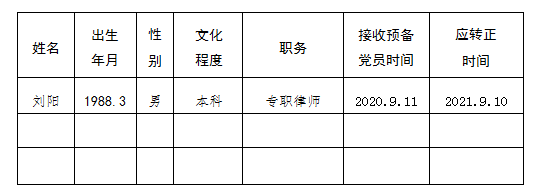
On the basis of listening to the opinions of the party group, party members, and the masses, after review by the branch committee, Comrade Liu Yang's probationary party member has expired, and he plans to submit to the branch party member meeting for discussion and voting to become a full member of the CCP. According to the relevant requirements of the work of recruiting party members, the relevant information is now publicized and subject to the supervision of the masses. Publicity time: September 23-September 30, 2021. Party branch supervision telephone number: 0531-66590909 Party (Work) Committee Supervision Telephone: 0531-81799079 If you have any objection to the above comrades, please report it to the party branch or the higher party (work) committee during the publicity period. The Fourth Party Branch of Shandong Zhongcheng Qingtai (Jinan) Law Firm of the Communist Party of China September 23, 2021
2021-09-23
22
2021-09
On May 18, 2021, a traffic accident case concluded by Jiangsu Higher People's Court was revised to the trial results of the first instance and the second instance. The opinions of the retrial High Court are inconsistent with the judgment purpose of the guiding case issued by the Supreme People's Court. Therefore, in this article, the author takes the retrial judgment as the starting point to discuss and learn the traffic accident cases involved with everyone, the legal issues related to the special constitution of the victim and the mitigation of the infringer's liability. The case of Jiangsu Shen Higher People's Court involves the following facts: the victim was injured in a traffic accident. Before the traffic accident, the victim had his own disease. The old fracture of lumbar 12 vertebral body, which was hit by the traffic accident, was injured again in the waist. After identification, the compression fracture of thoracic 12 vertebral body was caused by the traffic accident, and the left waist movement was limited, which constituted grade 10 disability in the traffic accident, and the participation in the traffic accident was 50%. In the first and second instance of the case, the court did not support the defendant's disability compensation corresponding to the 50% participation caused by the deduction of the victim's personal constitution. The case was finally revised after retrial. Let's take a look at the discussion of the court's determination in the High Court's retrial judgment: "This court believes that the causal relationship between the infringement and the consequences of the damage is the constituent element of the infringement. The causality of tort is divided into the causality of liability and the causality of the scope of liability. The former judges the causality between the infringement and the infringement of rights and interests. The latter determines the causal relationship between the tort and the consequences of the damage. There is no doubt that there is a causal relationship between the tort of the traffic accident in this case and the damage caused by Liu Yun, and there is no dispute on the establishment of tort liability. The focus of the dispute in this case is mainly on the determination of the causal relationship between the scope of liability. That is, as the infringer responsible for the traffic accident, what is the scope of responsibility that should be borne, and whether it should bear full responsibility for the damage consequences of Liu Yun's ten-level disability. The Court believes that the occurrence of tort results in the real world, the causes are complex, can not be generalized, the emergence of a damage consequence, sometimes with several acts of causality, should consider several violations of the damage to the consequences of the damage participation, that is, the problem of the proportion of the cause. When the victim itself has a special physique, it should also consider the proportion of the cause. Road traffic accidents themselves are negligent liability, and the perpetrators of the damage are unwilling to occur. As for how the victim's physical fitness is not what the person responsible for the infringement can predict, if the damage participation is completely denied, it is not in line with the fairness principle of civil law. From another perspective, the victim's original disease or damage is not caused by the perpetrator. When a traffic accident occurs, the perpetrator cannot expect the result of adding the victim's own physical reasons. Therefore, when the road traffic accident and The victim's own injury factors are superimposed to cause the damage consequences, it is necessary to find out the cause of the final damage consequences and distinguish the magnitude of the force of each cause in order to effectively draw the responsibility." Through the above-mentioned discussion of the court's view, we will discuss several issues involved: First, the issue of injury participation. 1, the concept of injury participation Injury participation refers to the proportional relationship that injury plays a role in the occurrence of death, disability and sequelae in the event that trauma, disease (including aging and physical differences) and other factors act on the human body together to damage human health. 2, the level of injury participation Injury participation can be divided into five levels: ①, there are both injury and disease, the consequences are completely caused by the injury, the disease does not work, there is an inevitable causal relationship between the injury and the consequences, which is a complete causal relationship; ②, there are both injury and disease, the consequences are mainly caused by the operation, the disease only plays an auxiliary role, then there is a direct causal relationship between the injury and the consequences, which is the main causal relationship; ③. There are both injuries and diseases, neither of which exists alone can cause the current consequences, or they are equally important in causing the current consequences, and it is difficult to prioritize, then the injury and the current consequences are boundary-type causal relationship, which is the same causal relationship; ④ There are both injuries and diseases, and the injury is the inducing or aggravating factor, that is, the injury is relatively minor and does no great harm to the human body, however, if it can induce or promote the onset of the disease, the indirect causal relationship between the injury and the current consequences is a secondary causal relationship; ⑤, there is both injury and disease, if the consequences are entirely caused by the disease, there is no causal relationship between the injury and the consequences. Second, the Jiangsu Provincial Higher People's Court mentioned in the discussion of this case: the causality of infringement is divided into the causality of the establishment of the responsibility and the analysis of the causality of the scope of the responsibility. The division of tort causation into the causation of liability establishment and the causation of liability scope is not distinguished by the High People's Court of Jiangsu Province itself, but the mainstream view of causation theory and practice in our civil law system at present. In fact, it is often said that there is considerable causation. The doctrine holds that no such act is usually bound to cause such damage, but such act is sufficient to cause such damage, there is a considerable causal relationship between the two, the doctrine holds that the causal relationship is divided into the causal relationship between the establishment of responsibility and the causal relationship between the scope of responsibility, referred to as the dichotomy of causation, the doctrine needs to divide the boundaries between the establishment of responsibility and damages. 1, the causal relationship between the establishment of responsibility. The causal relationship of responsibility is that there is a causal relationship between the imputable act and the infringement of power. The author thinks that this solves the problem of fact determination, that is, the causal relationship at the factual level, which involves the qualitative problem, that is, there is a causal relationship between the infringer's harm behavior and the victim's damage consequences. 2, the causal relationship of the scope of responsibility. The causal relationship of the scope of liability refers to the causal relationship between the infringement of power and the damage. The author thinks that this solves the problem of legal determination, that is, the causal relationship at the legal level, which involves quantitative problems. What is solved is the causal relationship between the harm behavior and one of the closest damages, that is, how much causal relationship is between the infringer's harm behavior and the victim's damage consequences. The classification of causality involved in tort law is a very complex issue. In reality, there are theories of causality, such as conditional theory, cause theory and Guran causality theory, in addition to the above-mentioned mainstream equivalent causality theory. However, no matter how reasonable the theory is, science cannot really solve all the causality problems involved in tort, therefore, some people think that the causal relationship involved in tort is not a legislative issue, but a judicial issue, and judges should be given discretion in individual cases to achieve judicial justice and further unity of judicial and social effects. Therefore, in this paper, the author only makes a brief discussion on the mainstream theory of causality, and no longer discusses it in depth. Third, the Supreme People's Court Guidance Case No. 24 involving the special constitution of the victim and the reduction of the infringer's liability. Guidance Case No. 24 issued by the Supreme People's Court in 2014 held that: Article 26 of the "the People's Republic of China Tort Liability Law" stipulates: "If the infringer is also at fault for the occurrence of the damage, the infringer's liability can be reduced." In this case, although the plaintiff Rong X Ying's personal physical condition has a certain impact on the occurrence of damage consequences, but this is not the tort liability law and other legal provisions of the fault, Rong X Ying should not be due to personal physical condition on the disability caused by traffic accidents There is a certain impact and self-responsibility. Although Rong X Ying is old, her old osteoporosis is only an objective factor of the consequences of the accident, and there is no legal causal relationship. Therefore, the victim Rong X Ying is not at fault for the occurrence or expansion of the damage, and there is no statutory situation to reduce or exempt the perpetrator from liability. For personal physical problems, the law of our country does not give clear opinions, so after the introduction of the guiding cases in that year, it played a certain role in the judicial practice of traffic accident cases that appeared in a certain period of time. However, with the development of time and the progress of theory, it is not supported by pure and unfair to a certain extent. Therefore, the author believes that the views of the Higher People's Court of Jiangsu Province precisely represent the further development of the theory of tort causation in practice. Fourth, the provisions of local courts on the special physique of victims. 1. Trial Rules of the Intermediate People's Court of Hefei City on Cases of Compensation for Damages in Road Traffic Accidents (Trial)(2019) Article 27: Where there is a causal relationship between the victim's own health condition and the consequences of the damage, and the self-health condition originates from the natural aging or special constitution of the human body, the infringer's liability for compensation shall not be reduced: but the disease suffered by the victim before the traffic accident significantly aggravates the consequences of the damage, for the part that exceeds the limit of liability for compulsory traffic insurance, the victim's own disease participation in the consequences of the damage should be considered, and the infringer's liability should be reduced accordingly. 2. The answer to the difficult questions on the application of civil trial law of Zhejiang Higher People's court in the 17th issue of 2013 is: if the victim with special physique (including physical and mental special physique, as well as congenital heredity or acquired aging and sick physique) suffers infringement, the compensation obligor shall, in principle, be liable for all the damages suffered by the victim. If the indemnity obligor defends that the damage suffered by the victim is induced by his own special constitution, it is generally not supported, but the consequences of the damage are beyond the scope that can be expected under normal circumstances and the infringer does not have intentional or gross negligence, the liability of the obligor may be appropriately mitigated by taking into account the specific circumstances such as the degree of fault of the infringer, the means of infringement, the manner of conduct, the gap between the usual possible consequences of the infringement and the actual consequences of the damage, and the financial capacity of the infringer to bear the liability. To sum up, whether the individual special physique can be a factor to reduce the responsibility of the infringer, although the theory of causality has certain limitations in practice, the author believes that in the trial practice, the judge can learn from the theory, comprehensively consider the degree of the infringer's fault, the means and methods of the harmful act, the expected consequences, the principle of fairness and other comprehensive identification, should not be supported.
2021-09-22
18
2021-09
In order to actively respond to the theme practice activity of "I do practical things for the masses" of Dezhou Judicial Bureau, on the afternoon of September 17, lawyer Shao Yan, senior partner and director of financial department of Shandong Zhongcheng Qingtai (Dezhou) law firm, was invited to carry out a lecture on "enterprise contract management" for Dezhou urban construction investment and Development Group Co., Ltd. According to the stipulations about contract codification in the Civil Code, based on the premise of risk identification and prevention of contract, and in combination with the process of contract management in enterprises, lawyer Shao Yan explained the principles and purposes of contract management, contract review, contract drafting, contract dissolution, contract file management and the legal provisions and cases of "the crime of dereliction of duty in signing and performing contracts and being cheated" in the criminal law, by means of case explanation and on-site interaction, this paper explains how to prevent, control and remedy in advance in the daily contract management of enterprises, and how to identify the risk loopholes in the contract encountered in commercial activities. The lecture had a good atmosphere, which strengthened the legal awareness of contract risk of the company's management and various departments, and greatly expanded the legal knowledge of contract management. Zhongcheng Qingtai lawyers will continue to promote the "I do practical things for the masses" activities, practice the lawyer's public welfare mission, and assume more social responsibilities.
2021-09-18


Zhongcheng Qingtai Jinan Region
Address: Floor 55-57, Jinan China Resources Center, 11111 Jingshi Road, Lixia District, Jinan City, Shandong Province
